Compiled and written by David R. Schleper, 2023
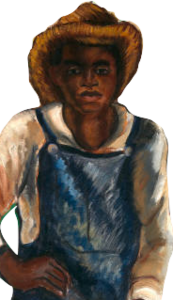
About 9:30 p.m., a thin, loose-jointed, poorly clad African American teenager was seen rounding the corner of First and Holmes Street in Shakopee, according to the Shakopee Argus-Tribune on May 8, 1930. He disappeared in the darkness of the alley at the south end of the Holmes Street Bridge, according to the article, “Dejected dusky youth finds end of rainbow in humble hospitality.”
Officer Kelly waited. After several minutes, Kelly commandeered Greg Hartmann’s car and drove through the alley, but he could not find the youth. A second trip over the course, Officer Kelly, along with the aid of a flashlight, spotted the youngster sitting motionless, stiffened with fear on a swing at the rear of a First Avenue residence.
According to the article, the search “revealed no weapons—in fact, nothing but a thin body lightly clad. He was taken to the city hall, where, after long and tedious effort, the boy was convinced he was not arrested but was being helped.” With eyes straight forward, never turning to high of left, he began his story.
The teenager was 16 years old and had left Minneapolis on a bicycle about 8 a.m. that morning. He was in ninth grade but had to leave school to help earn a living.
He was headed to Chaska. He had met a friend, a Mexican American, who worked at the sugar beet fields around Chaska and Shakopee.
As he was biking to Chaska, he was struck by a passing truck. The front wheel of his bicycle broke shortly after leaving Lyndale Avenue. So, the teen walked to Chaska and looked for his friend. He only had his first name and was unable to locate him.
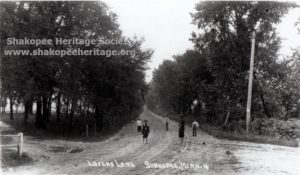
As he walked home to Minneapolis, he got turned around at the intersection of Highway 5 and Highway 52, and so he arrived in Shakopee. And so, he was sitting at city hall when Ray Hill walked in. Ray had seen the teenager in the afternoon on the highway.
The Mexican American family, including the friend of the African American, had left Minneapolis on Friday, driving a brown and black truck. According to the Shakopee Argus-Tribune, Ray Hill had seen the truck and its occupants—father, mother, and six children. They were building a shack on the Indian Road, where they would work in a sugar beet field.
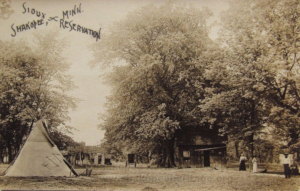
The Indian Road is a road on the north side of the Minnesota River. The road follows the river, then ends at Flying Cloud Drive. Along the road were the Dakota who lived in tipi tonka, tipi, and cabins along the Minnesota River. The Indian settlement on the north side of the Minnesota River in what is now Eden Prairie, though a common postcard called the area Shakopee’s Reservation, the land was purchased by Oyatekokepa Jacob Otherday. The 18 acres were purchased in 1871.
Once a car was procured, the group of people, including the African American teenager, headed across the Holmes Street Bridge, then right to Indian Road where the shack was located.
“Through an open window the glow of a lighted match fell upon the Mexican family asleep on the floor of the crowded shack.” The Mexican American father was awakened and summoned to the window. The Mexican American might have been Pedro Delgado, who was one of the migrant laborers who worked tending and harvesting beets for the massive sugar industry from 1924 to 1932, or one of the many Latino migrant laborers who worked there, according to the Chaska Herald article on October 23, 2009 called “Fields of memory: Former beet farmer revisits his childhood home of Chaska.”
The Mexican American saw, in the rays of a flashlight, the smiling face of the African American teenager. “There was no doubt as to their acquaintance.” In a moment the door was ajar; the youth accepted the humble hospitality.
The African American teenager and the Mexican American family spent the night, and in the morning all of them headed to work in the beet fields in Scott and Carver County.
Bibliography
“Dejected dusky youth finds end of rainbow in humble hospitality.” Shakopee Argus-Tribune, 8 May 1930.
Olson, Mark W. “Fields of memory: Former beet farmer revisits his childhood home of Chaska.” Chaska Herald, 23 Oct. 2009.