Compiled and written by David R. Schleper, 2020
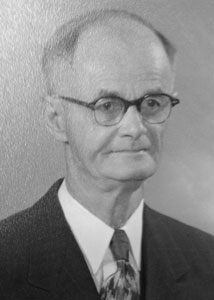
Dr. Frederick H. Buck was born Oct. 30, 1882, and grew up in Norwood, Ontario, Canada. His parents were farmers, and after graduating from high school he spent seven years working on the farm and “hated every minute of it!” While his father opposed him becoming a doctor, his mother encouraged him, and by age 24 he entered the University of Toronto to become a doctor.
He heard that Shakopee, which had about 1,500 people, needed a doctor, and in 1911, he moved here. He made most of his calls on foot or in a buggy.
After a year, he went back to Norwood and married his sweetheart, a nurse, Ida Gjerdrum Buck, and returned to Shakopee.
Dr. Buck’s office was at 127 ½ East First Avenue, which was above the old Shakopee movie theatre. He had the first microscope in Shakopee, and people reportedly came from miles around to see it! Dr. Buck and Ida lived at 421 East Third Avenue in Shakopee. After a few years, he bought a Model T.
Most of the time, Dr. Buck took a horse to farmhouses near Shakopee.
As he walked into one farmhouse, Dr. Buck saw a man lying on the bed, bright with fever. He knew it was pneumonia. The homemade remedies such as mustard plaster, goose grease, and turpentine all had been tried before the doctor arrived. The man on the bed was racked with coughing and spitting blood. His temperature was 104.
There was no way to check the diagnosis. There was no hospital in Shakopee. No laboratories, X-rays, and tests to confirm the decision. There was no phone. Dr. Buck was alone in that isolated farmhouse. Because pneumonia usually lasted seven days, the doctor returned in a few days, crossing the threshold and holding his breath. The man on the bed was bathed in sweat. His temperature had broken, and his breathing came easier. “The most wonderful sight in the world,” said Dr. Buck.
According to Dr. Buck, the railroad had been his ambulance line once. If you had an emergency—appendicitis, maybe—you got word to the station agent. You’d carry the patient on the back of a wagon to the depot. The next train would stop and you’d load the patient into a baggage car and climb in yourself, and ride with him to St. Paul, where an ambulance took both of you to either St. Joseph’s or St. John’s hospital. You always stopped in St. Paul because the train went there first before going on to Minneapolis.
When he first started, the doctor got $10 for each baby delivered. Over the many years that he was a doctor, Dr. Buck delivered 1,200 babies. He also made many hours in calls, including the Dakota at the tipi tanka and tipi along the Minnesota River.
When the scarlet fever epidemic happened in February 1918, Jane Cloud, a Dakota aunt of Minnie Josephine Otherday Weldon and a descendent of Dakota leader Ṡakpe II, sat on the curb in front of Dr. Buck’s office. She was crying her heart out because she was afraid the fever would kill Dr. Buck. Luckily, Dr. Buck survived.
On Dec. 5, 1914, Ida and Frederick had a child, Marion Bell Betty Buck (1914–2007) in Shakopee.
A few years after Marion was born, Ida became blind.
Ida went to Faribault School for the Blind to learned Braille. She received a seeing eye dog to roam around downtown Shakopee.
Ida died on Oct. 9, 1957. She is buried at Valley Cemetery in Shakopee.
Dr. Frederick Buck sold his general practice in 1946, but he continued as a physician for the masonic home until 1959, and for the women’s reformatory for 18 years, and continued to work with the children with disabilities at the reformatory until that was closed.
At age 95, Dr. Buck died. He had served the people in and around Shakopee for many, many years.
According to Vern Lang, “His death is the passing of another era.”