Compiled and written by David R. Schleper, 2020
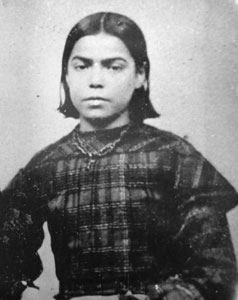
Pelagie Eliza Faribault, daughter of Oliver Faribault and Wakan Yaŋke Wiŋ (or Woman Who Sits at the High Place), was born at her parents’ log cabin in East Shakopee, the same log cabin which is now in The Landing in Shakopee. Wakan Yaŋke Wiŋ was pregnant when they built and established the trading post in 1844, and Eliza, as she was called, was born August 27, 1845, the sixth of nine children.
Eliza grew up with her three sisters, Mary Josephine (Jessie), Jane Luce, and Sarah Iréne, in the cabin and adjacent warehouse which was built on the west side of what was later called Faribault Springs, using tamarack logs which were obtained from a swamp nearby. Because Oliver was part Dakota, and Wakan Yaŋke Wiŋ was Dakota, so was Eliza. The French and Métis people called this area Prairie des Français (French Prairie), along the Rivière Saint-Pierre.
Eliza remembered about her early life, including the bark huts, called tipi tanka, and tipi. Her father conducted a trading post in Tínṫa Otuŋwe, in the area now called Shakopee.
She remembered her father conducting a trading post for a few years and building a warehouse in which he stored furs purchased from the Dakota Indians.
She only faintly remembered her father, as he died in the fall of 1850, when Eliza was 4 ½ years old. Eliza remembered the gaudy trinkets that were available to the Dakota Indians.
An Indian trail passed south of the Faribault Trading Post and cabin in Tínṫa Otuŋwe, and Eliza remembered watching the processions of ponies with packs strapped to their backs and long dog trains, each load drawn by four to eight or more dogs. Furs and skins formed the bulk of the freight. Later the ponies and dogs were replaced by six oxen and long trains of two-wheeled Red River carts. Eliza could still remember the ear-piercing squeaks of the poorly lubricated wooden axles that heralded the approach of the trains.
Eliza attended school in a little log schoolhouse near their home. When she was 14 years old, she was taken to Québec City, where she attended a school conducted by the Ursuline nuns at Monastère des Ursulines de Québec. It is the oldest institution of learning for women in North America. Eliza remembered, “We traveled from Faribault to Hastings by stage, and took a steamboat to La Crosse. From La Crosse we traveled by train, and it was the first time I ever rode on a railroad train. I don’t remember the cities we went through, but I clearly recall our arrival in Québec. It all seemed unreal to me as I had never before been away from the frontier …” Eliza attended school at Monastère des Ursulines de Québec for two terms and then returned home.
As they grew into womanhood, the four Faribault young adults, including Eliza, entered the social whirl of the frontier. “We had violin music and sometimes there were accordions,” said Eliza, “and we used to dance square dances, waltzes, and Virginia reel and the fireman’s dance.”
As a young woman, Eliza was often visited by Charles A. Manaige, whose father, Pierre Manaige, was a native of France, and his mother was part-Winnebago, or Ho-Chunk Indian. On July 30, 1870, Charles A. Manaige married Pelagie Eliza Faribault in Mankato. They returned to Shakopee, where they spent their lives.
Pelagie and Charles had four children, two sons and two daughters. Isabelle was born in 1871, married Harvey Randolph Leach in Des Moines, Iowa, and they had nine children. Melvin was born in 1872 and died April 12, 1931. He married and lived in Brooklyn, New York. Eugene Curtis was born 1874 and died of tuberculosis in 1903. Grace was born in 1876 and died at Friendship Manor in Shakopee in November of 1966.
Pelagie Eliza Faribault Manaige died on December 1, 1937. She is buried at the Valley Cemetery in Shakopee, Minnesota.
Charles August Manaige died on January 22, 1938, and is buried next to Eliza.