Category Archives: People

Dr. Bror Folke Pearson

Compiled and written by David R. Schleper, 2020
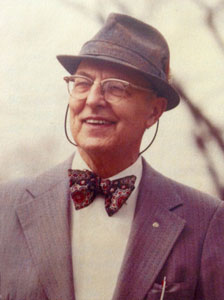
Dr. Bror Folke (B. F.) Pearson

Bror Folke Persson (Pearson) was born on a farm in southern Sweden July 30, 1906. Bror Folke, meaning “brother of the people,” was a particularly apt name for a man who devoted his life to his family, parents, and communities. He was kind and had a good sense of humor.

Dr. Pearson immigrated to America in 1919, and became a doctor for 42 years in Shakopee, starting in 1934. Dr. Pearson used to come directly to homes any time of the day or night, whenever called. He delivered more than 2,500 babies in Shakopee.

Gwen Johnson Humphrey remembered when Dr. Pearson “brought [me] into the world, then in the next few years brought four of my six brothers also. He was always at our house it seemed tending to either one or all seven and never left without giving someone a shot, Through measles, German measles, chickenpox, [tonsillectomies], stitches and owies he was always there.”

In 1939, Dr. Pearson, a local priest, and the editor of the local paper visited the convent of Franciscan nursing nuns and asked them to take over the decrepit county poor house and run it as a hospital and a home for the elderly.

By 1952, the little hospital was no longer big enough, and Dr. Pearson led the effort to build a new hospital with 120 beds, an emergency room, and a full services laboratory.

Dr. Pearson married Elizabeth Stephens in 1935, and after 40 years, Beth died in 1976. They had three daughters and a son. Pearson retired from his Shakopee practice in 1976, the same year Beth passed away.

Dr. Pearson received the 18th annual Franciscan International Award. The honor goes to someone whose humanitarian efforts and singular devotion to others live up to the ideals of St. Francis. Other recipients have included Dr. Billy Graham, Dr. Charles Mayo of the Mayo Clinic, and Harry Reasoner, nationally known ABC Television news anchorman. In 1976, it went to a little-known doctor from a small Minnesota town.

In 1980, he wed Dr. Dora Zaeske, and they were together for 22 years, traveling the world and working as humanitarians.

Dr. Pearson worked as a physician in locations in South America, the West Indies, and Taiwan, and a Navajo Reservation in Ganado, Arizona. He also led an effort to sponsor a leprosarium in Zambia, Africa.

In 1970, a new elementary school in Shakopee, B.F. Pearson Elementary School, was named after him. It is located at 917 Dakota Street South.

In 1995, Central became the fifth- and sixth-grade building, with Sweeney and Pearson elementaries serving grades kindergarten through fourth. As the number of students grew, the five other elementary schools in Shakopee continued, while in 2011, the school was converted to Shakopee’s Pearson Sixth Grade Center, which opened in 2012.

Pearson Sixth Grade Center served all public school sixth graders in Shakopee which included about 650 students. About 43% of the students were people of color.

In 2018, the school was closed for budget reasons. The sixth graders were moved to the two middle schools with other seventh and eighth graders.

In 2020, Pearson Sixth Grade Center became the Pearson Early Learning Center.

After a brief illness, Dr. Bror Folke Pearson passed away Aug. 24, 2004, at Sunrise of Mercer Island, Washington, at age 98.
PDF Brochure

Dan Eddings (1852-1919)

Compiled and written by David R. Schleper, 2020

Dan Eddings

Dan Eddings was born enslaved, probably in Kentucky around 1852.

So how did Dan Eddings move?

Elnathan Judson Pond married Wilhelmine Minnie Catharina Elisabeth Markus in Shakopee on June 24, 1879. Minnie was born Oct. 21, 1862, daughter of William (1823-1895) and. Wilhelmina (1832-1908) Markus. Elnathan and Minnie had six children. Elnathan’s younger brother, Samuel William Pond, Jr. married Irene Goodrich Boyden. The two couples started housekeeping at the mission farm. Later, Elnathan and Minnie moved across the road to a 170-acre farm. This farm is now part of The Landing in Shakopee, according to Pond Grist Mill Is Start of Something Big by Ginger Timmons, Scott County Historical Society, Shakopee Valley News, Aug. 30, 1972.

Elnathan and Samuel, Jr., sons of Rev. Samuel Pond, Sr. and Cordelia Eggleston Pond, built the Pond Grist Mill in 1875. The mill was built for supplementary income. Elnathan and Wilhelmine’s seven-room, two-story frame house, complete with summer kitchen and woodshed, stood about a block east of the mill. The families moved the big barn from the

The Shakopee Tribunealso discusses “our sole citizen of color.” According to the article, Dan was “quite harmless, although possessing only indistinct ideas of the philosophy of meum and tuum, especially when in the vicinity of a hen roost.” Meum et tuum means mine and thine and is used to express rights of property. In other words, he was a lady’s man. “In earlier days, before race prejudice had spread through the north, Dan often was present at social functions, and there may be those still living who have stepped off a quadrille with him.”

William Weiser, meanwhile, was back with his wife until she died, and then he married Kate Love McCallum. They have nine children before Kate died in 1901. William was a school teacher and brick mason, and died in Everett, Washington in 1919.

Dan spent his post-slave life living and working in Shakopee. In the Aug. 29, 1919 Scott County Argus, Dan “had spent his entire life here, and was well known among the farming community, having worked on many of the farms hereabouts.” He often worked at Lawrence Stemmer’s farm in east Shakopee. (“Threshers in Shakopee ca. 1910” by Shakopee Heritage Society)

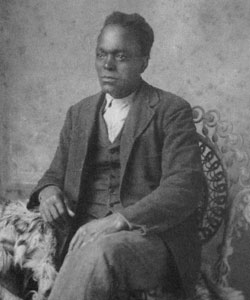
J.A. Reitz, a Shakopee photographer, took a picture of Dan in 1915. It was a studio portrait, where Eddings was sitting on a wicker chair covered with a fur pelt. He was wearing a button-down shirt, vest, jacket, and trousers. On the back of the photograph is written “Ni**er—Dan Eddings 1915.” Dan Eddings continued working at various farms until 1919, when he became sick with cancer. He was taken to the county poor house five weeks before he died. The Aug. 29, 1919 Shakopee Tribunenoted, “Dan Eddings, better known to Shakopee as ‘Ni**er Dan,’ died at the county poorhouse Wednesday morning, and was buried that evening.” The Scott County Argusadded, “Dan Eddings, the only local negro resident in this community, died Wednesday morning at 9:45 o’clock at the county poor house where he was taken about five weeks ago. The cause of death was cancer of the stomach.”

Dan Eddings was buried at Valley Cemetery in Shakopee. Valley Cemetery was a public cemetery with no church affiliation. Many of the early families are buried there. The area where he was buried is directly across from pine trees. Valley Cemetery made a note in the remarks: “Known as Ni**er Dan.”

Dan, who was enslaved, worked for years at various farms in Shakopee, and died of cancer, was buried in the potter’s section, a place for the burial of unknown or indigent people. The term is of Biblical origin, referring to a ground where clay was dug for pottery, later bought by the high priests of Jerusalem for the burial of strangers, criminals and the poor.

Dan Eddings does not have a tombstone.

PDF Brochure