Professor Thomas Tristram and his bride, Theresa, came to town in the late summer of 1878. He had been in Bloomington, and moved to work in Shakopee. He was one of the most popular teachers in the public school during the year, and was re-employed for the coming year of 1879. The professor and his new pretty wife, Theresa Pearle Tristram, were very popular socially and much sought after.
But then the rumors started. “I told you so!” said one person in Shakopee. “I knew something was wrong!” said another.
And immediately, the professor left town and returned to Ireland.
The Argus newspaper on August 7, 1879 started to investigate. The Argus noted that Reverend William R. Powell had received a letter from Annie Tristram, who claimed that she was the professor’s wife. The letter noted that she had not heard from the professor since 1876 and expressed concern as “he was one of the kindest of husbands…”
Thomas Tristram was born in Ireland in 1843. At the age of 17, he married a lady six years his senior, Annie. Thomas claimed that he had been drunk before the ceremony and kept intoxicated during the service. (Good excuse!) He also claimed that his wife was unchaste before the wedding, and since then had been repeatedly broken her marriage vows. They had four children.
Thomas was not happy, and he escaped by immigrating to the United States…without his wife or his four children.
In the United States, he enlisted as a private in the army for five years at Fort Snelling. While in St. Paul, he met Theresa Pearle and after two years of engagement, they were married in Minneapolis on September 16, 1876.
About two weeks ago, Reverend William R. Powell received a letter from Dr. Knickerbacker of Minneapolis. He included a letter that was sent from Ireland by Annie Tristram, who explained that she had been waiting patiently and trusting in God. She explained that she had been waiting the last three years, taking care of the children, and had been struggling. She heard that Thomas Tristram was in Shakopee, and she needed to find out more.
Upon being confronted with the letter, Thomas Tristram confessed, and then quietly and rapidly left to rejoin his wife in Ireland.
The second wife, Theresa Pearle Tristram, was left to pick up the pieces. According to the Argus, Theresa was “terribly wronged, yet she trusts the man who so wronged her. She has forgiven him…” and refused to prosecute.
Thomas Tristram was a villain, a rascal, and a man deserving to spend his remaining years in prison. In the newspaper, the Argus noted that frail, pretty and innocent Theresa, with her broken heart, was thrown upon the cold, heartless world.
In September, three men, clad in linen dusters, drew up their beautiful horses in front of John Dean’s blacksmith shop to have them shod.
As the story goes, according to The Shakopee Story by Julius Coller II, the horses were shod backwards; such a request would not have greatly surprised Dean or his helper, who took the men for dudes from Lake Minnetonka. (Lake Minnetonka was a favorite resort for the wealthy and near wealthy Easterners.)
When leaving, the leader tipped the blacksmith very liberally. Because of this, John Dean generally believed that this man was Jesse James.
Jesse James
In any event, it was quite certain that the men were members of the James-Younger gang who a few days later attempted to rob the First National Bank of Northfield. In the street battle, the gang was driven from the town after murdering Joseph Heywood, the acting cashier of the bank.
Luckily, they did not attack the people of Shakopee!
(Some information from The Shakopee Story by Julius Coller, II, copyright 1960.)
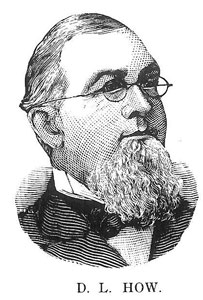
David Lennox How was born in Elbridge, New York on Aug. 23, 1835. When he was twenty years old, David decided to strike out on his own. After two years in Adrian, Michigan, he headed down the Minnesota River to Shakopee in the new state of Minnesota.
On the Antelope, the slender town smokestacks belched smoke. On the decks were a mixture of cargo and passengers, including Indian traders and settlers-colonists. David, age 22, was writing in his diary. “The scenery,” he wrote, “is very beautiful and the foliage more forward than in Michigan, Illinois, Wisconsin, or Indiana,” noted in The Shakopee Storyby Julius Coller II, pages 619-628.
In 1858, David entered a partnership with Dr. Josiah Schroeder Weiser, owning a drugstore in Shakopee. The old drugstore later became Strunk’s Drug Store. David also worked on several projects, including a Jordan flouring mill, a mill in Chaska, and a large mill in Shakopee.
At age 27, David Lennox How married 18-year-old Mary Margaret Robeson Sherrerd in 1862. Mary was born Feb. 13, 1844 in New Jersey. Her parents were William Maxwell Sherrerd (1805-1868) and Sarah Leeds Sally Bartow (1819-1896). William ran the American Hotel in Shakopee. David and Mary moved into the commodious Sherrerd brick residence on Holmes and Second Street, which is now torn down and is currently the Deco apartments. It was then called the Hows’ residence, and the couple had one child, Jennie Sherrerd How (1864-1935). Mary was pretty, talented, and entertaining. David was always the center of social activities with grace, magnetism, and ready wit. David and Mary were popular at parties and dances.
In 1872, a fire broke out, and J.G. Butterfield lost a drafting set. In one hour, $350 was raised to buy him a new set. The money was given to Butterfield, after a nice speech from David.
On the morning of Sept. 21, 1873, Mary went to visit a friend. When Mr. How telephoned to find out when she would be back, she was not there. Meanwhile, J.G. told his friends in Shakopee that he was going to Vermont, but he didn’t. He wrote his wife a letter saying they would never see each other again. Mary left her husband and child, and J.G. left his wife and five children.
Mr. Butterfield and Mrs. How left the state separately but met in Chicago. Then the new couple went to New York, St. Thomas, Panama, California, and back to Chicago. The people in Shakopee had a field day discussing what may have happened.
After three months, and ten thousand miles by rail and ocean steamer, Mary arrived back in Shakopee. So did J.G. Mary returned to David, and J.G. left Shakopee with his wife and family.
As far as it is known, neither Mary nor David offered any information or explanation. They took up their lives. Parties started up again, and their child, Jennie, married Ernest Lionel Welch (1863-1934) on Dec. 2, 1885 at the Hows’ house.
On Dec. 21, 1893, twenty years later, Mr. How ate breakfast and went upstairs. Moments later a shot was heard. The family rushed upstairs. David was sitting in the chair, grasping a revolver. The discharge from the 38-caliber weapon entered the right temple. He was dead.
David had several business enterprises and may have been overwhelmed and overdrawn on his accounts. The community was shocked. The funeral took place at St. Peter’s Episcopal Church on Sunday, Dec. 24, 1893, and he was buried at Valley Cemetery in Shakopee.
Mary ended up in the cities, and on Feb. 9, 1899, she married Alonzo Phillips (1843-1932), son of John Wesley Phillips and Catherine Enslen. Mary died on Dec. 5, 1928 in St. Paul. Mary was buried in St. Paul. David had a plot at Valley Cemetery for her, but she did not get buried in Shakopee. Eventually, the plot was given to Sarah-Irène Faribault (1853–1924), a nurse and domestic servant at the Hows’ home, and her remains was interred in the plot reserved for Mary Robeson Sherrerd How Phillips.
Axel Jorgenson was born Aksel Jørgensen on December 1, 1818 in Gjerstad in Aust-Agder County in southeast Norway. Axel was the eldest of four sons and a daughter born to Jørgen Akselsen (1783- 1864) and Karen Margrete Nilsdatter (1794-1866).
In Oslo, Norway on April 28, 1850, Axel married a certain Ingeborg Marie, age about 31. Five days later, according to the Carver Historic District, the newlyweds boarded the brig Incognito in Christiania (Oslo) and arrived in New York City on July 13 or 17, 1850 with 132 passengers, by name probably all Norwegians, including steerage passengers Axel Jorgenson and Ingeborg Marie.
After the ship’s arrival in New York Ingeborg Marie is found no more in connection with Axel. Her fate unknown, most likely she died in the first year or two after arriving in America.
Jorgenson probably traveled America’s water routes, eventually making his way to the frontier territory of Minnesota sometime in 1850-1851.
Axel came to Minnesota territory and took preemption claim as a settler-colonist in Carver County, which allowed squatters to purchase up to 160 acres on Indian land. It gave him a toehold on townsite before claims could be legally settled. He “improved” the land with dwellings, warehouses, and stores, and thus were less liable to be taken over those who came along later. He picked a large parcel of choice land on the north side of the Minnesota River at the junction of the Minnesota River, Carver Creek, and Spring Creek, a site situated some 32 miles upstream from St. Paul.
Jorgenson there built a crude claim shanty house, which he loosely called a hotel, and situated it just above the Minnesota River bank on First Street near Broadway. The claim shanty was a 14’ x 18’ dirt-floored upright board and batten (or log) shanty “hotel” with four large windows. Said to have been called Hotel Luksenborg, it was intended to augment his business of hauling logs, lumber, and supplies to and from St. Paul on a barge in the Minnesota River, and is said to have also served as his home and blacksmith shop, according to Mark W. Olson.
Axel had a barge, an old, dirty, heavy, flat-bottomed boat, which could float downstream, but would have to be propelled with long poles to pull upstream.
Jorgenson seems to have offered prospective settlers free lodging and transportation from St. Paul up the Minnesota River to land around his claim area in return for them helping to propel his barge. It purportedly would take three long days of hard poling work against the river current to reach Jorgenson’s claim in the future Carver County.
Alex moved to Shakopee by December 1863. He worked doing clock and watchmaker repair work. According to a business directory for 1865, Alex was advertised as a watchmaker and jeweler on Holmes Street.
In Shakopee on June 6, 1868 Axel Jorgenson took out a marriage license and married Ellen Marie Oleson, an immigrant from Vadsø in Finnmark County in northern Norway who arrived in America in 1865. The couple lived in Shakopee for the first years of their marriage.
The 1870 United States Census for Shakopee mentions that Axel Jorgenson was a watchmaker and legal citizen of the United States with $2730 in real estate worth and $600 in personal property value, a tidy sum for the period.
Axel is listed in 1870 as being married to Ellen M. Jorgenson, age 30, who is described as a housekeeper and not yet a legal citizen. Both are listed as born in Norway.
In May 1871, Axel had lumber on the ground in Shakopee in preparation for building a one-story building for his jewelry and silversmith business.
In 1874, Axel and Ellen separated, but by 1877 the couple moved to Stockholm Township in Wright County, where they lived for the rest of their lives.
In late 1879 or early 1880 Axel and Ellen adopted a son who they named Axel Peter Jorgenson. Son Axel Peter was born in Stockholm Township on Nov. 9, 1879. The infant’s 29-year-old mother died 24 days after his birth, perhaps from childbirth complications, leaving her widowed husband with two other children to care for, so he let Axel and Ellen adopt the child.
In the 1870s and 1880s, Axel was engaged in cutting and selling lumber in Stockholm Township. Axel was one of many involved in the Minnesota Commission of Fisheries’ task of stocking various species of fish in many Minnesota rivers and lakes. During 1885, Axel stocked 40 carp on Feb. 6; on March 28 he and 13 others stocked 425 carp; and on Nov. 16 he stocked 20 carp.
In December 1886, Axel’s family home in Stockholm Township burned, destroying all his papers, notes, and other valuables.
Axel died in Stockholm Township about 1899. His widowed wife, Ellen Marie, lived in the eastern part of Stockholm Township where she owned a farm and served as postmaster, with her son, his wife, and a granddaughter living with her in 1900. Ellen Marie died on Feb. 10, 1910, at the home of her son Axel in Keystone, Polk County, Minnesota and was buried in the family plot in the Stockholm town cemetery after services at the Stockholm Lutheran Church.
Florence Courtney Melton told the story of her trip from the Ohio to Washington on February 24, 1929. The book was called History of a Pioneer Family. It was later donated to the Garfield County, Washington Historical Museum in Romeroy, Washington.
Florence’s parents were Levis Courtney and Mary Anne Ashbaugh Courtney. Levi and Mary Anne were the parents of six children. All survived to reach maturity except William Laurence who died at age one while they were still in Ohio. Florence Courtney Melton was youngest member of the family. The family lived in Shakopee for six years, starting in 1854.
Levis, Florence’s father, was a chair maker. He became ill with epileptic seizures in 1849 or 1850, and doctors advised him to move to a colder climate. He and his wife and children moved to Shakopee, Minnesota, but his seizures got worse until the entire burden of the family fell on Mary Ann, Florence’s mother.
There was quite a rush for the new territory of Minnesota in 1854. So, the family equipped themselves for the journey west. Florence’s grandma, her uncles Robert and Joseph and their families, and Jane Patterson, Comfort Patton, and Florence’s mother, Mary Anne, and family started overland for the great Northwest. Here is part of the story about moving to Shakopee from 1854 – 1860:
*****
My folks had one team. Mother took a dozen chickens. I think that was all the livestock. The children were not well. Mary had a chill every other day. She was much opposed to leaving her pretty bedroom. She made so much fuss that Aunt Comfort lost patience with her. She said, “You little dunce, if you stayed here you would die.” Mary said, “I don’t care. I would have a nice little room to die in.” When they began traveling they all felt better.
Uncle William Patton was a drinking man. He carried a bottle with him all the time. He ran out before they got to another town to stock up, one time. They thought of Mother’s bottle she always kept to use as medicine. He got very sick and had Aunt Comfort ask for a little whisky for William. He was taken with pain in his stomach. Mother fixed a dose of some whisky about half whisky and half of the hottest colic medicine known. He drank it down without stopping but when he could speak he said, “I was a damn fool to think I could fool Mary.” They never came to Mother again for whisky.
They traveled across Indiana and Illinois and took the boat at Galena, Illinois. They went to St. Paul. They camped until the men located claims. Uncle Robert and Robert Patterson settled in Wisconsin. A distressing accident occurred while they were camped in St. Paul. Robert Patterson’s oldest son went swimming in the Mississippi and sank within a rod from shore in water twenty feet deep. He was about 14 years old. Uncle Robert was an odd fellow. He was soon surrounded by friends. Everything was done for their comfort that could be done. This may have been the cause of their going to Wisconsin.
The rest of the party kept together and took up claims nine miles south of Shakopee, county seat of Scott County. It was dense timber. Indians were as numerous as the squirrels. There was a lake about a mile from our claim. Uncle Will and Uncle Joe took claims at the lake. Grandmother stayed with them most of the time.
It was September when they got started to work on their houses. They camped on the ground and the nights were quite cool. A neighbor who lived almost a quarter of a mile away had his cabin built. He offered to let the little girls sleep in his house. Mother used to take one boy with her and the girls. After they were tucked in bed, she would go back to the wagon where the other brother was watching Father. She did this for three weeks. She gave directions about the cabin.
The roof was covered with clapboards with logs to weight them down. There was a big fireplace at one end of the room; a small window by the door. The floor was made of small ash trees hewn on both sides and laid side by side; it was called a puncheon floor. Father took the adz and smoothed it; then went over it with a plane until it was almost as planed boards. Mother always said it was the whitest floor she ever owned.
Adz
They had no cook stoves, so she wanted a Dutch oven built of stone or brick out in the yard. There wasn’t a man who could build one, so Mother told them to haul some stones and she would build it herself. Uncle William Patton was always ready to help her. He got the rocks and she bossed the job. They built an oven and they used it as long as they lived in Minnesota (six years). The built some kind of shed for the horses; by that time winter was at hand.
That first winter was very long and lonesome. My father soon found he could not stand the cold weather. He and his brother Jake froze their feet every time they tried to work, but Baxter and Mary played out of doors with “Old Sorrel” and a jumper sleigh. The runners made shafts and cross pieces held it together. A seat was fastened on. They played for hours, many a day, with the thermometer 20° below zero.
The Indians taught the boys how to fish by cutting a hole in the ice and gigging fish. They could get necessary supplies at Shakopee, as it was a trading post established by the fur company. Shakopee is a Sioux Indian name that signifies six. The fur company had built six little cabins, hence the name. (Not the real reason for the name!) There was a company of soldiers who came up on the boat our folks came on; they were stationed at Fort Snelling as protection to the settlers.
The long winter came to an end. All was bustle and stir, clearing land, getting ready to plant a garden. Mother worked with the boys. Either that spring or the next, Baxter thought he could cut down trees equal to any man. He cut off one toe of one foot, and soon after cut three toes from the other foot. One toe hung by a thread of skin, the others were clear gone. Mother raised the scissors to clip it off, but he began to beg for it and cried.
He said, “Don’t take them all away.” She said, “All right, I’ll see if I can mend it.” She fixed some splints and set it; it grew together as good as ever – never a thought of a doctor.
She was the doctor for miles around – put the first clothes on all the little ones who came to the homes of the settlers. Also the Indians soon found they could come to her and she would help if she could. In March of 1856 (I believe) Cotapantopo, the chief of the Shakopee band, brought his squaw and papoose, a boy of two years, to Mother. He was very sick. She knew at a glance he had the mumps so she helped them care for him. They spread their blankets in a corner by the fireplace. They stayed there three days and nights. The old chief would try to get the baby to eat. He would smack his lips, and say, “Chehumpa” (sugar), but the baby’s throat was too badly swollen. Mother fixed some soft food for him. They seemed very grateful, and many a mess of fish and venison were brought to us in return.
When they had been there a short time, in Minnesota, Baxter and Mary grew very enthusiastic about teaching an Indian to speak English. He would say over after them in English after telling them in Sioux. He had played with them for an hour or longer when they ran and put their arms on Old Sorrel and said, “Horse.”
He said in perfect English, “It isn’t a horse at all; it’s a mare.” And then he laughed at them. They never gave any more lessons. The Indians would not speak English unless compelled to. One came once and asked for something to eat. He could not make Mother understand, so he said, “Mrs. Courtney, I wish you would give me a bite to eat, I am very hungry.” They were just like other folks; they would conform to the rules if they gained by it. I think the fall after the mumps episode my brothers and sisters all took the mumps from the papoose.
My mother was topping turnips to bury in the root cellar for stock food through the winter. A band of Indians came along, stopped and began eating turnips. She had a small pile of the most perfect ones for seed. One Indian wouldn’t take any from the large pile. She told him, “NO!” (and) jerked the turnip out of his hand, threw it down.
Father saw there was something wrong. He came to the door of the shop, hand axe in hand. The Indian raised his gun to shoot, but Mother struck the gun down. She called Father to go back in the shop, then turned to the Indians and told them to “pockochee,” which is Sioux for “Go home!” The other Indians took no part in the squabble. Some of the neighbors thought we would be massacred, but no notice was ever taken of it. Mother was kind to the Indians but she was the master; they had to come to her terms.
In looking over the timber on the farm, several sugar maple trees were found, so it was a regular job every spring making maple syrup and sugar.
The severe winters proved too much for Father’s health. They both longed for their Ohio friends. On the thirtieth of September, 1857, I (Florence Courtney Melton) was born. The other children were so near grown that I was hailed with delight. No doubt I was a fund of pleasure during the long cold winter. To illustrate what the winters were like, the thermometer froze up the six winters we lived there, with the exception of one.
Sarah was seventeen the twenty-third of November, 1858. They had a dinner and invited friends. The guests came in sleds and drove over a stake and fence to safety. When she married [Jacob Houk] the eleventh of March, 1859, the same snow was on the ground, and they still drove over the fences, and it snowed so hard the day of the wedding that some of the guests had a narrow escape from being lost.
Sarah Jane Courtney Houk
Jacob Houk
The family became more dissatisfied with the cold and snow. They had an opportunity to sell the farm, and September 1860 saw us bound for Iowa.
Florence Emily Courtney Melton and her husband James Moran Melton (1849-1895) ended up having three children: Ralph B. Melton (1878-1949), Caroline Elizabeth (1880-1966), and Gertrude Lucile Melton (1884-1971).
Florence Melton Family
And that is the story about Florence Emily Courtney Melton and her family in Shakopee!
The first physician was Dr. Frederic N. Ripley. He died in 1856 when he froze to death.
Dr. Ripley had a site near the Crow River. Dr. Ripley and Mr. McClelland started about March 1, 1856 from Cedar City en route for Forest City, for the purpose of obtaining supplies. When they were about halfway there, they lost the road, and wandered until Dr. Frederic Ripley gave out.
McClelland persevered, and at last found a cabin unoccupied. McClelland spent 16 days in this cabin, and only a pound of cheese and a quart of rice to live upon. His hands and feet became badly frozen, and had to be cut off.
Dr. Ripley, at the time of his death, was county commissioner of the new county of Meeker. He intended to make Cedar City his home, and was one of the principal proprietors of that town. He was supposed to be married in a short time to a highly estimable young lady of Minneapolis. The melancholy news had a crushing effect upon the poor lady.
(In other words, she needed a doctor!)
Dr. Frederic was 28 years old, and a native of New York, where he was connected with some of the first families. His remains were not found, and it was probable that the wolves had devoured him.
McClelland had a very hard time keeping the wolves off of him while in the cabin. McClelland was discovered by Messrs. Chapman and Moore of Glencoe while on an exploring expedition.
(Physician, warm thyself!)
(Some information from Shakopee Independent, April 2, 1856.)
In 1848 the U.S. government removed the Ho-Chunk (Winnebago) from their reservation in the northeastern part of Iowa to Long Prairie in Minnesota Territory. The Ho-Chunk found the land at Long Prairie a poor choice to meet their needs as farmers. In 1855 they were moved again, this time to a reservation in southern Minnesota.
The Ho-Chunk (Winnebago) Indians stopped in Shakopee on May 31, 1855. They were removed from the Watab, on the upper Minnesota River, and forced to move to the Blue Earth reservation.
Ho-Chunk Leaders, including Winneshiek II, second from left
The Winnebago Indians came down the Mississippi River, and then up the Minnesota River. The Braves, the woman, the children, their dogs, and the canoes all came, creating excitement wherever they stopped.
Several days’ delay occurred at Shakopee for some reason, and the fifteen hundred Winnebago Indians were camping along the Minnesota River near Shakopee. Some of the Winnebago came into downtown Shakopee, and several of them were getting drunk. The white people in Shakopee was afraid, as the number of Indians far exceeded the whites, and the whites were not close to Fort Snelling.
The white people in Shakopee noticed that some of the Indians were drunk, and they figured out that Old Jenks, a white man living in the town, was the one selling the whiskey to the Winnebago. After ascertaining that Old Jenks was dealing out the whiskey, nearly every white man in Shakopee joined in a procession that marched down to the amazing Old Jenks’s house at night and saw the liquor.
B. F. Davis, who headed the party with a hatchet, rolled out a barrel of whisky. He poured it out on the ground and set fire to it. Lots of other bottles and demijohns were broken. It was all destroyed.
After all of this, the nuisance effectually was abated.
(Some information from The Diary of Daniel M. Storer from 1849 to 1905: A Pioneer Builder and Merchant, p. 65; and History of the Minnesota Valley 1882 by Rev. Edward D. Neill, p. 294)
Elizabeth Lizette Schmitz was born Jan. 13, 1823, in Mönchengladbach, North Rhine-Westphalia, Germany, daughter of Wilhelm and Anna Gertrud Schmitz.
Lizette was a keen student and was well grounded in her profession, although she never graduated from a medical school. She grew up in Westphalia, which is a region in Germany between the Rhine and Weser rivers. As a girl she developed the ability to be a great soprano singer. A wealthy physician employed her as an instructor in singing for his only son. While there, Lizette studied with the German physician for a number of years and supplemented her knowledge by reading medical books.
In the early 1850s, Lizette decided to seek her fortune in America. She first settled in St. Louis. She met Joannes Josephis Antonius Entrup there. Anthony, as he was called, was born on February 8, 1821, in Westphalia. They got married in St. Louis and moved to Shakopee shortly after.
Anthony was a mason and bricklayer in Shakopee starting in 1855. He built a number of structures in and around Shakopee, including St. Mark’s and St. Mary’s, and the Argus Block.
Anthony and Lizette had six children.
While working at a building in Jordan, Anthony fell from the building and died on June 19, 1876.
Lizette then found her practice of obstetrics, or midwifery, her sole means of livelihood, and from that year until a short time before her death in 1895, she practiced steadily and managed to maintain a comfortable home for her six children and get them well started in life.
When Dr. Lizette Entrup began practicing in Shakopee, the settlement was still just getting started. There was no railroad, and the only way of travel was the Minnesota River and the crude trails made by white settlers, following the Indian trails of the Dakota. The pioneer doctor drove over these trails behind a yoke of plodding oxen, summer and winter, day or night, and always greeted her patients with a cheery smile.
“No trip was too long or arduous for mother,” said Antonia M. Entrup Strunk, one of her six children in article in the Shakopee Tribunein 1925, and in a book by the Shakopee Heritage Society called Recollections of Early Pioneers 1925compiled by Betty A. Dols.
“She never thought of herself, she was interested only in her patients. Many a night, she fought her way through a winter storm behind her ox-team to reach the bedside of a patient. Sometimes she suffered severely. I remember that on one occasion she came home early one winter morning. We children met her at the door. ‘Oh, mother,’ we shouted in chorus, ‘Your face is frozen!’ Sure enough, both cheeks and her nose and chin were white and numb. Mother simply went outside, rubbed snow on her face, and thought no more about it.”
There were few physicians in the Minnesota Valley at that time, so Dr. Entrup’s practice embraced a large territory. Lizette frequently was called to Glencoe, Jordan, Belle Plaine, and New Prague. Her fame travelled far and wide, and at the height of her career she was one of the most widely known physicians in the state.
Dr. Entrup was a physician with a general practice, but she gave much attention to obstetric work. She “brought more babies into the world in this section of the state than any other physician in her time or since.”
Dr. Elizabeth Lizette Schmitz Entrup died March 13, 1895.
She was buried next to her husband, Anthony, at the Calvary Cemetery in Shakopee.
Charles Sperry tended to say one thing, but do the other. Charles often had a lot of bets that he didn’t pay off. People in the town called him a dead beat.
One day, Charles was going around, but this time with plenty of money in his pockets. John Burnham found Charles at Peckham’s store, and demanded that he pay his debt quietly.
But Charles received no answer.
And so John knocked Charles down, and showed that he would repeat the treatment until his demands were complied with.
The fun part is that Charles Sperry was a big fellow, and had been regarded from his own bravado as almost a prize fighter, while John Burnham was smaller and made no such pretensions.
Charles Sperry promised to pay if John Burnham would cease with knocking him down. And so Charles got up, but then noticed that all of the other people in the store started laughing at him—the prize fighter on the floor. So Charles again tried to swagger away, and said he was not going to pay.
John Burnham again cornered Charles in the corner of the store, and once again told him to pay his debt. Charles realized that he was stuck, and he reluctantly paid with a $20 gold piece, which was the amount of the debt.
(Some information from History of the Minnesota Valley 1882 by Reverend Edward D. Neill.)
On Oct. 13, 1854, a St. Paul newspaper published correspondence dated Oct. 10 from Shakopee, Minnesota Territory that included the news that “Mr. Judd, Daguerreotypist of Hennepin County, has recently purchased a lot upon which he intends to erecting a building suitable for Daguerrean purposes. Mr. Judd is an accomplished artist.”
The daguerreotype process, introduced in 1839, was the first publicly announced photographic process and the first to come into widespread use. It was a photographic process in which a picture is made on a silver surface sensitized with iodine that was developed by exposure to mercury vapor.
By the early 1860s, later processes which were less expensive and produced more easily viewed images had almost entirely replaced it. Daguerreotypes soon were obsolete.
The distinguishing visual characteristics of a daguerreotype are that the image is on a bright mirror-like surface of metallic silver and it will appear either positive or negative depending on the lighting conditions and whether a light or dark background is being reflected in the metal.
Several types of antique images, particularly ambrotypes and tintypes but sometimes even old prints on paper, are commonly misidentified as daguerreotypes, especially if they are in the small, ornamented cases in which daguerreotypes were usually housed. The name daguerreotype correctly refers only to one very distinctive image type and medium, produced by a specific photographic process that was in wide use only from the early 1840s to the late 1850s.
William S. Judd advertised his services as a daguerreotypist, ambrotypist, and silversmith in Shakopee, according to the ad in June of 1857. He noted that he had “taken rooms for a few days, in Holmes’ brick block, two doors north of the Wasson House.” Judd claimed to have had “the experience of a number of years in the business” and added that he was “in possession of all the recent improvements.” He guaranteed his pictures to be “equal if not superior in durability and artistic merit to anything ever produced in the County.”
On June 22, 1857, Judd took a daguerreotype portrait of Miss Abigail Gardiner, who had been captured by Dakota Indians at the Spirit Lake Massacre and later ransomed by three friendly Dakotas. Judd took Miss Gardiner’s portrait at the insistence of the editor of the Shakopee Valley Herald.
Abigail Gardiner Sharp
Inkpaduta was born in what later became the Dakota Territory shortly before the turn of the 19th century. He was the son of Chief Wamdisapa (Black Eagle). As a child, he contracted smallpox, which killed several of his relatives and family members. The disease left him badly scarred for life. After the father was later murdered in a tribal dispute, the band moved to Iowa, near the present-day Fort Dodge. Inkpaduta was an American Indian who was respected by the white settlers who lived amongst Inkpaduta’s people and traded goods with them.
Chief Inkpaduta
Inkpaduta was born in what later became the Dakota Territory shortly before the turn of the 19th century. He was the son of Chief Wamdisapa (Black Eagle). As a child, he contracted smallpox, which killed several of his relatives and family members. The disease left him badly scarred for life. After the father was later murdered in a tribal dispute, the band moved to Iowa, near the present day Fort Dodge. Inkpaduta was an American Indian who was respected by the white settlers who lived amongst Inkpaduta’s people and traded goods with them.
Inkpaduta and his band were not signatories with the rest of the Wahpekute to the 1851 Treaty of Mendota, which transferred the land in northwestern Iowa to the United States. They refused to recognize the treaty restrictions. In 1852, a drunken white whiskey trader, Henry Lott, killed the new Chief Si-dom-i-na-do-tah, (Inkpaduta’s older brother) and nine of his family.
Chief Si-dom-i-na-do-tah
Desperado Henry Lott had built a cabin which became a rendezvous for house thieves and outlaws near the mouth of the Boone River. Horses were stolen from the settlements below and also from the Indians. He secreted them on Lott’s premises and from there took them to the eastern part of the state of Iowa and sold.
Inkpaduta succeeded his brother as chief. He told the U.S. Army of the murders, but little was done to bring the killer to justice. In fact, the local prosecuting attorney nailed the dead chief’s head to a pole over his house.
In the late winter of 1857, which was severe, Inkpaduta led his starving band into Iowa. On March 8 he launched a series of raids on white settlers in the Spirit Lake area, where a total of 38 people were killed. The European Americans called this the Spirit Lake Massacre. His warriors took four young women captive. Although chased by a civilian corps from Fort Ridgely in Minnesota, Inkpaduta and his band evaded capture. Two of the women were killed along the way (possibly because they could not keep up), and released the third relatively quickly.
And that is the story of Wiliam S. Judd, who lived in Shakopee, and the picture that he made of Abbie Gardner Sharp.
(Some information from Pioneer Photographers from the Mississippi to the Continent at Divide: A Biographical Dictionary, 1839-1865 by Peter E. Palmquist and Thomas R. Kailbourn, 2005 by Stanford University Press; and Shakopee Valley Herald, June 17, 1857 and June 24, 1857.)