Category Archives: People

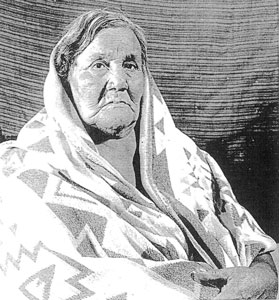
Pelagie Eliza Faribault Manaige (Aug. 27, 1841-Dec. 1, 1937)

By David Schleper

Pelagie Eliza Faribault Menaige

According to Florence Leach, granddaughter of Pelagie Eliza Faribault Manaige, three Dakota Indians who were killed in the Battle of Shakopee in 1858 are buried near the house and close to the orchards. “The graves are flat, and you cannot see them. Grandfather Faribault buried them and concealed the graves so the Chippewa would not find the bodies and scalp them. We were traders and friendly to all Indians.”

An Indian girl was also buried there. According to Florence, “Grandmother said this girl was a very fine horsewoman, and one day she was on horseback and racing across the fields with a group of young men. The girl was in the lead, but she turned in her saddle to see how far ahead she was, and to wave to the men, when her horse stumbled and she was thrown and broke her neck. She died, and they buried her here.” Florence also recalled that Pelagie Eliza Faribault Manaige, her grandmother, remembered that the girl had bracelets on her wrists. “I know these Indians are buried here because when I was a little girl, my brother and I started to dig into the graves to see if we could find the bracelets. We did not think it was wrong, for we were just little children.”

“Grandmother caught us digging, and she was so worried that she called the priest. He told her not to worry, we had done no harm; but just a few years later we tried it again, and uncovered bones. It scared us because we hadn’t believed anyone was really buried there. Of course, Grandmother found us, covered the hole, and she was frightfully upset; again she called the priest, and he comforted Grandmother. We all went out to the graves, and he said a little prayer.”

“Then the priest told Grandmother he didn’t think those Indians minded our digging for them one bit, as long as we were only trying to find out if they were really there. Now, the priest felt sure our curiosity was satisfied, and we would let them rest in peace.”

(Some information from Marian Winter story for the Sibley House Historic Site.)

Related Articles

William Louis “Bill” Quinn (November 4, 1828-March 5, 1906)

By David Schleper

William Louis "Bill" Quinn

William Louis “Bill” Quinn was born near Coldwater Springs near Fort Snelling, Minnesota on November 4, 1828. His father was Peter Quinn, who was an Irish immigrant who married Ineyahwin, also known as Mary Louisa Finley, who was a mixed-blood Christeneauz (Cree) Indian. Therefore, William was half Cree by blood.

When Bill was 20 years old, he married a half-blood Dakota woman, Angelique Jeffries, of the Mdewakanton band in 1848. By 1856, the couple had three children, all of which were one-quarter Dakota. Bill was fluent in Chippewa, Dakota, English, and perhaps other languages. At various times he was a clerk, a scout for the army, and an interpreter. Bill was employed as a clerk in the Indian trade for many years.

In the spring of 1851, Thomas A. Holmes employed Bill as a guide. They packed for one week, and Bill had already decided on two possible places for a town. They ascended the Minnesota River and cooked a meal in a hollow near the old Dakota Indian village of Tiŋta-otoŋwe. Thomas and Bill looked the place over, and climbed the bluffs north of the settlement, and Thomas was even more impressed. They decided to continue up the river to Le Sueur. But soon Thomas and Bill returned to the first landing, and deemed it the more favorite place to locate. And so Thomas Holmes picked the area near Tiŋta-otoŋwe, and called the area Holmes Landing. It was here that Thomas built a trading post for the Dakota Indians in Tiŋta-otoŋwe (which was close by where today is Sommerville Street, and continued until beyond Memorial Park.)

One interesting story about William Louis Quinn happened a few years later.

In 1862, Bill and his family were at the Yellow Medicine Agency, where he worked in William Forbes’ store. In 1862-1865 he was a scout, guide, and messenger. Bill was chief of scouts at Fort Wadsworth from 1867-1870. For 30 years, starting in 1870, Bill was immersed in learning, documenting, and providing testimony about the genealogy of Dakota mixed-bloods. In an article written in 1901, Knute Steenerson discussed his experience of being a pioneer. He had a saloon in the village of Lac que Parle. “I sold whiskey by the drink, pint, quart, and gallon. Along in the winter came a half-breed from St. Paul. He had driven up by team—there was no railroad at that time—and he was going to Big Stone Lake, he said, to buy scrip from the Indians.” Scrip allowed the holder to appropriate about 480 acres of land not already occupied for people who were half-Dakota.

“His name was Bill Quinn. He had seventeen hundred dollars in cash in his pocket book. He came into my saloon often and treated the crowd, no matter how many there were or how few. He would throw a five-dollar bill on the counter and did not want any change. When I gave him change back, he would throw it on the dirty floor and tramp on it. So I learned after a while to please him and never gave him change, but slipped the bill into the money drawer and set up the drinks. This pleased him entirely.”

“So he proceeded on to Big Stone Lake and in about a week or ten days he was back again. He brought his son and his son’s sweetheart with him. They were pretty good-looking half-breed Indians. He said he had caught them wild on an island in Big Stone Lake and wanted to ‘buckle them up’ and marry them. So he bought ten gallons of whiskey and ten gallons of cherry brandy. I was invited to the wedding, which was held at the house of a French squaw man, who lived down the river a few miles. The next thing was to send for a justice of the peace to ‘buckle them up,’ as he said.” Knute continued, “A New England Yankee was sent for. His name was Mr. Stowell, and he performed the ceremony. But Mr. Quinn was in such a hurry that he sang out between drinks, ‘buckle them up, buckle them up,’ and then again he would jig and laugh. Well, after it was done Quinn said he was so glad that they were ‘buckled up.’”

“We had a good time at the wedding. Some were drinking, some dancing, and others talking. It was a sort of cosmopolitan gathering. There were Dakota Indians talking with the lady of the house around the cook stove. There were the squaw man and old Bushma taking French. There were Fritz and Rosenbaum talking German. There were Ole Olson and John Johnson talking Norwegian. They were all enjoying a trot sling and conversation between themselves, while Bill Quinn was dancing with a glass in his hand, to the music of the violin played by the half-breed, Joe Laframboise. A more pleasant and jolly time I have never enjoyed.”

(From Knute Steenerson’s Recollections The Story of a Pioneer, Minnesota History Magazine, Vol. 4, Issue 3-4, 1921, pg. 130-151.)

Timothy Canty and Margaret O’Keefe (1851)

By David Schleper

Timothy Canty came to Shakopee as an employee of Thomas A. Holmes. Some said that Timothy came on the flat boat Wild Paddy in the fall of 1851, though others think he arrived a short time later. He came to file on a tract of 80 acres granted him by the government because of his involvement in the Mexican-American War, also known as the Invasion of Mexico.

The Mexican-American War (1846-1848) marked the first U.S. armed conflict chiefly fought on foreign soil. It pitted a politically divided and militarily unprepared Mexico against the expansionist-minded administration of U.S. President James K. Polk. Polk believed the United States had a manifest destiny to spread across the continent to the Pacific Ocean. A border skirmish along the Rio Grande started off the fighting. It was followed by a series of U.S. victories. When the dust cleared, Mexico had lost about one-third of its territory, including nearly all of present-day California, Utah, Nevada, Arizona and New Mexico.

Timothy was born in Lower Canada, and came to the eastern part of the United States at an early age. He was in the Mexican-American War, and was in many of the battles, including Cerro Gordo, Buena Vista, and Vera Cruz. After working with Thomas A. Holmes in Shakopee, he worked on the steamboats, including Greek Slave and Pocahontas.

Tim married Margaret O’Keefe in St. Paul in 1851. When the Civil War arrived, he wanted to go, but Tim couldn’t leave his wife. His wife lost her sight, and was blind at that time, so Tim stayed to be near his wife.

Timothy was dressed in keeping with his manner of living, and his ways and his philosophy was simple, direct, unassuming, and not given to boasting. He did reminisce occasionally about his experience in the Mexican American War, and when General William Tecumseh Sherman became prominent in the Civil War, Canty recalled that he had served under Sherman when Sherman was in the American forces in Mexico.

Tim, as he was called, even went so far one day as to assert that he knew Sherman well. “He’s a fine officer and a real man,” he observed to a group of settlers in Guyermann’s store in downtown Shakopee. Tim had been there to purchase his weekly supply of groceries. Many of the settlers felt that Timothy was exaggerated a bit, and that he didn’t know the great Sherman as well as he claimed. They often asked again and again, but Tim made little comment.

One day the news brought up the Minnesota River from St. Paul said that Sherman was making a tour of the west, and would pass through Shakopee. It happened in the late 1860s. When the news of the impending visit was announced, there was great excitement.

“Where’s Canty?” some of the settlers asked. “He ought to be here, since he claims Sherman knows him so well.” When Timothy was told, he didn’t say much. A few of the townspeople hinted that Tim couldn’t make good with his claim.

Finally, the day of the general’s visit arrived. Homesteaders and city residents formed quite a sizable crowd. Along noon a cloud of dust was seen down the trail. “Here they come!” someone shouted.

Presently the stage came into view, drawn by four large horses. The driver swung around the corner at Strunk’s Drug Store and stopped with a flourish. A cheer arose and General William Tecumseh Sherman put his head out of a window to acknowledge the greeting. His eyes roved over the crowd as he spoke. Suddenly, he stopped and the watchers saw his attention was riveted on a man in the rear of the crowd. Timothy Canty was there, having come to Shakopee to get his scythe sharpened. He was still carrying the scythe.

“Hello Tim!” Sherman called. “Don’t you remember me?” Tim came forward and shook hands. For some time their hands were clasped and the embarrassed settlers who had doubted Tim’s claim saw tears welling in the eyes of the two veterans – the general of all the armies and the humble homesteader.

“I want to congratulate you on your success in the later war, General,” Tim faltered.

“Thank you, Tim,” said Sherman. “Say, do you remember that big black horse I had in Mexico? Wasn’t he a dandy?” Then the general grew serious. “How is the world treating you, Tim, my boy?”

“Fine, General, fine,” said Timothy. “I have a good maple homestead and a wife and boy out here a ways.”

“That’s good. Take care of yourself,” Sherman called as he resumed his seat to continue the journey. After short remarks to the crowd, General Sherman’s coach was again on its way.

The crowd melted slowly and silently, and several went to find Tim, who had disappeared. But when Tim arrived back to Shakopee later, the reception was wholly different. The settlers were inclined to look with awe on the man who had been so intimate with Sherman. It was reported that this feeling never did wear off entirely, and persisted even until Timothy’s death in 1885.

(Some information from Timothy Canty Typical Pioneer: Father of Local Man was Personally Acquainted with General Sherman. Shakopee Tribune, 1925. In Recollections of Early Pioneers 1925 compiled by Betty A. Dols, 2000, Shakopee Heritage Society.)
Witch-e-ain: The Second Wife of Thomas A. Holmes

By David Schleper

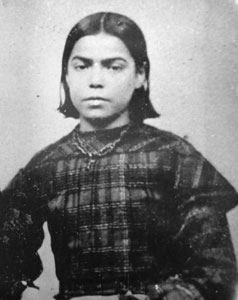
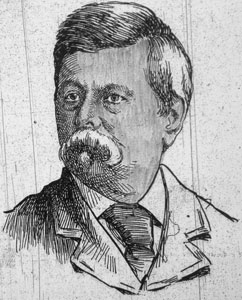
Witch-e-ain

Witch-e-ain was around 15 years old in early 1840s. Witch-e-ain’s father was another chief named Mock-ah-pe-ah-ket-ah-pah. (Although some people said that Witch-e-ain’s father was Wah-pa-sha).

The name of Witch-e-ain is closest to the Dakota word wićíte, “the human face,” although like some of LaFayette Houghton Bunnell’s other names, it is highly corrupted. The name “Face” could allude to her beauty and seductiveness. The name may also be a corrupted front formation from Wićítokapa, “the eldest born,” although this posits such a degree of corruption as to defy probability.

In the early 1840s, a special celebration was happening in Wah-pa-sha’s band. They assembled, and after elaborate preparation and sanctification of the ground by invocations and incense, the chief speaker came forward, and in a sonorous address lauded the virtues of chastity and warned against the sin of bearing false witness.

Wah-kon-de-o-tah, the great war-chief of the band, addressed his warriors in a quiet and affectionate manner, and told his braves to maintain the truth as sacred, and not offend the spirits of their ancestors. Wah-pa-sha then called for the virgins and matrons to come forth, and for some time there was the silence of expectation.

Again the call was made for any virgin to come forward and receive her reward. Two maidens came partly forward, but, upon reaching the line of denunciation, faltered and turned back, probably from modesty. We-no-nah, the wife of the speaker, and eldest sister (or cousin) of Wah-pa-sha, motioned to her youngest daughter, Witch-e-ain to come forward.

After repeated calls by the crier of the assembly, Witch-e-ain came modestly forward and was crowned goddess of the feast that immediately followed. Her head was encircled with braids of rich garniture and scented grass, and presents of colored cloths, calicoes, yarns, beads and ribbons were lavished upon her as the tribe’s representative of purity.

Wah-pa-sha said that Witch-e-ain could pick either LaFayette Houghton Bunnell or Thomas A. Holmes, as both allowed royal alliance for the family. Witch-e-aim said she did not like the trader, and preferred LaFayette. When Bunnell declined her offer, Witch-e-ain’s withering, silent contempt was clear.

During the feast, Thomas was so enchanted that he decided at once to make Witch-e-ain his wife.

Witch-e-ain was allowed to marry European American traders, like Thomas A. Holmes, in the fashion of the country. This means that these marriages were not recognized by law or religion. The French speaking traders of Canada term for this is “a la faḉon du pays.” Some people would call them “country wives.” While many marriages brought loving couples together for the rest of their lives, other marriages were very short-lived or violent. Many traders married native women, but also had other wives back home. Sometimes when the men retired from the fur trade, they returned to their legitimate, or legally married wives.

These marriages came with the expectation that trade between the woman’s relations and the trader would be secured, and that aid would be mutually provided in times of need. It was also the hope of the woman’s family that the trader’s generosity would increase after the marriage took place. The marriages between these two groups would lead to the creation of the Métis people, who would be considered the offspring of the fur trade.

So Thomas gave Wah-pa-sha an offer that he accepted. Based on this, Witch-e-ain then picked Thomas A. Holmes. This was in the early 1840s.

Thomas then married Witch-e-ain a la faḉon du pays. They were married in the fashion of the country, and lived together. But Witch-e-ain did not like living with Thomas. Like a caged bird, she soon pined for her Dakota prairie home. By the spring, while flowers bloomed, Witch-e-ain died of consumption.

(Some information from Lafayette Houghton Bunnell, Winona (We-No-Nah) and Its Environs on Mississippi in Ancient and Modern Days, Winona, MN: Jones & Kroeger, 1897; History of Wabasha County: Together with Biographical Matter, Statistics, Etc. Gathered from Matter Furnished by Interviews with Old Settlers, County, Township and Other Records, and Extracts from Files of Papers, Pamphlets, and Such Other Sources as Have Been Available. Also a History of Winona County, H.H. Hill & Company, 1884.)

Dr. Frederick H. Buck

Compiled and written by David R. Schleper, 2020

Dr. Frederick H. Buck

Dr. Frederick H. Buck was born Oct. 30, 1882, and grew up in Norwood, Ontario, Canada. His parents were farmers, and after graduating from high school he spent seven years working on the farm and “hated every minute of it!” While his father opposed him becoming a doctor, his mother encouraged him, and by age 24 he entered the University of Toronto to become a doctor.

He heard that Shakopee, which had about 1,500 people, needed a doctor, and in 1911, he moved here. He made most of his calls on foot or in a buggy.

After a year, he went back to Norwood and married his sweetheart, a nurse, Ida Gjerdrum Buck, and returned to Shakopee.

Dr. Buck’s office was at 127 ½ East First Avenue, which was above the old Shakopee movie theatre. He had the first microscope in Shakopee, and people reportedly came from miles around to see it! Dr. Buck and Ida lived at 421 East Third Avenue in Shakopee. After a few years, he bought a Model T.

Most of the time, Dr. Buck took a horse to farmhouses near Shakopee.

As he walked into one farmhouse, Dr. Buck saw a man lying on the bed, bright with fever. He knew it was pneumonia. The homemade remedies such as mustard plaster, goose grease, and turpentine all had been tried before the doctor arrived. The man on the bed was racked with coughing and spitting blood. His temperature was 104.

There was no way to check the diagnosis. There was no hospital in Shakopee. No laboratories, X-rays, and tests to confirm the decision. There was no phone. Dr. Buck was alone in that isolated farmhouse. Because pneumonia usually lasted seven days, the doctor returned in a few days, crossing the threshold and holding his breath. The man on the bed was bathed in sweat. His temperature had broken, and his breathing came easier. “The most wonderful sight in the world,” said Dr. Buck.

According to Dr. Buck, the railroad had been his ambulance line once. If you had an emergency—appendicitis, maybe—you got word to the station agent. You’d carry the patient on the back of a wagon to the depot. The next train would stop and you’d load the patient into a baggage car and climb in yourself, and ride with him to St. Paul, where an ambulance took both of you to either St. Joseph’s or St. John’s hospital. You always stopped in St. Paul because the train went there first before going on to Minneapolis.

When he first started, the doctor got $10 for each baby delivered. Over the many years that he was a doctor, Dr. Buck delivered 1,200 babies. He also made many hours in calls, including the Dakota at the tipi tanka and tipi along the Minnesota River.

When the scarlet fever epidemic happened in February 1918, Jane Cloud, a Dakota aunt of Minnie Josephine Otherday Weldon and a descendent of Dakota leader Ṡakpe II, sat on the curb in front of Dr. Buck’s office. She was crying her heart out because she was afraid the fever would kill Dr. Buck. Luckily, Dr. Buck survived.

On Dec. 5, 1914, Ida and Frederick had a child, Marion Bell Betty Buck (1914–2007) in Shakopee.

A few years after Marion was born, Ida became blind.

Ida went to Faribault School for the Blind to learned Braille. She received a seeing eye dog to roam around downtown Shakopee.

Ida died on Oct. 9, 1957. She is buried at Valley Cemetery in Shakopee.

Dr. Frederick Buck sold his general practice in 1946, but he continued as a physician for the masonic home until 1959, and for the women’s reformatory for 18 years, and continued to work with the children with disabilities at the reformatory until that was closed.

At age 95, Dr. Buck died. He had served the people in and around Shakopee for many, many years.

According to Vern Lang, “His death is the passing of another era.”

PDF Brochure

Elizabeth Gerdesmeier Lenzmeier: An Heroic Pioneer Woman

By David Schleper

A contingent of peasant farmers from Germany left for the New World, including the Lenz and Gerdesmeier families around 1848. When they arrived in America, the authorities asked their name and occupation, and decided to combine their name (Lenz) with their occupation (dairy farmer) to become Lenzmeier. At some time, either in Germany or in East St. Louis, Illinois, Elizabeth Gerdesmeier Lenzmeier married Francis Lenzmeier.

Two sons were born and died in infancy, and then Henry was born in St. Louis. In 1860, Elizabeth and Stephan came by steamboat to St. Paul, where they traveled to Scott County and to Marystown. Twenty-five year old Elizabeth, who was either pregnant or carrying a newborn infant along the trip, arrived and they registered their homestead in Shakopee. The family, like others in Marystown, spoke German.

Stephan settled the homestead and brought in crops and did fairly well, with Elizabeth every inch the heroic pioneer woman, keeping people fed and clothed while rearing a big family, including eight boys, and finally a baby daughter, Mary, in 1878.

Stephan went out to South Dakota under General George Custer to look for gold in the Black Hills. Stephan was 53 years old, while Elizabeth was 38, and stuck at home with the children. Stephan was hoping to get rich quick, but he didn’t succeed. He reportedly fell ill away from home and had difficulty getting back. He did return, but his health was broken, and he died at 57 of heart failure.

It was said that his widow, Elizabeth, was very bitter about his death, blaming him for bringing on his own demise and leaving her to raise their large brood and run the farm, even with an infant at her breast. She reportedly held up the child before his open casket and cried something to the effect of “Here, take her with you, why don’t you! How can you leave me here alone with all this responsibility and this little one, too?”

Now Elizabeth surveyed her situation. She was a widow at age 43 with assets of a good farm, eight sons, and an infant daughter. Life must go on. Elizabeth learned of a good family in Shakopee who was growing a very of marriageable daughters. She made an inevitable logical decision. One Sunday morning, she hitched up a team to the buggy and drove the five miles to the Hubert Roehl farm just west of the town of Shakopee, along the road leading to Jordan.

Hubert Roehl was an immigrant from Luxembourg, and owned a long piece of land parallel to the Minnesota River. He also owned an overabundance of daughters!

Elizabeth told Hubert about her big, handsome boys, and suggested that they had a basis for an arrangement. Elizabeth was one smart woman!

And so it was arranged that her sons would marry Roehl girls. And four of them did! The four brothers who married Roehl sisters received pieces of good land from their father-in-law’s original claim along the Minnesota River.

And Elizabeth? She was happy. And one smart woman!

(Some information from First Reunion of the Lenzmeier Families, Shakopee, Minnesota, June 19, 1983.)

Grace Manaige

By David Schleper

Granddaughter of Oliver Faribault and Wakanyankewin

Grace ManaigeGrace Manaige, daughter of Charles A. Manaige and Pelagie Eliza Faribault Manaige, and granddaughter of Oliver Faribault and Wakanyankewin, was planning to marry. But she went to South Dakota to be with her sister, Isabelle, during the birth of a child.

It was a difficult delivery, as the baby came breech and couldn’t be turned. In order to save Isabelle, the doctor cut off an extremity of the baby, and the baby died.

When Grace returned home, she broke off the engagement with the man she was to marry. She said she would not go through that for a man!

Hilarius Drees and Agnes Dorzinski Drees Hog Farm 1943

By David Schleper

In 1943, Shakopee Avenue stopped about one block west of the farm, and there was just a gravel road leading to the farm. To the north and east of the farm was a sand and clay pit, about 25 feet deep. The clay from this pit once was used by the Schroeder Brick Company for making brick for Shakopee.

Hiliary Drees purchased a farmstead which consisted of approximately 20 acres. He bought the farm from Mr. Turner, who was a rural mail carrier for Shakopee. The location is just north of Pearson Sixth Grade Center, near Prairie Street today.

Hilarius Antonius Drees was born June 4, 1903 in Wanda, Minnesota, and died April 18, 1974 in Shakopee. He married Agnes Nathalia Dorzinski, who was born August 1, 1904 in LeSueur County, and died July 1, 1978 in Shakopee. They married on November 24, 1925. Hiliary was a farmer, but also worked at Rahr Malting, as well as Pullman Club as a waiter. Agnes was a homemaker, but also worked as a clerk at M.J. Berens grocery and dry goods store, and was a waitress at Pullman Club. They had five children.

Because Drees Hog Farm was at the outskirts of Shakopee, there was no city water or sewer. A cow barn stood north of the house, with a chicken coop, outdoor well, smoke house, and outdoor privy making up the rest of the farmstead. The outdoor privy was used until 1951.

Along with the dairy cows and chickens, Hiliary Drees started to raise hogs. He built two hog barns east of the farm house and started his hog operation. At the peak of the hog operation, he raised as many as 300 or 400 hogs a year on 10 acres. The hog pasture went east and about 300 feet north of the house.

In the past, butchering was used using a big black iron kettle to heat the water and a wooden barrel to soak the pig until the hair came loose, noted Margaret Haas of Shakopee.

According to Margaret:

“We cooled the meat and then the hams and some side pork were put in dry salt for a while. Later came the task of smoking them. We would hang them on pipes with wire hooks and then a smoldering fire was built by using hard wood and some apple wood, covering it with damp sawdust.

“We had to watch this fire very closely for sometimes if the wind blew hard it would cause the fire to flare up and one had to add more sawdust. Sometimes one would wake up and see flames coming out of the smokehouse, and then quick steps were taken to add the sawdust.

“The rest of the pork was fried down and put in crock jars. We also butchered beef, so taking parts of beef and pork, we made sausage. We used the pig heads for head cheese, pickled the tongues and hearts, and also used the brains for a special food. We took the tallow and extra fat to make soap.”

LaVina Busacker noted that her father and two brothers butchered two beef animals, and they let their meat age in a sun porch for three weeks, as it was a large, enclosed, and unheated porch. After that, they butchered six hogs:

“That was about three days’ work – to cut up the meat, grind it up for sausage.… The hams and bacon were put in a brine (water with enough salt in it to float an egg). They made head cheese, liverwurst, summer sausage, pork sausage, gritwurst (oatmeal and lard cracklings) and blood sausage.”

At the smoke house, apple and hickory wood would be used to smoke the meat. According to LaVina Busacker, “When we got our smoked hams from the smoke house, we would bury them in the wheat bin as deep as possible, so they would stay cold, since we had no refrigeration in those days.”

Hiliary and Agnes Drees and their family continued the hog operation until 1952. At that time, hog cholera hit the farm. After the quarantine was lifted, Hiliary did not resume hog farming.

Many years later, the hog farm is gone, and houses and schools have taken over the area that used to be Drees’ Hog Farm. The original house is still there, on Shakopee Avenue and Prairie Street, right across from Pearson Sixth Grade Center in east Shakopee.

(Some information from Butchering Many Years Ago by LaVina Busacker; A New Type of Living by Margaret Haas, As I Remember Scott County, 1980 by Scott County Senior Citizens, edited by Marcia Spagnolo; and Scott County Historical Society.)

Joe Jenn (1907-1999)

By David Schleper

Joe Jenn

Joe was orphaned as a child. He worked on road construction crews and for Union Carbide before he became in charge of maintenance for the K-12 Shakopee school. He lived in Shakopee for 66 years. Clifford Thibodeau remembered, “Joe was a great guy! I remember being in 5th grade, if I remember right. Me and some other boys were asking him about his job. I don’t know if he was supposed to, but he showed us areas of the school that may have normally been off limits to students, like the boiler room, and the pretty big basement the school had. In all the years I went to that school, he was always such a good humored guy!”

Barb Stein also remembered Joe. “He was so cool, he would let us play with his retractable key chain, zing, zing, zing, the patience of a saint.” “When we talk about Joe I always smile. I remember when we moved to Shakopee my sophomore year, my parents just had me walk to school and register myself. Joe was out cleaning the sidewalk and could tell I was lost. He took the time to walk me to the office,” said Marilyn Rein.

Joe Jenn recalled growing up in Shakopee. “Shakopee was really a community by itself, cut off by the Minnesota River and the river bottoms. Back in the 1930s, the town was a little Las Vegas. We had 33 beer joints at one time and notorious nightclubs like Rock Springs and the Riviera. People, including gangsters, came here for booze, women, and gambling; the mayor, sheriff, and city councilmen went along with it all.”

Joe said, “A garage was established on Lewis Street. In the rear door off the alley was a receiving depot for boxes of liquor.” According to Joe, “There was also a bottling works in town; they’d delivered bottles of pop to St. Paul and return with bottles of whiskey.”

(Some information from Midwest Highways and Byways by Alice M. Vollmar, Summer 1999.)

Minnie Josephine Otherday Weldon (July 24, 1877-June 18, 1959)

By David Schleper

Minnie Josephine Otherday Weldone

According to Mary Cavanaugh DuBois, “Everyone in the community knew ‘Indian Minnie,’ who made beautiful beaded articles. The purses mother had her make were not leather, but made from rubber inner tubes. They had beaded handles and rubber streamers decorated with beads. The price was $1.00 each.”

Minnie Josephine Otherday was born in a tipi on July 24, 1877 on the north side of the Minnesota River in Tiŋta-otoŋwe. Her parents were Jim and Lucy Otherday. Her grandmother was the sister of Chief Ŝakpe II, whom the city of Shakopee was named.

According to Diane Sexton, “My grandma had a pair of baby booties and a pillow made by Minnie, they always fascinated me as a young girl. She later donated them to the historical society.” Marcia Wagner remembered, “When I was a girl Indian Minnie lived on the Indian Road, on the Eden Prairie side. I used to take a walk and visit her. She was a very nice lady. Went to school with her granddaughter Darlene. I grew up in Eden Prairie on Spring Road, so Indian Road was just like a hop and a skip away.”

In the 1980 McDevitt family history book, there is mention of Minnie:

“Because the homestead only consisted of fifty acres, his father rented land at a number of places and also purchased some land at two different sites adjoining the city of Shakopee. These tracts of land that his father had purchased are now a part of the city of Shakopee and many homes have already been built on this land…To get to one of the rented fields, they had to drive across the old bridge at Shakopee onto the Indian Road, where they would see Indian Minnie sewing under a shade tree and the young Indian boys running and hiding behind trees, aiming and shooting their Fourth of July guns.”

(Some information from online discussion on If You Grew Up In Shakopee…)