Compiled and written by David R. Schleper, 2020
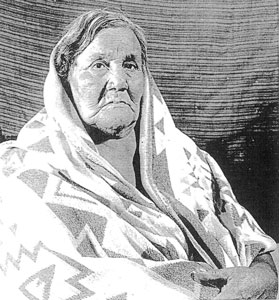
According to Mary Cavanaugh DuBois, many people in Shakopee knew Minnie Otherday Weldon, who made beautiful, beaded articles. “The purses mother had her make were not leather but made from rubber inner tubes. They had beaded handles and rubber streamers decorated with beads. The price was $1.00 each.”
Minnie Josephine Otherday was born in a tioti on July 24, 1877, on the north side of the Minnesota River in Tínṫa Otuŋwe. Her parents were Oyatekokepa Jacob Otherday, and Hapstiŋna Makaakaŋiwaŋkewiŋ Black Flute Lucy Otherday.
Minnie was a direct descendant of Dakota that once reigned supreme in the Minnesota valley and are still here today. Her grandmother was the sister of Dakota leader Ṡakpe II, for whom the city of Shakopee was named.
Minnie’s relatives purchased 18 acres in 1871, directly across the Minnesota River. On this land, the Mdewakaŋtoŋwaŋ, the Spirit Lake People, lived, not far from which used to be Tínṫa Otuŋwe. They caught fish and turtles with spears and hooks, caught the mink, muskrats, and beavers along the shore, the cranberries grew in profusion in the lowlands, and the wild rice was plentiful on the lakes on the valley floor.
During the 1897 Scott County fair, the Indian Village included the “tum-tum” sound of the beaten drum which vibrated again and again, while the “hi-yah” of male voices mingled occasionally with the shrill sounds of the Dakota woman who echoed throughout the village. Minnie and others cordially allowed the inquisitive white people to see inside the tioti (plural is tipi).
In 1900, the colony consisted of about 15 residents, living in three dwellings. The surnames included Otherday, La Framboise, Ortley, Bluestone, Shoto (or Choteau), Campbell, Cloud, Jackson, Tahkudo, and Baska.
In 1908, Minnie married Charles “Chuck” Weldon, a fisherman, and they grew up on the bottomland of the Minnesota River. They had four sons and a daughter, all born in the east part of Shakopee. Hilary Drees remembers driving his bike … down to the river to Indian Road, where they saw the hogs that lived on the north side of the river, and continued past Sever’s farm to look at the tipi of the Indians. Irene McDevitt Reinke Bursey recalled “…they had to drive across the old bridge at Shakopee onto the Indian Road, where they would see Indian Minnie sewing under a shade tree and the young Indian boys running and hiding behind trees, aiming and shooting their Fourth of July guns.”
Minnie is also the grandmother of Charlie Vig, who was the Shakopee Mdewakanton Sioux Community chairman for eight years. The Shakopee Mdewakanton Sioux Community is the most influential Native American tribe in Minnesota.
As a young woman, Minnie used to make the rounds of Shakopee homes with her almost-blind mother, Lucy. The two of them would gather food from the tiŋta, or prairie, including different kinds of berries. They waded in the wetlands to harvest psiŋca, a nourishing bulbous root with their feet and hands.
Minnie and her mother dug mdo, a wild potato, and tipsiŋna, prairie turnips, from the tiŋta. They also gathered berries, crabapples, plums, and nuts from the woods. They also harvested watercress which also grew in the springs.
The watercress from Faribault Springs, the wild grapes in season, the moccasins, and the beadwork were sold to people in Shakopee. They would sell watercress from the Faribault Springs area in season, and take orders for tanning skins, making moccasins or selling a variety of beadwork.
Elizabeth Schultz remembered “Minnie and Lucy would come in by my father, and he would buy watercress and little things they made, such as little moccasins, little boats made from birch bark, and also beads. They also came to our house to visit my mother and grandmother….”
Charles Weldon died of heart failure on the Minnesota River in January 1936. He had gone down onto the river ice that morning and was suddenly stricken with a heart attack. His family carried him up the riverbank and he died in a few minutes.
Minnie Otherday Weldon died on June 18, 1959, at a nursing home in Sisseton, South Dakota, at the age of 82. She had been confined to her home for more than a month when her condition grew critical because of a paralytic stroke she suffered in January 1959.
For more information about Minnie Josephine Otherday Weldon and Tínṫa Otuŋwe, visit Hoċokata Ti (ho-cho-kah-tah-tee), the Shakopee Mdewakanton Sioux Community’s (SMSC) cultural center and gathering space. The public exhibit, “Mdewakanton: Dwellers of the Spirit Lake,” enhance the knowledge and understanding of the Mdewakanton Dakota people and their history. Hoċokata Ti is at 2300 Tiwahe Circle, Shakopee, MN 55379. (952) 233-9151.