Category Archives: People

Henry David Jones Koons: Philadelphia to Shakopee, Minnesota

With Notes on Shakopee Pioneers Thomas A. Holmes and Robert Kennedy

Written by David Hewitt Eggler, Jan. 9, 2017
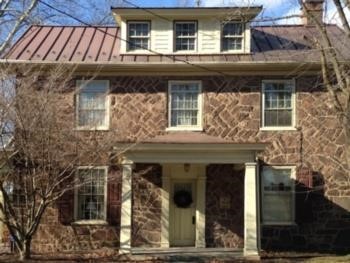
David Jones house

Henry David Jones Koons, my second great-grandfather, was born in southeastern Pennsylvania. His mother, Frances B Jones, was born in 1811 in Union Township, Berks County, to David Jones, Esq. and Mary Brower. Mary’s father, Abraham Brower, built a commercial empire in Browertown1, a community built in a narrow space between the Schuylkill Canal, a commercial waterway, and the Schuylkill River, about 40 miles northwest of Philadelphia. Several buildings in Browertown, today Unionville, still stand, including the David Jones house, a stone structure with distinctive herringbone pattern built by Abraham for his daughter Mary and her husband David Jones.

Frances B Jones married Philip T B Koons in 1830 in St. Gabriel’s Episcopal Church in Douglasville, across the Schuylkill River from Browertown. Philip’s parents were Henry Koons and Mary Magdalena Trumbauer. Henry Koons, born in 1778, was from Limerick Twp. in Philadelphia (now Montgomery) County, the son of Frederick Koons and Mary Kendall. Mary Magdalena, born in 1782 in Trumbauersville, Bucks County, was the daughter of Philip Trumbauer and Catherine Huber. When Mary was two, however, her father died, and her mother remarried to an older man, Adam Brotzman, who lived in Limerick Twp. So Mary and Henry Koons were brought into proximity and married about 1803. In 1820 Henry Koons bought land in Union Township, Berks County, from his brother-in-law, Nicholas Brower, and moved there with his five sons including Philip.

The period between 1828 and 1832 was eventful for the Koons families. In 1828 Abraham Brower unexpectedly died, and the Browertown empire began to fall apart. Henry Koons still lived in Union Twp. in 1830, but by March 1832 Henry, along with his sons, was a resident of Philadelphia and an Innkeeper. In October 1832 Henry bought land in Marion County, Ohio, and shortly thereafter he and four of his sons, including Philip, farmed there on adjacent farms. During that period, on April 15, 1831, Henry David Jones Koons was born to Philip and Frances in Philadelphia County; on Oct. 1, 1831 Henry D J Koons was baptized in the German Reformed Church in downtown Philadelphia.

While the Koons clan lived in Marion, Ohio, they would have become acquainted with two other families that would play major roles in the history of Henry D J Koons. One was the family of Edward and Susannah Gordon Kennedy. The family moved from Harpers Ferry, Virginia (now West Virginia) to Marion in 1826, where Edward kept a tavern. Two of his children were Robert and Ursula, of whom more to come. The other family was Judge William and Rachel Day Holmes, originally also from Pennsylvania. Judge Holmes lived in Marion from 1820 to 1833; one of his sons was Thomas Andrew Holmes, who in 1829 in Marion married Ursula Kennedy.
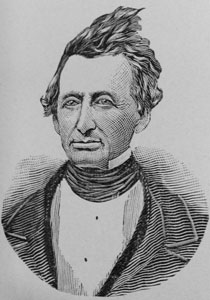
Thomas A. Holmes

Thomas A. Holmes was an itinerant early pioneer and entrepreneur. He was instrumental in the establishment of Janesville, Wisconsin and Fountain City, Wisconsin (Buffalo County, initially called Holmes Landing). In 1851 he laid out and named Shakopee, Minnesota and then the nearby Chaska. In 1862, he participated in founding Bannack City, which became the first capital of Montana. He never stayed long enough in any of those towns to profit very greatly, preferring to move on. His Wisconsin endeavors began in 1835, when he built the second house there and became the second permanent settler. He made the first settlement in Janesville, Wisconsin, in 1836. He persuaded the family of his father, Judge Holmes, to participate in the latter adventure, building shanties in what was then unsettled wilderness.

Exactly how the family of Henry D J Koons became involved in the Wisconsin ventures of Holmes is unclear. What is known is that on Dec. 6, 1834 Philip T B Koons sold 100 acres of land in Marion Township, Ohio, and on Aug. 1, 1837 Frances B Jones Koons married Robert Kennedy in Milwaukee, Wisconsin. We can speculate that Kennedy and the Koons family decided to join Holmes in his Western expeditions. Whether Philip Koons died in Ohio, or on a journey west, or in Wisconsin is unknown.

“In 1839 Thomas Holmes, his wife Ursula, his brother-in-law Robert Kennedy and his wife [Frances B Jones Koons Kennedy], and others in a party of 13 left Milwaukee and were enroute up the Mississippi with St. Anthony Falls (present day St. Paul) as their goal. [That party included two children, the eight-year-old Henry David Jones Koons and Thomas Edward Kennedy, born to Frances and Robert Kennedy in 1838.] However, in the late fall of the year an early freeze caused the Mississippi to freeze just above the mouth of the Waumandee which is just north of present-day Fountain City. With their travels forced to a halt, the group built dugout shelters on the shore of present-day Fountain City and settled in for the winter. During the winter Thomas Holmes, who had an excellent understanding of Indian dialects, established contacts with the Dakota Sioux band of Chief Wapasha whose winter camp was just down the river at what is now Winona. He found what he felt was a great opportunity for fur trading with the Indians.” 2

Robert Kennedy was primarily a hotel-keeper. In 1840-41 he kept a hotel at Holmes Landing (now Fountain City), in 1844 in Dakota, Winona County, in 1846 in Stillwater, Washington County, and in 1850 in St. Paul. He was enumerated in St. Paul in the 1850 census, the first to contain names of family members, which were Frances B, Henry Kennedy (who was Henry D J Koons), teamster, Edward, and two more young Kennedy boys. In 1851-52 he was town president of St. Paul. In 1853 he re-settled in two-year-old Shakopee, running boarding-houses and hotels, one of them the Kennedy and Reynolds National Hotel, until at least 1860, when he returned to St. Paul.

In 1852 Henry D J Koons, by then twenty-one, filed a claim in the new town of Mankato, Minnesota and for a time for an employee of the claims office there. But the next year he appears in a narrative about Shakopee. After its founding by Holmes in 1851, Shakopee in 1852 had twenty people. The real influx began in 1853 when the Indians were removed to the Upper Sioux Agency. The first officers of the town in July 1853 appointed a judge and an election board that included H.D.J. Koons; he was also appointed a road viewer. Henry D J Koons bought his first property in Shakopee, Scott County, on Nov. 10, 1853, paying $100 to Thomas Kennedy, the brother of his step-father Robert Kennedy. He sold two pieces of land in 1855 for a total of $795. His dealings began in earnest in 1856. Either by himself or with his wife he bought four properties for a total $2000, and with Robert Kennedy (his step-father) bought four properties for a total $7000. He sold 14 properties by himself or with his wife, almost all lots in the city of Shakopee, for a total $4532. The Shakopee lots came mostly from the public land that he acquired on June 16, 1856, when he purchased 80.65 acres in Township 115 North, Range 22 West, Section 6 N ½ SW ¼ in Eagle Creek Township, from the Red Wing land office (v. 1080, p. 111, document 119). The document also appears in the Scott County Deeds for the same date, and that document names him as Henry David Jones Koons. Many settlers bought 80 acres of public lands, but his section lay within the city limits of Shakopee, east of the original patent. In present-day Shakopee, it would lie approximately between Third and Seventh avenues and Main to Naumkeag (extended) streets. In fact, he sold some of the lots before the public land acquisition was finalized. In 1857 he bought one property in Scott County for $285 and three in the town of Helena for $300. That year eight properties were sold for a total $9250. In 1858 two properties were bought for $4000 and one sold for $100; in 1859 one was sold for $430. In 1861 two were sold for $800, including one in T114N R22W to Painted Differently and his wife Third Daughter of the Calhoon Band of the Sioux Tribe.

The History of the Minnesota Valley (1882, p. 300) says that claim jumping was frequent in the early days. “On July 18th, 1854, nine citizens were arrested for pulling down the claim shanty of Dr. Kinney of St. Paul on a disputed claim. Twenty-six or seven were engaged in the affair but fortunately all were not known and the offence could not be treated as a riot, as the injured party would have been glad to have made it, for blood ran high in these claim fights. The nine arrested were from the most substantial citizens and were no less persons than Thomas Kennedy, H.D.J. Koons, Thomas A. Holmes, John C. Somerville, Comfort Barnes, William H. Nobles, J.B. Allen, William Smothers, and D.M. Storer. The arrest was made by Dr. Kinney’s agent, and threatened to be a serious matter. The claim belonged to Henry D J Koons in the judgment of the citizens, and Dr. Kinney jumped it.”

On April 16, 1854 Henry D J Koons and Henrietta Allen were married in Shakopee by the Rev. Samuel William Pond, one of the two Pond brothers, noted early missionaries to the Sioux Indians. It was the first marriage ceremony in Shakopee. She was the daughter of John Boswell Allen and Jane Dillard, who had migrated from Spencer County, Kentucky to Boone County, Indiana and then to Shakopee.

Reconstructed Upper Sioux Agency in Yellow Medicine County
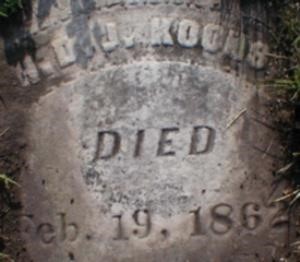
Gravestone of Henry David Jones Koons

In addition to his land speculation, Henry D J Koons was also an interpreter for the US Army. He undoubtedly learned the Dakota language from Thomas A. Holmes. In that capacity, working out of the Upper Sioux Agency in Yellow Medicine County on the Minnesota River, he “died of pneumonia in a cold winter with very deep snow” (family narrative of Ada Hewitt). The picture is of the reconstructed Agency. The report of Thomas J. Galbraith, the Indian agent for the two Sioux reservations in the Northern Superintendency, can be found within the Report of the Secretary of the Interior, specifically the Annual Report of the Commissioner of Indian Affairs (1861, 37th Congress, 2nd Session, Senate Executive Document 1, p. 624, Serial Set Volume 1117; Galbraith’s report is on pp. 699-704). He writes, “Several complaints of Indian depredations on the frontier, in the region of Spirit Lake and Sioux City, have been made at this office. Early in September, under the direction of the Department of Indian Affairs, I sent Mr. H.D.J. Koons, the United States interpreter of this department, to Sioux City, via Spirit Lake, with instructions to inquire into these depredations and report at the earliest day possible. He has returned, but has been too unwell to prepare his report. As soon as possible his report will be transmitted to the department. He obtained considerable valuable information, from which I am able to state that the Indians of this agency stole some twenty or thirty horses the past summer from citizens of Iowa and Minnesota.”

Ada Hewitt

Henry Koons died on Feb. 19, 1862. His obituary in the Shakopee Weekly Argus for March 1, 1862 reads: “Death of Henry Koons.–The friends of Henry Koons will regret to hear that he died on Wednesday of last week, of lung fever, at the Sioux Agency. In all the relations of citizen, husband and father he is well spoken of. He leaves a wife and three young children — besides many warm friends — to mourn his death.” Family history from Ada Hewitt (picture at right) reads: “Abner Riggs used to say that if young Koons had lived, the Minnesota Indian uprising and massacre would not have occurred. He liked the Indians, and they were friendly toward him.” Abner Riggs was the husband of Ann Eliza Allen, sister of Henrietta Allen, and also a Shakopee pioneer. His mother was a sister of the missionary Pond brothers. The story is obviously an exaggeration. Hewitt family history also says, however, that the Sioux, out of respect, brought the body of Henry D J Koons down the Minnesota River to Shakopee, a perilous journey in winter.
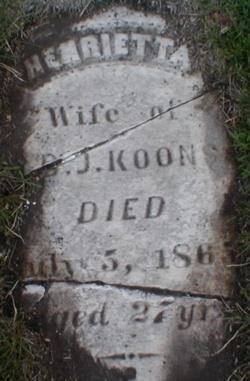
Gravestone of Henrietta Koons

On March 21, 1862 Henrietta Koons petitioned Probate Court of Scott County, meeting in Shakopee, to appoint her father John B. Allen Administrator of the Estate of her deceased husband. That was approved on April 17. The claims against the estate were finalized on Dec. 30, 1862 and consisted of a $20 account to James L. Wakefield, M.D. for medical services and medicines for the deceased at Yellow Medicine during his last sickness, $376.31 to the U.S. Government for foods furnished the deceased at the time he was employed by the government, various notes totaling $387.82, and two merchant accounts for $13.90, a total of $855.78. After subtracting assets, the amount of indebtedness was $479.47. It would seem, given the amount of real estate dealings that Henry D.J. Koons had been pursuing, that the amount could be satisfied easily. Nevertheless, John B. Allen reported to the Court in November 1863 that to pay the debts and the expenses of the administrator the whole of the real estate of the deceased would have to be sold. Several public auctions took place in 1864 and two in 1869. These did not bring prices commensurate with prices Henry paid. Every property was sold under $100 except for a property in Anoka County that brought $250. Most notably, many lots in the town of Helena went at auction for twenty-five cents each. Although the probate court record contains no concluding statement, the indebtedness was presumably settled once and for all in 1869.

Henrietta Koons visited Marion County, Ohio in December 1863, possibly to solicit money willed to her husband by his grandfather Henry Koons, but two years later died. The tombstone in Valley Cemetery reads “wife of H.D.J. Koons, died July 5, 1865 aged 27 yrs.” Two girls were left orphans, including my great-grandmother Martha Mae Koons. Ten years later Martha Mae (below right) would marry George Hewitt (below left), the uncle of Ada Hewitt cited above. George and Martha Mae also died very young, leaving five orphan children including my grandmother.

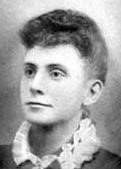
George Hewitt
Martha Mae Koons

Other families from Browertown pop up in Shakopee. The brother of Frances B Jones Koons Kennedy, Abraham Brower Jones, appears as a merchant in the 1857 census for Shakopee, and in that same year was one of the partners, including Thomas Holmes, in an unsuccessful venture to develop Spring Lake, south of Shakopee. In 1863 he was an officer in the Shakopee Lodge, A.F. and A.M., but by 1885 was living in St. Paul with his sister. The families of his daughters, Charity M Jones Leopold and Mary Elizabeth Jones Sencerbox, also were early Shakopee residents. Leopold was a prominent Browertown name.

SOME AFTERMATHS: Henry Koons and his wife Mary Magdalena died in 1859 and 1868 in Defiance County, Ohio. Judge Holmes and his wife died in the 1860s in Janesville, Wisconsin. Ursula Kennedy Holmes died ~1841 in Dubuque, Iowa. After her death, Thomas A Holmes married twice more and died in 1888 in Cullman, Alabama. Robert Kennedy kept several boarding-houses and hotels in St. Paul; in 1864 he journeyed west to gold fields near Helena, Montana, for about a year, accumulating enough wealth to pay his debts. He died in 1889 in St. Paul. His wife Frances B Jones Koons Kennedy died in St. Paul two years later. The Shakopee Courier Dec. 3, 1891 wrote: “Mr. and Mrs. Robert Kennedy were of the old settlers of Shakopee, Mr. Kennedy having built the National hotel, afterwards burned down.”

1 Susan Speros-Miller, The Town of Brower: A Lost Family Legacy, Historical Review of Berks County, Winter 2006-2007, p. 20-29, available online at ancestry.com and at http://www.schuylkillhighlands.org/downloads/news_docs/newsfile_1375472575.pdf (scroll to the bottom)

2 Buffalo County Biographical History: Celebrating 150 Years, 1853-2003, Buffalo County Historical Society (Buffalo County, Wisconsin), 2002, p. 7 (available online). For many more details on those years, although this source needs to be read with caution, see Winona (WE-NO-NAH) and its environs on the Mississippi in ancient and modern days by Lafayette Houghton Bunnell, M. D., written for and under the auspices of the Winona County Old Settlers’ Association, Winona, Minnesota, Jones & Krobgek, Printers and Publishers, 1897, chapters X and XII, available online.
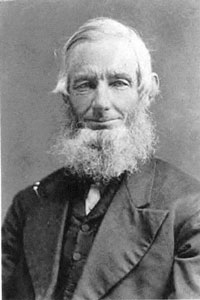
Hazen P. Mooers

Aug. 3, 1789-April 3, 1857
In Tiŋta-otoŋwe and Prairieville 1846-1849
By David R. Schleper

In 1818, Mar-pi-ya-ro-to-win II married Hazen P. Mooers, an American who was sent to Minnesota to work with the American Fur Company in 1816.

Hazen was born near Plattsburgh, New York on Aug. 3, 1789, the son of Moses Hazen Mooers and Jemima Jackson. He was the fifth of 13 children. He lived and worked on their farm until he joined Aitken’s Volunteers, which repulsed an attack of the British. He received a rifle as a testimonial of his work.[1] He then headed to Prairie du Chien.

In Prairie du Chien, Hazen was employed by James Aird, a Scotchman. When Hazen was about 23, he married Mar-pi-ya-ro-to-win II (Grey Cloud Woman).

Hazen was a large and athletic man, courageous and even tempered. He was a trader who made much profit to the American Fur Company where they conducted a trading post at Big Stone Lake for 15 years. He would make annual trips to Prairie du Chien, carrying his gathering of furs bought, and getting a supply of goods to trade with the Dakota. In 1829 Hazen came down from Lake Traverse with one hundred and twenty-six packs of furs, with a value of twelve thousand dollars![2] In 1835, he established a post at Little Rock, five miles below Fort Ridgely.[3]

After years of traveling throughout the state to various trading posts, in approximately 1838, the family moved to Spirit Wood Island, which is now called Grey Cloud Island. Grey Cloud Island, about five miles long and one to two miles wide, is situated in the south end of Washington County, Minnesota, between St. Paul and Hastings.[4] Historical accounts surmise the move was made in order for Mar-pi-ya-ro-to-win II (Grey Cloud Woman) to be closer to relatives in a large Black Dog Village, directly across the river, while Hazen could establish a trade center. Thanks to the strong influence of his wife, he was able to traffic with three bands of the Dakota Indians.

In the fall of 1846, Hazen and Mar-pi-ya-ro-to-win II moved to Tiŋta-otoŋwe and lived there among the tipi tanka (or bark lodges) and a few tioti or two until the spring of 1849. The house was built in the fall of 1846, and located just as you arrived on Highway 101 into downtown Shakopee. It was located on the right side as you head west, close to the duck pond. The location is also located about 10 rods, or 55 feet, north of Reverend Samuel W. Pond and Cordelia Eggleston Pond’s house (which would be built the next year). Hazen was appointed an Indian farmer, which provided him land there to farm.

Hazen and Mar-pi-ya-ro-to-win II moved out in the spring of 1849. (Hazen’s son, Kahoton, continued to live in Tiŋta-otoŋwe, and was an Indian farmer for the government until the spring of 1853.) Mar-pi-ya-ro-to-win II, known as Grey Cloud Woman, died on July 20, 1849 at Black Dog Village, a village of her Dakota relatives.

Hazen and his son, Kahoton John Mooers, decided to move north in 1853. Hazen secured a contract for erecting the first government buildings at the Lower Sioux Agency.

Hazen later married Ellen Stafford (1815-1893) in November 1853 at the Lower Sioux Agency. Hazen and Ellen Mooers had one child named Ellen Mooers, who was born March 10, 1855 at the Lower Sioux Agency and has been reported as the first white child to be born in Redwood County. Once Hazen completed his work, he retired to a small farm home in the valley just below Fort Ridgely.

Hazen died April 3, 1857 at the age of 68 years old and was buried at the local cemetery.[5] He was one of the first white people who lived in the area later called Shakopee.

[1] From Collections of the Minnesota Historical Society, Volume XV, 1915, pg. 372.

[2] Collections of the Minnesota Historical Society, Volume 2, pg. 119 at archive.org/stream/collections02minnuoft#page/119/mode/1up

[3] “Historical notes of Grey Cloud Island and its vicinity” archive.org/stream/historicalnoteso00caserich/historicalnoteso00caserich_djvu.txt

[4] Collections of the Minnesota Historical Society, Volume XV, pg. 371.

[5] Learning About the U.S. – Dakota War at midwestweekends.com/plan_a_trip/history_heritage/frontier_history/dakota_war_1862_minnesota.html

Mar-pi-ya-ro-to-win II (Grey Cloud Woman) | Margaret Aird Anderson Mooers

1793-July 20, 1849
In Tiŋta-otoŋwe and Prairieville 1846-1849
by David R. Schleper

Mar-pi-ya-ro-to-win II was born in 1793 at Prairie du Chien on the Mississippi River. Her father was James Aird, a prominent fur trader. James was a Scotchman, born in Ayrshire, and was a cousin of Robert Burns, the poet. He came to America in 1783, landing at Quebec and then heading to Wabasha’s village as a trader in the employ of the Hudson Bay Company.[1] Mar-pi-ya-ro-to-win II’s mother, also known as Mar-pi-ya-ro-to-win I, which means Grey Cloud Woman, was a member of the Dakota tribe. She was born at her father’s village where the city of Winona now stands.

Mar-pi-ya-ro-to-win II was of noble lineage. She was the daughter of Chief Wabasha I and sister of Wabasha II, both powerful Dakota chieftains. Mar-pi-ya-ro-to-win II’s grandfather was Chief Wah-pa-ha-shaw (Red Cap) who was born in 1720 and died in 1806.[2] Because of her unique family position, Mar-pi-ya-ro-to-win II became a major facilitator in trading between tribal members and white traders, even at a very young age.[3] Mar-pi-ya-ro-to-win II was “a beautiful and attractive half-breed girl, not without schooling, and it is not surprising that she should have found favor among the few white men employed about the trading post.”[4]

In 1818, Mar-pi-ya-ro-to-win II married her second husband, Hazen P. Mooers, an American who was sent to Minnesota to work with the American Fur Company in 1816. He was born near Plattsburgh, New York on Aug. 3, 1789, the son of Moses Hazen Mooers and Jemima Jackson.

After years of traveling throughout the state to various trading posts, in approximately 1838, the family moved to Spirit Wood Island, which is now called Grey Cloud Island. Grey Cloud Island, about five miles long and one to two miles wide, is situated in the south end of Washington County, Minnesota, between St. Paul and Hastings.[5] Historical accounts surmise the move was made in order for Mar-pi-ya-ro-to-win II to be closer to relatives in a large Black Dog Village, directly across the river, while Hazen could establish a trade center. Thanks to the strong influence of his wife, he was able to traffic with three bands of the Dakota Indians.

In the fall of 1846, Hazen and Mar-pi-ya-ro-to-win II moved to Tiŋta-otoŋwe and lived there among the tipi tanka (or bark lodges) and a few tioti or two until the spring of 1849. The house was built in the fall of 1846, and located just as you arrived on Highway 101 into downtown Shakopee. It was located on the right side as you head west, close to the duck pond. The location is also located about 10 rods, or 55 feet, north of Reverend Samuel W. Pond and Cordelia Eggleston Pond’s house (which would be built the next year). The family moved here because Hazen was appointed as an Indian farmer, and this also provided land to farm.

Hazen and Mar-pi-ya-ro-to-win II moved out in the spring of 1849.

Mar-pi-ya-ro-to-win II, known as Grey Cloud Woman, and also known as Margaret Aird Anderson Mooers died on July 20, 1849, appropriately enough, at Black Dog Village, a village of her Dakota relatives. Family traditions state that she was buried near the village and the burial site of her mother in what is now Eagan, Minnesota.

There is no picture of Mar-pi-ya-ro-to-win II, although she was described in a historical memoir as “by no means inattractive.” Perhaps the most interesting and most telling bit of research to describe the prominence of Mar-pi-ya-ro-to-win II was a story told in 1858 by Thomas Anderson Robertson, a grandson of Grey Cloud Woman.

Thomas and his father had accompanied a treaty agent who tried to bully some Yankton tribal members into a deal they did not want to make. The Yankton men showed their displeasure by taking the group’s horses. Thomas had the task of trying to get them back. After giving the men each a knife and some tobacco, Thomas shared with them his lineage including the name of his grandmother, Mar-pi-ya-ro-to-win II.

They knew her right away and said, “she had fed many of them the winter of the great famine when so many of them starved to death getting back from their winter hunt.” With that, the horses were immediately returned to Thomas and his party.[6]

Even with the limited amount of specific data regarding her life, it is apparent that Mar-pi-ya-ro-to-win II was an important part of local heritage, and a highly regarded citizen in the early history of Tiŋta-otoŋwe, on the land later called Shakopee.

[1] Collections of the Minnesota Historical Society, Volume XV, page 371.

[2] From Find A Grave Memorial #83017978 by James and Sharon Cissell, Jan. 5, 2012.

[3] Grey Cloud Elementary School, Cottage Grove, Minnesota at gces.sowashco.org/about-us/grey-cloud-namesake

[4] From Find a Grave Memorial # 82925771 by James and Sharon Cissell.

[5] Collections of the Minnesota Historical Society, Volume XV, page 371.

[6] Information about Grey Cloud Woman at gces.sowashco.org/about-us/grey-cloud-namesake.

Father Augustin Ravoux

Jan. 11, 1815-Jan. 17, 1906
In Prairie des Français (Later Shakopee) in 1844

by David R. Schleper

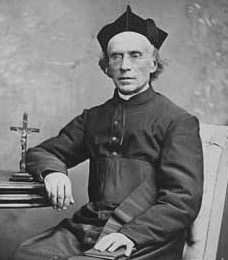
Father Augustin Ravoux

Fr. Augustin Ravoux was born on January 11, 1815, in Auvergne, France.[1] He was one of seven seminarians recruited to America. Fr. Ravoux faced many difficulties. There were no developed roads, and he nearly drowned in the Mississippi on a trip to Dubuque, and nearly died of thirst crossing the prairies to Ft. Pierre. He was ordained in Dubuque, Iowa in January 1840.[2]

He was assigned to St. Gabriel’s in Prairie du Chien, but in September of 1841, Fr. Ravoux was asked to visit various outposts in the northern part of the diocese in Minnesota and Dakota Territories to see if a mission for the Indians might be established.[3]

Fr. Ravoux, a subdeacon, and others, went up the Mississippi and reached its juncture with the Rivière Saint-Pierre (St. Peter’s River). He found Catholic families living in Mendota, at that time in Iowa Territory, just across the valley from Fort Snelling, which was in Wisconsin Territory.[4]

Fr. Ravoux quickly realized he would have little success in converting the Dakota Indians unless he could converse directly with him. Luckily, Jean-Baptiste Faribault, his wife, Elizabeth Pelagie Airse (who was half Dakota) and their two sons, Oliver and David, encouraged him. They spoke fluent English and Dakota, as well as French. During the winter of 1842 and early 1843, Fr. Ravoux joined Jean-Baptiste, Elizabeth, Oliver, and David at Little Prairie, now Chaska, Minnesota.

According to Ravoux, he spent the winter of 1842-1843 with Faribaults at “La Petite Prairie” where they had a trading post occupied by their families and a few others. A prolific and influential French Canadian trader who had an established trading post in Little Prairie (present-day Chaska), was an ardent proselytizer and invited Ravoux to his post to continue his linguistic studies. They were very cordial to Fr. Ravoux, and David began to teach him the Dakota language. The Minnesota Handbook by Parker (1857) spoke of Oliver Faribault’s “extensive” trading house at Chaska, settled “primarily by Canadians, most of whom left with him” sometime before Holmes’s arrival in 1851.[5]

No maps show the post, and fur trade records consulted refer vaguely to posts “at” Little Rapids, which may or may not have included Little Prairie (Chaska). When the speculators bought up Thomas A. Holmes’s claims in Chaska, they found the site already cleared, with evidence of prior occupation and cultivation. Strawberries and asparagus were abundant; there were “indications of a garden and quite extensive buildings having once existed near the bend of the river.” Later excavations on the sites turned up artifacts, including gun parts and iron tools, suggesting a prior European occupation, possibly of late eighteenth century vintage.[6]

This would probably be the Little Rapids trading post established by Jean-Baptiste Faribault of the Machilimackinac Fur Company and the Northwest Fur Company, which was visited by fur traders, Dakota Indians, and Christian missionaries over the next 45 years. The Wahpeton Village, ca. 1800-1851, was above the rapids, and the Lewis and Clark map of 1806 showed a “Sioux” village on the west bank of the Rivière Saint-Pierre (St. Peter’s River), near Carver.[7] The Minnesota Democrat in 1852 noted in passing that Chaska “is an old but abandoned Sioux town site.”

Thomas A. Holmes’s 1851 license allowed him to establish a trading post near there. The site would be well-suited to native settlement because its access to the river and position on the Can ki-yu-te O-can-Ka and the tinta (or the big woods and the prairie transitional zone). The Faribault Trading Post in Chaska probably would be somewhere inside the existing levee.

Fr. Ravoux said that he was amazed how easily he mastered the Dakota language, and that it was so much harder when he had learned Latin and Greek. With Jean-Baptiste Faribault and the family helping, Fr. Ravoux started learning the language. He translated and published a little devotional work, Katolik Wocekiye Wowapi Kin, or The Path to the House of God.[8] The book was translated from French to Dakota by Alexander Faribault and his brothers Oliver and David.[9]

Jean-Baptiste urged the priest to establish a permanent Roman Catholic mission at the site.[10] Details about the short-lived mission are scanty. Fr. Ravoux built a small log cabin and named the parish St. Francis Xavier.[11] The mission was almost certainly located near the Faribault compound at Little Prairie. It is more likely that he stayed with the Faribaults, rather than in the nearby Wahpeton village. The Wahpeton village was located between Chaska and present-day Carver.[12] The dimensions of the chapel were 15 x 30 feet.[13] Presumably, it was of log construction, similar or identical to the Faribault Trading Post. It was probably built in the style of la maison en pièce sur piècela, or a cabin but of hewn logs, laid horizontally.

The chapel was located for a very short time in Little Rapids. Then, when Oliver Faribault and Wakan Yanke moved to Prairie des Français (French Prairie), also known as Tiŋta-otoŋwe, Fr. Ravoux also moved the chapel there. It was probably located close to the Faribault Trading Post, near the Springs later called Faribault Springs. The Dakota Indians saw the European immigration as a threat, and so the Dakota threatened to burn the chapel down within the year.[14] As a result, the chapel was sold to the German Catholics in Wabashah in 1844.[15] Ravoux departed in the spring of 1844, never to return.

The chapel was placed on a raft and floated down the Rivière Saint-Pierre, and was set up on the point where Main Street was terminated in Wabashaw in 1844.[16] (It was called Wabashaw until 1868, where mapmakers and publishers abandoned the letter “w” in the name.) This was the first building for Catholic religious purposes ever erected in Wabashaw. It was used for this purpose for several years, but then went into disuse as a church edifice, probably because of the result of the irregularity of religious services there. The log building was then used for secular purposes. The first newspaper printed in Wabashaw was printed in this building. Later, a school was taught in this place. Finally, the log chapel succumbed to civilization, and today, traces of the old church are obliterated.

Fr. Ravoux described his life as a frontier priest with rich understatement: “Though ever pleased with the mission entrusted to my care by Divine Providence, the path I had to walk in was not always strewn with flowers.”[17]

Fr. Augustin Ravoux died on January 17, 1906.[18]

[1] Coffin, Cindy K. “Fr. Augustin Ravoux (1815-1906).” Find a Grave, 11 Feb. 2011, www.findagrave.com/memorial/65691836.

[2] Luban, Marianne. Lucien Galtier-Pioneer Priest. Pacific Moon Publications, 2nd ed., 2011.

[3] “Augustin Ravoux.” Wikipedia, 18 Feb. 2018, en.wikipedia.org/wiki/Augustin_Ravoux.

[4] Scanlan, Dr. P.R.; Arr. Father U. Killacky. Centennial History of St. Gabriel’s Parish: Prairie du Chien, Wisconsin. Crawford County Press, 1936.

[5] Parker, Nathan Howe. The Minnesota Handbook for 1856-1857, 1857.

[6] Neill, Edward Duffield. History of the Minnesota Valley: Including the Explorers and Pioneers of Minnesota. North Star Publishing Company, 1892.

[7] Spector, Janet D. What This Awl Means: Feminist Archaeology at a Wahpeton Dakota Village. St. Paul: Minnesota Historical Society Press, 1993.

[8] Katolik Wocekiye. Brown & Saenger, 1890. Retrieved from the Library of Congress, lccn.loc.gov/06010756.

[9] Ravoux, Augustin. The Labors of Mgr. A. Ravoux Among the Sioux or Dakota Indians: From the Fall of the Year 1841 to the Spring of 1844. Pioneer Press Company, 1897.

[10] Barac, LaVonne E. Chaska: A Minnesota River City. Chaska Bicentennial Committee, 1976.

[11] Luban, Marianne. Lucien Galtier-Pioneer Priest. Pacific Moon Publications, 2nd ed., 2011.

[12] Holcombe, R. I. Compendium of History and Biography of Carver and Hennepin Counties, Minnesota. H. Taylor & Company, 1914.

[13] Coller, Julius A., II. The Shakopee Story. North Star Pictures, Inc., 1960, p. 13.

[14] Coller, Julius A., II. The Shakopee Story. North Star Pictures, Inc., 1960, p. 13.

[15] Holcombe, R. I. Compendium of History and Biography of Carver and Hennepin Counties, Minnesota. H. Taylor & Company, 1914.

[16] St. Felix Church History. uploads.weconnect.com/mce/dc543d2abbb092d676b4e412354e0d2e0d7bf91b/St.%20Felix%20Church%20History.pdf

[17] Luban, Marianne. Lucien Galtier-Pioneer Priest. Pacific Moon Publications, 2nd ed., 2011.

[18] Coffin, Cindy K. “Fr. Augustin Ravoux (1815-1906).” Find a Grave, 11 Feb. 2011, www.findagrave.com/memorial/65691836.

Revised May 10, 2018.

Sarah-Iréne Faribault

Daughter of Oliver Faribault and Wakan Yanke
1847-May 23, 1924
Compiled by David R. Schleper

Sarah-Iréne Faribault was one of the four girls who grew up at the Faribault Cabin and Trading Post on the Prairie des Français (French Prairie) on the Rivière Saint-Pierre (St. Peter’s River). She was the seventh of nine children of Oliver Faribault and Wakan Yanke, or the Woman Who Sits at the High Place, and was born in 1847. The area later became part of the east part of Shakopee, Minnesota, near Faribault Springs.

Sarah remembered growing up at the Faribault Trading Post. “My father, Oliver Faribault, built a house which was his home and trading post near ‘Little Six’ or Shakopee’s village in 1844.[1] It was a fine point for a trading post, as three Indian villages were near; Good Roads, Black Dog’s and Shakopee’s.[2] He was a very successful trader. I can well remember the great packs of furs.”[3]

“We used to play all around the country near. I could shoot an arrow as well as a boy. The hunting was fine.”[4]

“We used often to go to the sacred stone of the Indians and I have often seen the Sioux[5] warriors around it. It was on the prairie below town. There was room for one to lie down by it and the rest would dance or sit in council around it. They always went to it before going into battle.”

“They left gifts which the white people stole. I can remember taking some little thing from it myself. I passed a party of Indians with it in my hand.” Sarah remembered that one Dakota woman saw what Sarah had, and she became very angry. “She made me take it back. She seemed to feel as we would if our church had been violated.”[6]

“One morning in the summer of ’58 we heard firing on the river.[7] Most of the Sioux[8] had gone to get their annuities but a few who were late were camped near Murphy’s.[9] These had been attacked by a large band of the Chippewa.[10] The fighting went on for hours, but the Chippewa were repulsed. That was the last battle between the Sioux and the Chippewa near here.”[11]

According to Sarah, “Little Crow was often at our house and was much loved by us children. He used to bring us candy and maple sugar.”[12] Little Crow or Thaóyate Dúta (ca. 1810 – July 3, 1863) was a chief of the Mdewakanton Dakota people. His given name translates as “His Red Nation,” but he was known as Little Crow because of his grandfather’s name, Čhetáŋ Wakhúwa Máni, (literally, “Hawk That Chases/Hunts Walking”) which was mistranslated by the whites to Little Crow.[13] Thaóyate Dúta would stop on his way from St. Paul and usually camped with his attendants on the vacant prairie opposite the Faribault Trading Post in the area later called Shakopee. By 1840, Oliver was closely allied with the Dakota Chief Ŝakpe II, and maintained kinship ties with other Dakota families as well. According to Sarah, “My father (Oliver Faribault) was fond of him too, and said he was always honest.”

Sarah understand how the Dakota Indians feel, not just because she was part Dakota, but also because she lived around the 600 people at Tiŋta-otoŋwe. “The Indians did not understand the white man’s ways. When the white man had a big storehouse full of goods belonging to the Indians and the Indian was cold and hungry, he could not see why he could not have what was there, belonging to him, if it would keep him warm and feed him. He could not see why he should wait until the government told him it was time for him to eat and be warm, when the time they had told him before was long past. It was the deferred payments that caused the outbreak, I have often heard from the Indians.”[14]

“I have often seen Indians buried on platforms elevated about eight feet on slender poles. They used to put offerings in the trees to the Great Spirit and to keep the evil spirits away. I remember that one of these looked like a gaily colored umbrella at a distance. I never dared go near.”[15]

Sarah never married. She lived with the family, and then resided at the E.L. Welch family, first in Henderson, and then in St. Paul for almost 22 years. She also had a long association with the D.L. How household as a trusted, faithful friend and nurse.[16] She died in 1924 at age 74. She was interred in the How family lot in Valley Cemetery in eastern Shakopee.[17]

[1] The village is Tiŋta-otoŋwe, translated to prairie village. Ŝakpe II (ca. 1794-1862) and Ŝakpedan or Little Six (1811-1865) were head men there.

[2] The village of Good Roads was near the mouth of the Nine Mile Creek was Titaŋka Taŋnina, the village of Penichon. It was also called the old village, and it was probably the first village of the Dakota on the river, according to Mni Sota Makoce: The Land of the Dakota by Gwen Westerman and Bruce White, Minnesota Historical Society, page 126. The chief was Tacaŋku Waste, or His Good Road. The village of Black Dog’s was called Ohanska, Long Avenue Village or Black Dog’s village. Village chiefs included Waŋbdí Tháŋka (Wa-kin-yan-tan-ka) or Big Eagle, Sunka Sapa (Black Dog), and Maza Hota (Gray Iron) according to the Dakota Presence in the River Valley, 2002, by Shakopee Mdewakanton Sioux Community.  Shakopee’s village is Tiŋta-otoŋwe, with chiefs Ŝakpe II and Ŝakpedan.

[3] Morris, Lucy Leavenworth Wilder, editor (1914). Miss Sara Faribault in Old Rail Fence Corners: The A.B.C.’s of Minnesota History (Second Edition). Austin, MN: F.H. McCulloch Printing, p. 233.

[4] Morris, Lucy Leavenworth Wilder, editor (1914). Miss Sara Faribault in Old Rail Fence Corners: The A.B.C.’s of Minnesota History (Second Edition). Austin, MN: F.H. McCulloch Printing, p. 233.

[5] The people are Eastern Dakota Mdewakaŋtoŋwan, pronounced Mid-ah-wah-kah-ton, meaning “The Spirit Lake People” band.

[6] Morris, Lucy Leavenworth Wilder, editor (1914). Miss Sara Faribault in Old Rail Fence Corners: The A.B.C.’s of Minnesota History (Second Edition). Austin, MN: F.H. McCulloch Printing, p. 233.

[7] In May 27, 1858, between 150 and 200 Ojibwe warriors entered the Minnesota River valley near Shakopee hoping to ambush a nearby group of Dakota. Ojibwe warriors fired gunshots and kill a Dakota man fishing in the river around 5:00 am, starting the Battle of Shakopee, which was on the north side of the river in Chanhassen. It lasted for five hours, until the Ojibwe retreated and moved north toward Lake Minnetonka. From Reicher, Matt. “Battle of Shakopee, 1858.” MNopedia, Minnesota Historical Society. http://www.mnopedia.org/event/battle-shakopee-1858 (accessed Aug. 2, 2017).

[8] The correct name of Sioux is the Mdewakantonwan (Bdewékhaŋthuŋwaŋ Spirit Lake Village of the Eastern Dakota who lived in Tiŋta-otoŋwe.

[9] In 1853 Murphy settled in Eagle Creek Township just east of early Shakopee, where he built a large two-story house and hotel. It became a mecca for travelers, with good food, drink, merry dancing. Richard G Murphy had the exclusive right for 15 years to operate a ferry across the Minnesota at a point known as Murphy’s Ferry in 1853. Murphy unfailingly collected his fare in mid-steam, even during the Battle of Shakopee, which was fought less than a hundred yards from his home.

[10] The correct name of the Chippewa is the Ojibwe, an Anishinaabeg group of indigenous peoples in North America. They live in Canada and the United States. The Ojibwe people traditionally have spoken the Ojibwe language, a branch of the Algonquian language family.

[11] Morris, Lucy Leavenworth Wilder, editor (1914). “Miss Sara Faribault” in Old Rail Fence Corners: The A.B.C.’s of Minnesota History (Second Edition). Austin, MN: F.H. McCulloch Printing, p. 233.

[12] Morris, Lucy Leavenworth Wilder, editor (1914). “Miss Sara Faribault” in Old Rail Fence Corners: The A.B.C.’s of Minnesota History (Second Edition). Austin, MN: F.H. McCulloch Printing, p. 233.

[13] https://en.wikipedia.org/wiki/Little_Crow

[14] Morris, Lucy Leavenworth Wilder, editor (1914). “Miss Sara Faribault” in Old Rail Fence Corners: The A.B.C.’s of Minnesota History (Second Edition). Austin, MN: F.H. McCulloch Printing, p. 233.

[15] Morris, Lucy Leavenworth Wilder, editor (1914). “Miss Sara Faribault” in Old Rail Fence Corners: The A.B.C.’s of Minnesota History (Second Edition). Austin, MN: F.H. McCulloch Printing, p. 233.

[16] David Lennox How (1835-1893) was involved in several projects in Shakopee, including setting up a drug store, and a mill in Jordan, Chaska, and Shakopee. He married Mary Sherrard in 1862. They had one child, Jennie. This information from The Shakopee Story by Julius Coller II, 1960.

[17] Billion Graves site at https://billiongraves.com/grave/Sarah-Faribault/1526925

Oliver Faribault

May 15, 1815 – Oct. 4, 1850
In Prairie des Français (later called Shakopee) 1839-1850
Compiled and Written by David R. Schleper

Oliver Faribault was born at Prairie du Chien, now in Wisconsin, on May 15, 1815.[1] His father was Jean-Baptiste Faribault, a well-known French-Canadian fur trader with the Northwest and American Fur Companies. His mother was Elizabeth Pelagie Kinzie Haines. (Her name is spelled differently in various documents.) Pelagie was the daughter of a French voyageur and Mdewakanton mother, so Oliver was at least ¼ Dakota.

Oliver’s older siblings were Alexander and Lucie-Anne. His younger siblings were David-Frederick (David), Emilie (Emily), Marie-Louise (Mary Louise), Philippe (Philip) and Frederick-Daniel (Daniel). Among them, only Philip didn’t grow up to adulthood.[2]

In 1804-1805, not far upstream on the Rivière Saint-Pierre (Minnesota River) from present day Carver, the Little Rapids trading post was established. It was first operated by Jean-Baptiste Faribault of the Machilimackinac Fur Company and the Northwest Fur Company and visited by fur traders, Dakota Indians, and Christian missionaries over the next 45 years. The early map indicated that this Indian village was associated with Dakota leader Mazomani.[3]

Jean-Baptiste lived among the Wahpeton community for a few months each year with his Dakota wife, Pelagie. The villagers brought their tanned furs, and their maple sugar to the Trading Post. Faribault would give them glass beads, silver ornaments, tin kettles, iron knives, awl tips, axes, hatchets, and hoes for their summer work. Faribault was there for many years, and he probably enjoyed amicable relations with the community. According to Janet D. Spector, “Faribault probably strengthened his connection to Little Rapids by his marriage to Pelagie Hanse, the twenty-two-year-old widow of a former superintendent of Indian affairs and the mixed-heritage daughter of trader Francois Kinzie.”[4] She and Faribault had several children, including Oliver, and through her, Jean-Baptiste would acquire knowledge about Dakota language and culture, further enhancing his role as cultural middleman at Little Rapids. Oliver spent time at Little Rapids trading post learning the procedures of the fur trade.

In 1819, the Faribault family settled on Pike Island near a new fort, Fort Snelling, at the mouth of the Rivière Saint-Pierre. They were invited to do this by Colonel Henry Leavenworth, who knew that Jean-Baptiste understood the Dakota who lived in the area and could help develop the fur trade in Minnesota. The Dakota were also more likely to trust people who were related to members of their tribe. The family built a log house and farmed. Oliver and his siblings also helped their father with his fur trade business.

In 1826, the family moved off the island and built a home on the river bank in what was to become Mendota, Minnesota and traded with the Dakota.

Although Oliver was friends with the Dakota, and was part Dakota, pioneer life on the frontier was dangerous. When he was only 14 years old, Oliver had to defend his father’s life when Jean-Baptiste was attacked by a Dakota:

“On one occasion for a trivial matter an Indian plunged a knife into [Jean-Baptiste] Faribault’s back, but his vigorous constitution and temperate habits carried him through. The Indian, however, was summarily shot by one of Faribault’s son, Oliver, a boy of fourteen.”[5]

Jean-Baptiste also purchased a female slave, even though slavery had been outlawed in the region for well over a decade by the Missouri Compromise of early 1800s. That slave had a child, Joseph Godfrey, who was enslaved, and who ended up in Shakopee, as a slave to Oliver and Wakan Yanke. Joseph Godfrey escaped from the Faribault Trading Post around 1848.[6]

Working for the American Fur Company, Oliver was busy doing almost every job that could be done on the new frontier. He was a trader, a clerk for the Fur Company, and, along with his brothers, earned money as whiskey smugglers in the 1830s. Fur traders could do this well because they always traveled from one place to another.

Oliver married Wakan Yanke, or Harriet Menary, in a civil or Indian ceremony in 1837. Wakan Yanke was a close relative of Chief Ŝakpe II.

Oliver was at Prairie des Français on a semi-permanent basis starting in 1839, as he was appointed government farmer to the Dakota Indians at Tiŋta-otoŋwe, according to Taliaferro Journal, June 11, 1839.[7] This was probably the year that Tiŋta-otoŋwe moved from the north to the south side of the Watpá Mnísota, also called the Rivière Saint-Pierre. His personal history, his occupations as a farmer and trader, and his dwelling location were not part of the history of the Minnesota valley area. According to a report, he had nine oxen, four cows, three horses, one bull, one cart, one wagon, two yokes, and bows, two single plows and two double plows.[8]

According to Rev. Samuel Pond, the assigned farmers for many of the villages were not very good, and were soon replaced. This might be the case for Oliver. “The first farmer for the Shakopee band got along several years without doing anything for the Indians except that now and then he gave a present to the chief. He used their wagons and carts for his own business, and let their cattle starve to death, and some of the other farmers did not do much better.”[9]

By 1842, Oliver was back at Little Prairie.[10]

On Feb. 11, 1844, Oliver married Wakan Yanke at the St. Francois Xavier Sioux Mission, located at Little Prairie on the St. Pierre River.[11]

In 1844 Oliver moved to Prairie des Français with Wakan Yanke, or Woman Who Sits at the High Place.[12] They lived among the large circle of Wakan Yanke’s Dakota relatives. The Faribault trading post and cabin was surrounded by tipi and tipi tanka, or lodges. Oliver and Wakan Yanke had nine children, and in Prairie des Français (Tiŋta-otoŋwe), the four daughters who lived there included Josephine, Pelagie (Eliza), Sarah-Irene, and Henriette Luce (Harriet).[13]

Pelagie Eliza Faribault Manaige remembers her father conducting a trading post for a few years, and building a warehouse in which he stored furs purchased from the Dakotas. She only faintly remembered her father, as he died in the fall of 1850 of quinsy, when Eliza was 4 ½ years old. Eliza remembered the gaudy trinkets that were available to the Dakota Indians.[14]

Faribault had a horse and a cow. The horse and cow lived in a small cow shed just south of the log cabin in Prairie des Français. Father Augustin Ravoux, who for a short time built a chapel near the Springs, refers to borrowing Oliver’s horse. And Rev. Samuel W. Pond once hid his own cow. That caused Faribault’s cow to be killed by a Dakota Indian. Family oral tradition also tells of storing furs in the shed, and of a mixed-blood employee of Faribault’s who guarded the furs kept there.[15]

When Oliver lived in the Faribault Trading Post in 1844, it was in the last decade of the fur trade in the Minnesota Valley before the onslaught of settlers who irrevocably changed the history of the area forever. Rather than being a primitive fur trader in buckskins, beads, and feathers, Oliver was a gentleman who wore silk and sateen sometimes, and a man who provided for his family with the best that was available to him in the 1840s.[16]

Ledgers by Henry Sibley at the Mendota trading headquarters show Oliver’s purchases of food, fabric, clothing, as well as agricultural pursuits, lumber purchases, furnishings for his home, repair done by the fur company’s blacksmith, purchases for his hired men and for Joseph Godfrey, who was enslaved.[17]

Oliver Faribault died Oct. 4, 1850.[18] He contracted quinsy while digging out Faribault Springs. Quinsy is an abscess between the back of the tonsil and the wall of the throat. Quinsy is now rare because most people get effective treatment for tonsillitis early enough to prevent it, but in 1850 quinsy often led to death.

Oliver is buried at Calvary Cemetery, in Faribault, Rice County, Minnesota.[19]

[1] Find A Grave Memorial #49026654 on Oliver Faribault by Cindy K. Coffin, March 2, 2010.

[2] Interview of Patricia Jeanine Menaige Cates by David R. Schleper (2016) in Prior Lake, MN.

[3] Spector, Janet D. (1993). What This Awl Means: Feminist Archaeology at a Wahpeton Dakota Village.  St. Paul: Minnesota Historical Society Press.

[4] Spector, Janet D. (1993). What This Awl Means: Feminist Archaeology at a Wahpeton Dakota Village.  St. Paul: Minnesota Historical Society Press.

[5] Curtiss-Wedge, Franklyn (1910). History of Rice and Steele Counties, Minnesota. Chicago, IL: H.C. Cooper, Jr. & Company, p. 84.

[6] Bachmann, Walt (2013). Northern Slave, Black Dakota: The Life and Times of Joseph Godfrey. Bloomington, MN: Pond-Dakota Press.

[7] Williams, Richard (2000). Oliver Faribault and Early Settlement at Faribault Springs. HSP Journal: The Journal of La Compagnie des Hivernants de la Rivière Saint-Pierre, p. 11.

[8] Williams, Richard (2000). Oliver Faribault and Early Settlement at Faribault Springs. HSP Journal: The Journal of La Compagnie des Hivernants de la Rivière Saint-Pierre, p. 12.

[9] Pond, Samuel William Jr., 1893). Two Volunteer Missionaries Among the Dakotas: Or The Story Of The Labors Of Samuel W. And Gideon H. Pond. Boston: Congregational Sunday-School and Publishing Society.

[10] Williams, Richard (2000). Oliver Faribault and Early Settlement at Faribault Springs. HSP Journal: The Journal of La Compagnie des Hivernants de la Rivière Saint-Pierre, p. 12.

[11] Find A Grave Memorial # 49026654 on Oliver Faribault by Cindy K. Coffin, March 2, 2010.

[12] Hinds, William (1891). A Sketch of Shakopee, Minnesota: Historical and Industrial. Shakopee, MN and Reprinted by the Shakopee Heritage Society, pp. 9-10.

[13] Interview of Patricia Jeanine Menaige Cates by David R. Schleper (2016) in Prior Lake, MN.

[14] Winter, Marian B. (2003). A Visit with a Great-Granddaughter of Oliver Faribault. La Compagnie des Hivernants de la Rivière Saint-Pierre (HSP) Journal. From a working scrapbook 3061B in 1930s, and in the Sibley House Museum and the Minnesota Historical Society collections.

[15] Minnesota History Quarterly, Fall 2015. 64:7

[16] Williams, Richard (2000). An Analysis of the Purchases of Oliver Faribault, 1842-1846. HSP Journal: The Journal of La Compagnie des Hivernants de la Rivière Saint-Pierre, p. 5-8.

[17] Williams, Richard (2000). An Analysis of the Purchases of Oliver Faribault, 1842-1846. HSP Journal: The Journal of La Compagnie des Hivernants de la Rivière Saint-Pierre, p. 5-8.

[18] The Shakopee Argus, Nov. 11, 1880, p. 4, col. 1, obituary.

[19] Find A Grave Memorial # 49026654 on Oliver Faribault by Cindy K. Coffin, March 2, 2010.

Wakan Yanke (Woman Who Sits at the High Place) (ca. 1817-Nov. 7, 1880)

In Prairie des Français on the Rivière Saint-Pierre 1844-1880
by David R. Schleper

Wakan Yanke, or the Woman Who Sits at the High Place, was born in the Minnesota Valley area around 1817 among the large circle of her Dakota relatives. According to some researchers, Wakan Yanke was the daughter of Colonel Menary, a soldier at Fort Snelling, Minnesota, and a “Sioux Indian girl.” Wakan Yanke was a close relative of Chief Ŝakpe II.

According to Patricia Jeanine Arnold Cates, the great great granddaughter of Wakan Yanke, her relative might be a full Dakota Indian.

Wakan Yanke grew up as a Mdewakaŋtoŋwaŋ, or an Eastern Dakota member of the Spirit Lake People. She lived along the Watpá Mnísota (or Minnesota River) Valley. Wakan Yanke played with others, helped her family, and sometimes went hunting or fishing. She played with dolls and toys, and she sometimes played Ta-ka-psi-ca-pi, meaning “ball game” and now called lacrosse.

Wakan Yanke, wore long deerskin or elk skin dresses and moccasins on her feet. She also wore buffalo-hide robes in bad weather. Over time, Wakan Yanke learned how to sew clothing using material from the fort.

Dakota women, like Wakan Yanke, were in charge of the home. Besides cooking and cleaning, she helped build her family’s house and dragged the heavy posts with her whenever the tribe moved. Later, when she was married, Wakan Yanke became in charge of the log cabin built in Tiŋta-otoŋwe near the springs at Prairie des Français on the Rivière Saint-Pierre. Houses belonged to the women in the Dakota tribes. Wakan Yanke also took part in storytelling, artwork and music, and traditional medicine.

In 1837, she married Oliver Faribault in a civil/Indian ceremony.

Many traders and voyageurs, like Oliver, married into American Indian communities and utilized kinship networks, often trading exclusively within their particular community. “As a result, large communities of individuals of diverse heritage developed, often called ‘mixed-bloods’ or Métis during the period, and many of these individuals maintained ties to both the fur trade and American Indian communities.” Oliver was at least ¼ Dakota, and Wakan Yanke was either full Dakota or half Dakota.

As part of the settlement in an 1837 treaty, each Mdewakanton Dakota village was to receive an assigned farmer to teach them the benefits and techniques of “modern agriculture.” Oliver was assigned to Tiŋta-otoŋwe in the spring of 1839. Wakan Yanke probably stayed at Little Rapids.

Lawrence Taliaferro was a United States Army officer and an Indian agent at Fort Snelling. In Taliaferro Journal, June 11, 1839, he wrote:

“Under terms of the treaty of 1837, each Mdewakanton village was to receive an assigned farmer to teach them modern farming. Oliver’s close relationship with Ŝakpedan, also known as Little Six, led to his being assigned to that position in the spring of 1839.”

In Taliaferro Journal, June 17, 1839, and Aug. 13, 1839:

“Taliaferro recorded that Oliver had nine oxen, four cows, three horses, one bull, one cart, one wagon, two yokes, and bows, two single plows and two double plows.”

It was during this period that Tiŋta-otoŋwe moved from the left bank to the right bank of the Minnesota River. Exact year of the village removal has not been determined.

On Feb. 11, 1844, Oliver married Wakan Yanke, also called Henriette Menegre or Menary, in a religious ceremony (after the 1837 civil/Indian ceremony) at the St. Francois Xavier Sioux Mission, located at Little Prairie on the Rivière Saint-Pierre (St. Peter’s River.) Wakan Yanke spoke Dakota and French, and a bit of English.

Together, they had nine children:

  • Gabriel Olivier Faribault (1838-Dec. 1859)
  • Olivier Emile (born about 1840)
  • Angelique (birthdate unknown)
  • Mary Josephine Jessie (born 1842)
  • Jane Luce (born 1843)
  • Pelagie Eliza (Aug. 27, 1845-Dec. 1, 1937)
  • Sarah-Iréne (born 1847-May 23, 1924)
  • Henriette Luce (born 1848)
  • Lauren Philippe (born 1850)

Gabriel Olivier Faribault, who was born in 1838, probably was with Pelagie’s siblings, as is often done with young Dakota boys, in order to learn the Dakota way of living. He died in December of 1859. Oliver Emile, Angelique, Henriette Luce, and Lauren Philippe all died in infancy or early childhood.

In 1844, Wakan Yanke and Oliver built and established a trading post near three springs, later called Faribault Springs, in the midst of Tiŋta-otoŋwe, a Dakota summer planting village in what was later the east part of Shakopee. The cabin and adjacent warehouse were built on the west side of Faribault Springs, using tamarack logs which were obtained from a swamp nearby.

Oliver Faribault was in his early thirties and Wakan Yanke was about 27 years old when they moved into the area. Mary Josephine Jessie, their daughter, was two years old, and Wakan Yanke was also pregnant with another daughter, Pelagie, who was born in 1845.

Wakan Yanke spent her time as a mother and wife. She took care of Mary Josephine Jessie and Pelagie Eliza, along with Sarah-Iréne and Henriette Luce. Her last child, Lauren Phillippe, died in infancy in 1850. According to purchases in 1845-1846, the log cabin included a cook stove, and from 1842-1845 kitchen utensils included a pitcher, a coffee pot, a wrought iron tea kettle, four tin pans, three tin dishes, a set of blue cups and saucers, a dozen plates, six blue plates, four blue bowls, and a broom.

Oliver died on Oct. 12, 1850, after contracting quinsy while digging out Faribault Springs. Quinsy is an abscess between the back of the tonsil and the wall of the throat. Quinsy is now rare because most people get effective treatment for tonsillitis early enough to prevent it, but in 1850 quinsy often led to death.

The girls were still very young when their father died. Their mother, Wakan-Yanke (Harriet), remained in the home and raised the four girls, Josephine, Pelagie, Sarah, and Harriet. Wakan Yanke preempted a quarter of the land in 1856, but gradually was forced to sell small parcels of it.

Wakan Yanke, also known as Harriet Menegre/Menary Faribault, died of typhoid fever on Nov. 7, 1880. According to the Shakopee Argus, she had been unwell for weeks, but during the past ten days she was apparently improving.

The obituary noted the following:

“Mrs. Harriet Faribault died at her residence in East Shakopee, Monday last. She had been unwell for weeks, but during the past ten days was apparently improving. Except to old settlers she was unknown, of late years never leaving her residence. She was a full-blooded Sioux, but married David Faribault, a Frenchman. He died at Shakopee in 1853. Since then she has lived just at the outside of the city with her daughters. She was probably born at or near this place before visited by white man.”

A few notes about the obituary include that Wakan Yanke was full-blooded Dakota (which is probably true). She did not marry David Faribault, but Oliver Faribault, who was a brother of David. Oliver (and David) were ¼ Dakota, and were also French Canadians who were born in Prairie du Chien, now in Wisconsin. Oliver died Oct. 12, 1850 (not 1853). And the Faribault Post was inside the limits of Shakopee, on the east side just west of Memorial Park.

Eventually, the logs of the original house built by Oliver and Wakan Yanke were covered with wood frame siding. The house was lived in by the Faribault family until the 1949 and was moved to Murphy’s Landing in 1969. Now a historic site, the house is used to interpret the fur trading era at The Landing in Shakopee.

Cordelia Eggleston Pond

Compiled and written by David R. Schleper, 2020

It was the beginning of November 1847. Cordelia Eggleston Pond, along with her husband, Samuel W. Pond and their children, Jennette, age five, Rebecca, age three, and baby Elnathan, just a month old, arrived at Tínṫa Otuŋwe, which Samuel called Prairieville.

They moved into the mission house, which had been built on a gently rising ground, about a half mile south of the Rivière Saint-Pierre (St. Peter’s River) over the last few months. According to Samuel Pond, Jr., the mission house was “about half a mile south of the Minnesota River.”

What was Cordelia Eggleston Pond thinking as she looked at the Faribault Trading Post, the Dakota village of 600 people, and the mission house, right in the middle of it all? There were no white families except for Hazen P. Mooers and for the missionaries who lived 14 miles away at Oak Grove. Around her were 600 men, women, and children of the Eastern Dakota Mdewakaŋtoŋwaŋ, or the Spirit Lake People. As a missionary, Cordelia focused on caring for her children, keeping house, and feeding the family, along with ministering to the Dakota.

Cordelia Eggleston was born Nov. 22, 1815, in the small community of Stafford, just outside of Batavia, New York. Cordelia’s father, Esquire Ebenezer Eggleston, died eight weeks earlier. Her mother was Anna Kingsley Eggleston, who was left a widow with eight children. When Cordelia left home in 1837, she unlikely saw her mother again, as she died in 1843.

Cordelia’s older sister, Julia, married Rev. Jedediah Stevens, and eventually their mission station was at Lake Harriet Mission. Cordelia decided to join them there.

According to Samuel Pond, Jr., “…a sister of Mrs. Stevens, Miss Cordelia Eggleston, then a young lady of twenty-two, had joined the Lake Harriet Mission in the capacity of teacher. She was a great favorite with her sister, Mrs. Stevens, who had long and diligently laid her plan to have her younger sister associated with her at her work in the Indian country, and was much elated with her success.”

“The lady commended herself to all by her amiable character, modest demeanor, and personal attractions….

“During the spring and summer following Mr. Pond’s return to Bde Maka Ska, he saw much of this young teacher and the acquaintance resulted in a marriage engagement after a brief courtship in the beautiful groves bordering the lovely lake,” said Samuel Pond Jr.

On Nov. 22, 1838, Samuel W. Pond married Cordelia Eggleston near the Mission Boarding School near Bde Maka Ska. It was attended by anyone of importance in the territory, including U.S. Army doctor John Emerson, owner of Dred Scott (who was living at Fort Snelling), political, civil, and military, and groomsman, Henry H. Sibley, and Rev. J.D. Stevens, whose wife was a sister of the bride.

In 1847 the family moved to Prairieville. Cordelia and Samuel had four children, Jennette, Rebecca, Elnathan, and Samuel Jr. According to Samuel, “… though we have endeavored to have as little property exposed as possible we are obliged to be continually on the watch. My wife had been only a mile from home in three years, and when the Indians are here, I seldom go out of sight of the house unless I am obliged to do so.”

According to Samuel, “…the young mother (Cordelia), never very strong, gradually failed in health from that time. The oldest girl, Jennette, now eight years of age, was a great comfort and help to her mother, whom she was said to resemble closely in both character and person. She was morbidly conscientious and must have been rather precocious, since she had finished reading the Bible through by course before she was six years of age.”

In the fall of 1851, Samuel obtained from the Board a year’s leave of absence and prepared to visit New England. The journey was a fatiguing one, as much of it was by stage. In Connecticut, kind friends “took charge of the four children, for their mother was rapidly failing, and by the first of February it was evident that the end was near.”

The dying mother, Cordelia, expressed a desire to see all her children once more, knowing that it would be the last time in this world. “To the older ones she gave words of counsel which were carefully heeded and diligently followed. Jennette Clarissa never forgot her mother’s parting words. Mr. Edward Pond went over the icy hill and brought Elnathan Judson from his aunt Jennette’s, to receive his mother’s last kiss and listen to her dying words. She told him to be a good boy and love God. To the youngest, she said, ‘Poor boy! He will not remember his mother!’ and kissed him farewell.”

Before the dawn of the sixth day, Cordelia passed away at the age of 36 years, fourteen of them spent in continuous service of the Dakotas. The tombstone of Cordelia Eggleston Pond is at the Old Judea Cemetery, Washington, Litchfield County, Connecticut.

Samuel, widowed at age 43, was left with four young children. He remarried an old school friend, Rebecca Susan Smith, in Connecticut about two months after Cordelia’s death. They returned to the mission in Shakopee, where Rebecca, Samuel’s second wife, died on July 9, 1891. Samuel joined her in death on Dec. 12, 1891, at the age of 83.

PDF Brochure

Rev. Samuel William Pond

April 10, 1808 – Dec. 12, 1891
In Prairieville/Sha K’Pay/Shakopee 1847-1909
by David R. Schleper

Rev. Samuel W. Pond, Jr.

Samuel Pond and his brother, Gideon, arrived in 1834 in the area later called Minnesota. He was a missionary, language translator, agricultural instructor, carpenter, farmer, and ongoing advocate for fair treatment of American Indians.

As Samuel got off the steamboat, he asked someone how to say, “What is this?” in Dakota.[1] As he wrote this down, he walked over to a Dakota and asked, “Ka taku he,” pointing to a horse that was near the steamboat landing.[2] (This would sound like “gay-dah-koo-hey.”)

“Hé šúŋkawakȟaŋ héčha,” the man responded.

And Samuel Pond quickly wrote down the word for horse, šúŋkawakȟaŋ. And Samuel continued, doing this for years, eventually creating the Pond-Dakota alphabet, which is still used today.

Shortly after, Samuel and his brother began teaching Euro-American farming to Dakota people near Bde Maka Ska (Be-DAY Mah-Kah Ska) in present-day Minneapolis.[3] The brothers continued to work on the Dakota dictionary. Samuel noted, “The language was a game I went to hunt, and I was as eager in the pursuit of that as the Indians were in pursuit of the deer.”

After a brief engagement, Samuel W. Pond married Cordelia Eggleston on Nov. 22, 1838.

In 1847, after accepting the invitation from Ŝakpe II to locate in Tiŋta-otoŋwe, Rev. Samuel W. Pond began preparing for the building on the mission house. Materials were purchased at Point Douglas in Wisconsin. The timbers were framed and the materials were prepared at Fort Snelling, and then, as the ice melted, the timbers were loaded on a barge and brought up the St. Peter’s (Minnesota) River to the location at Tiŋta-otoŋwe, which Samuel W. Pond called Prairieville.

The Mission House was built in the middle of Ŝakpe II’s village of Tiŋta-otoŋwe, where approximately 600 Dakota lived in tipi tanka (or bark lodges). It was a busy place, and Pond decided to surround the Mission House and front garden with a fence of tall stakes to prevent the Dakota from claiming a portion of the crops that Pond’s family planted.

In November of 1847, after working on the Mission House during the spring and summer, Samuel, Cordelia, and their three children moved into their new home. Jeanette was five years old; Rebecca was three, and baby Elnathan was scarcely a month old when they moved in. (Samuel, Jr. was born a few years later.) Elnathan remembered in 1925, “There were no white children excepting my brother, my two sisters, and myself….I recall that white men were a rare sight, and our childish eyes grew round with wonder when we saw one!”

Samuel W. Pond described the site: “The mission house at Shakopee was pleasantly located on gently rising ground, about half a mile south of the Minnesota River. At a distance of twenty rods or so to the West was the house of Oliver Faribault. Between these two dwellings was a ravine through which ran a never failing spring of clear cold water…” Tiŋta-otoŋwe, the village of the Dakotas, was south of the mission house and was nearby. The Mission House was “…sufficiently commodious, carefully and comfortable built, although inexpensive in all its appointments. The walls were carefully filled with moistened clay, making them probably bullet-proof and rendering the house very warm.”

Samuel and his brother Gideon both resigned from the Dakota Mission after the Treaties of 1851 removed all of the Dakota people to the Upper and Lower Sioux Agency reservations in western Minnesota.

Samuel became the founding pastor of the first Presbyterian Church in the rapidly growing city of Shakopee, Minnesota. He served as pastor for thirteen years. Samuel died on Dec. 12, 1891, at the age of 83.

The wood frame Pond Mission House was razed in 1907. The foundation is still there, across the road from Memorial Park in East Shakopee. A historic marker tells about the Mission House and Reverend Samuel W. Pond.

[1] This is an imaginary response, based on the true story of Samuel W. Pond in Pond, Samuel William (1893). Two volunteer missionaries among the Dakotas: or, The story of the labors of Samuel W. and Gideon H. Pond. Boston, MA: Congregational Sunday-School and Publishing Society.

[2] The he is a question mark. The Dakota do not have periods and marks like in English. So any time someone ends a sentence in he, the person are either being asked a question or someone is be asking a question.

[3] Bde Maka Ska (Be-DAY Mah-Kah Ska) used to be called Lake Calhoun, after John C. Calhoun, a proponent of slavery. He was infamously known for calling slavery “a positive good.” The name of the lake was changed back to the Dakota name of Bde Maka Ska in 2017.

Related Articles

The Night Watchman (July 1, 1893)

By David Schleper

According to Daniel M. Storer’s diary:

“The night watchman got shot at in the night. He saw a couple of fellows in an alley, and he called to them to halt, and they shot at him and ran. The ball went through his hat.”

(From The Diary of Daniel M. Storer from 1849 to 1905: A Pioneer Builder and Merchant in Shakopee, Minnesota by Shakopee Heritage Society, 2003, p. 197.)