Category Archives: People

Andrew and Susan Maria Hazeltine Adams (1854)

By David Schleper

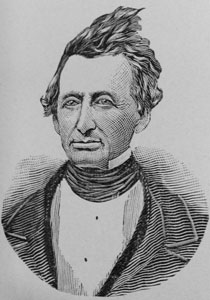
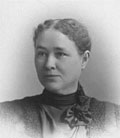
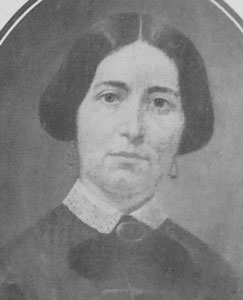
Susan Maria Hazeltine Adams

Susan Maria Hazeltine Adams and her husband Andrew settled in Shakopee in 1854. He was the first county surveyor of Scott County, and she was a schoolteacher. They apparently did not have children when she kept this diary in 1856. She was 29 years old.

March 30, 1856

Delightful prayer meeting…Spent eve in singing and praying. Retired early. (We) talked much about religion etc. after we were in bed.

April 1, 1856

Beautiful morning…I went to school as usual. Wind rose and rain began to fall at noon. It looked dark and threatened a heavy storm. Still I did not dismiss school until the usual time when it began to sleet, hail & snow, in the midst of which marched home. Found a party of Swedes had taken shelter there. Very stormy night. Thought much of my husband and hoped he is in some safe comfortable place…The weather more disagreeable than any I have known for month.

April 5, 1856

Lovely morning. Sun soon thawed the ground. Two years to day bade adieu to Pitt. (Pittsburgh?), perhaps forever. How little I dreamed about any of the changes which should take place during the coming two years. How little I thought my lot would be cast in Minnesota! That I should become the wife of a stranger in so short a time. How different the scenes! What a contrast in my feelings!

April 6, 1856

Cloudy morning but came out very bright & warm by noon…Had much trouble to cross the running brooks on the way. Found blades of grass long & very green. Strawberry leaves in abundance. Oh! Glad sight! Herald of the happy spring time! While at church heard the music of grogs. Good bye to Winter now! Had good prayer meeting…Walked home with A. Sat down by the brook and chatted together. What a pleasure thus to converse of spiritual things! May this joy be ever increasing while we live together.

They lived together another five years. Andrew died in 1861.

(Information from the Minnesota Historical Society, Susan Maria Hazeltine Adams Diary, from Too Hot, Went to Lake: Seasonal Photos from Minnesota’s Past by Peg Meier (1993), Minnesota Historical Society Press, p. 294.)

Spier and Rose Ann Spencer and Spencer Street (1853)

By David Schleper

Spier Spencer was born in Elizabethtown, Spencer County, Kentucky, January 22, 1827. His father was a prominent slave owner. He lived there until age 14, when his father sold his slaves and moved to Boone County, Indiana. The family stayed in Indiana for eight years.

In 1849, accompanied by his only brother, John B. Spencer, he went west and located at St. Paul when that city was still a small village. They worked as carpenters there until 1853. On November 16, 1853, Spier married Rose Ann Spencer at Traverse de Sioux. Rose Ann Spencer was the first white girl who married there. Spier and Rose Ann were cousins.

Traverse des Sioux

For thousands of years, Traverse des Sioux was a crossroads and meeting place. American Indians gathered here to hunt and to use the shallow river crossing. During the 1800s, Europeans and European Americans came to trade furs with the Dakota hunters and to farm the fertile prairie.

In 1851, it was the site of the Treaty of Traverse des Sioux, where the upper bands of the Dakota nation ceded about half of present-day Minnesota to the U.S. government in exchange for promises of cash, goods, and education and a reservation. U.S. government representatives negotiated the first of two treaties with the Sisseton and Wahpeton bands of Dakota. Approximately 24 million acres of Dakota land were transferred to the government and opened to white settlement.

The town of Traverse des Sioux soon grew up around the site with more than 70 buildings, including five taverns, two hotels, and several churches. In 1856, however, nearby St. Peter was chosen as the county seat and by the late 1860s, nothing was left of the once-booming town of Traverse des Sioux.

Spier and Rose Ann sold their farm and moved to Shakopee in 1853. He purchased 1/3 of the town of Shakopee from Thomas Holmes and David L. Fuller. It cost him $4100.

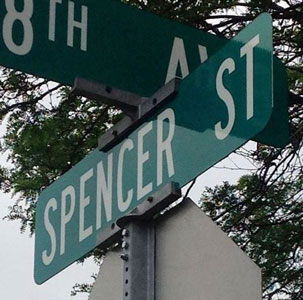
Spencer St. Sign

Spier opened a general store in Shakopee and traded produce and furs with the Indians. In 1855 he built a home on the site later known as the Major Strait farm. He had a side business in 1861 owning and operating a steamboat, Clara Hinds, on the Minnesota River. He was active in the affairs of the rapidly growing village of Shakopee.

In February 1856, with three other men, Spier struck out from Shakopee to stake out and plat a town site in the wilderness. They arrived and staked out the city of Blue Earth. Spier went back to Shakopee, while the other three became the county commissioner, sheriff, and justice of the peace of Blue Earth.

In the fall of 1862 a kernel of wheat struck him in the eye and caused inflammation, resulting in total blindness in one eye. Spier then disposed of the farm, bought a home on Second Street, and opened a private boarding house known as the Union Home. Later he mastered the trade of broom-making and supplied local stores and communities until 1895, when he retired.

Spier Spencer passed away on January 26, 1907 and was buried at Valley Cemetery in East Shakopee.

Rose Ann Spencer was born at Terre Haute, Indiana on April 25, 1834. She was educated at St. Mary of the Woods Convent.

St. Mary of the Woods Convent

In 1852 Rose Ann came to St. Paul with her parents, and she married her cousin and moved to Shakopee. Spier and Rose Ann had six children: George, Julia, Charles, Carrie, Hattie, and Belle.

Rose Ann was of a kind and loving disposition, a kind neighbor, and a loving wife and mother. She died on October 5, 1913. She was one of the pioneer residents of Shakopee, and she was “summoned to enter into the Great Beyond, and a general wave of sorrow swept over the community when his death was announced.”

This information from Shakopee Tribune Nov. 20, 1903 and October 10, 1913, and two obituaries of Spier Spencer: Shakopee Tribune Feb. 1, 1907; and Scott County Argus, Feb. 1, 1907.

Ursula Kennedy Holmes, the First Wife of Thomas A. Holmes (1840s)

By David Schleper

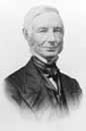
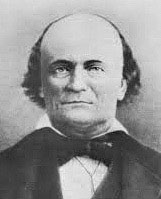
Thomas A. Holmes
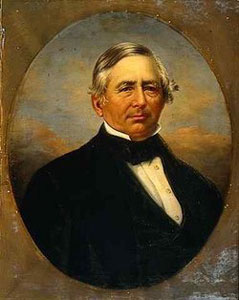
Thomas A. Holmes

Ursula Kennedy Holmes was the first wife of Thomas A. Holmes. But for some reason, very few people ever talked about her. L. Kessinger, who wrote The History of Buffalo County, Wisconsin, said in 1888, “All the parties whom I had a chance to consult with regard to the particulars of the life of Thomas Holmes, himself included, were persistently silent on this one point (concerning Holmes’ first wife)…”

According to Lafayette Houghton Bunnell, in the book, Winona (We-No-Nah) and Its Environs on the Mississippi in Ancient and Modern Days in 1897, “There was a demon of unrest in (Thomas A.) Holmes, partly inherited, and partly the result of a misalliance with a woman entirely unfitted for frontier life.”

Ursula Kennedy was the petted daughter of a hotel keeper of Baltimore, Maryland, and came west with her brother, Robert Kennedy, and his wife and two children. Ursula Kennedy Holmes was much younger than her husband, and no doubt married with an expectation of wealth and a return to her beloved Baltimore. She soon saw that that would never be fulfilled.

Besides her dislike of frontier life, Ursula was subject to periodic attacks that made her frantic with pain. Without an option of a competent doctor, she resorted to the use of opiates, which finally enslaved her. Ursula probably kept a supply of opium paraphernalia such as the specialized pipes and lamps that were necessary to smoke the drug. She would recline in order to hold the long opium pipes over oil lamps that would heat the drug until it vaporized, allowing her to inhale the vapors.

In 1840, Thomas built a strong trading boat of hardwood lumber, partly covered with a deck. After floating down the Rock River over the rapids, he loaded up his goods above the rapids on the Mississippi River, and was towed to Dubuque, Iowa. Holmes stayed in Dubuque for some time while his wife, Ursula, was under treatment for what was termed heart disease by the attending physician.

Later, Thomas headed to trade with the Indians, while Ursula stayed in Dubuque with some previous friends for treatment. Thomas returned from his trip up the river with lumber, and had built a comfortable house. Ursula, who returned in 1841, had rooms assigned by her brother, Robert, and his wife, who kept the house for Holmes as a hotel. Ursula seldom appeared, but stayed in her room.

Thomas and Ursula had a partially adopted child with “a very little Indian blood in her veins,” named Matilda. (I have no idea what a partially adopted child is…probably a foster child).

Matilda was the only one called on when Ursula had her almost insane attacks of pain and aversion, not only to her husband but brother as well, for Robert had not sympathy for, nor appreciation of her condition, according to Bunnell. Robert would call Ursula’s pain “tantrums.”

In 1843, Bunnell was heading down the river to attend his brother’s wife’s pregnancy. Ursula wanted to attend, and she wanted to have Matilda along. Robert called Bunnell aside and said that if the boat tips, please save the child first. “Coming from his brother, the warning angered me, and I replied that both persons and their lives would be held sacred by me,” noted Bunnell. The remark showed that Ursula had a distrust of her brother and her husband. Ursula and Matilda, arrived safely.

Bunnell noted that he often thought of Ursula, and the bravery and devotion to Matilda. Not long after, he heard that Ursula was back in Dubuque, and he heard of her sudden death from heart failure.

There was no hope for any reconciliation or adaption to the frontier life for Ursula from her husband, Thomas. Thomas’s character showed the difference between him and his fastidious wife. Once Thomas noted, “While I can only just about write my name now, I can skin a muskrat quicker than an Indian.” Thomas loved the smell of the Indian camp, and of skinning muskrats, rather than the civilized life that his wife wanted.

Bunnell noted that he admired her good qualities, and death had cured her of her diseases.

So now you know about Ursula Kennedy Holmes, the first wife of Thomas A. Holmes!

(Some information from Bunnell, Lafayette Houghton (1897). Winona (We-No-Nah) and Its Environs on the Mississippi in Ancient and Modern Days. Winona, MN: Jones & Kroeger, Printers and Publishers; and Kiester, J.A. (1896). The History of Faribault County, Minnesota: from its first settlement to the close of the year 1879: in three parts: first part, the annals of the county; second part, historical sketches of the several townships; third part, historical sketch of the government of the county, and of the several county offices; the story of the pioneers. Minneapolis, MN: Harrison & Smith, Printers).

Jane Lamont and Moses Starr Titus (1844)

Compiled and Written by David R. Schleper

Shakopee was one of the oldest settlements in Minnesota, but was really only a frontier outpost, part Indian and part white when the Titus family moved there.

Moses was born near Washington, Connecticut. The Titus family was related to the Ponds, an old Connecticut family. Moses Starr Titus’s parents were Starr Titus and Rebecca Pond. Rebecca Pond was the sister of Samuel Pond and Gideon Pond. Samuel and Gideon came west about 1832 as missionaries among the Indians. They established a mission among them on the east side of what is now known as Lake Calhoun in the city limits of Minneapolis.

Moses Starr Titus came west about 1844 to join the Ponds and assist them as a teacher. He also was an Indian farmer and a trader at Black Dog village. He came to Shakopee by canoes, and then by ox teams, following the old Indian trail.

Moses met Jane while at Lake Calhoun.

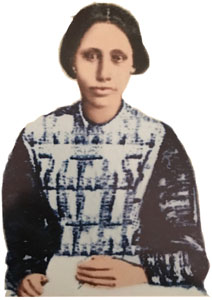
Jane Lamont Titus

Jane Lamont was born 1827, the daughter of Daniel Lamont, a trader from Scotland, and Hanyetukihnayewn (Hush the Night), Mdewakanton Dakota. Daniel’s father and Jane Lamont’s grandparents were Colin Lamont Sr. and Jane Smith of Scotland. Hanyetukihnayewn’s father was the Dakota Lake Calhoun band chief. Jane’s grandparents were Mahpiyawicasta and Canpadutawin. Mahpiyawicasta was also known as Cloud Man, and Canpadutawin was known as Red Cherry Woman.

In 1828 while on a hunting expedition, Jane’s grandfather, Mdewakanton leader Mahpiyawicasta, or Cloud Man, was caught in a blizzard and survived by letting the snow cover him. The snow fell for three days before Mahpiyawicasta could crawl out from under it.

“While trapped by the snow,” local missionary Samuel Pond wrote, “Cloud Man (Mahpiyawicasta) thought upon a hunter’s life and decided that if he survived he would follow [Indian agent Lawrence] Taliaferro’s advice and raise corn.”

(In Mahpiyawicasta’s lifetime there was not a written language for the Dakota. This information is drawn from accounts of European-American traders, politicians, missionaries, and other settlers who wrote accounts in the early 19th century. Due to the prejudices and misconceptions of the time, Samuel Pond and other accounts may inevitably reflect some of that bias.)

It wasn’t just a near-death experience and advice of an ally that pushed Mahpiyawicasta to abandon the traditional lifestyle. Opportunities for hunting were being diminished by fur-trapping and squatters taking Dakota land as more Americans pushed into tribal lands. Mahpiyawicasta, called Cloud Man, saw an opportunity to use the technology of the plow to increase yields and help prevent starvation of his band.

Cloud Man was nearly alone in his embrace of permanent farming, and few Dakota leaders agreed with his decision, but in the year after the snowstorm, Cloud Man led the Mdewakanton band of Dakota to farm at the area which would be known as Lake Calhoun. Cloud Man was chief of this village, known as Reyataotonwe, or Inland Village, which was set up in 1829. Taliaferro called the village Eatonville after then-Secretary of War John H. Eaton.

By 1832 the village’s population had increased significantly from 8 to 125 people. Many of those who joined Cloud Man were women and children. Mahpiyawicasta and Canpadutawin had a few daughters, including Hanyetukihnayewin.

In 1834 two missionaries, Samuel and Gideon Pond, were sent by Taliaferro to live at Eatonville. Cloud Man chose to welcome them and both Ponds respected his leadership. Samuel spoke of Cloud Man as “a man of superior discernment and of great prudence and foresight.” The Ponds helped farm the land and studied the Dakota language.

Although staying in Eatonville brought opportunities for a more consistent food supply for the Mdewakanton band, life in the village was tenuous.

Sac and Fox Indians attacked the Dakota people, making Cloud Man wary of continuing to listen to the advice of Taliaferro. Cloud Man addressed a group who were pressuring his people not to retaliate, saying, “I always thought myself and my people would be made happy by listening to your advice. But I begin to think the more we listen, the more we are imposed upon by other tribes.”

Affairs worsened in 1838 as news arrived that Ojibwe chief Hole-in-the-Day had killed some of the Wahpeton band of Dakota. Lake Calhoun was too close to Ojibwe territory to be safe from attack.

News of Taliaferro’s resignation as Indian agent came as an additional sign that it was time to move the band further from the threat of Ojibwe attack. With new leadership at Fort Snelling, there would be no support of the farming experiment at Lake Calhoun.

In 1840 Cloud Man’s band moved to a more defensible location near the Minnesota River in Oak Grove (now south Bloomington), leaving the farm and village they had built behind. The farm and village today is in Lakewood Cemetery.

By 1840, Jane’s mother, Hanyetukihnayewn (Hush the Night) was a widow. Daniel Lamont, who had been trading in the Minnesota River since early 1820s, died between 1836 and 1837. Their daughter was Jane, who was born at Lake Harriet on January 11, 1827. In the spring of 1840, Samuel Pond was planning to abandon the Lake Harriet mission. Hanyetukihnayewn had known the Ponds while living in their father’s village. For reasons we will never know, Hanyetukihnayewn asked Samuel to take Jane and raise her with the Pond family.

Jane was about 10 or 11 years old, and she spoke Dakota. She did not speak English.

Jane lived in the homes of Samuel and Gideon Pond at Oak Grove and Shakopee for 13 years. Family letters and Gideon’s diary refer frequently to Jane’s activities, health, character, and piety. It was clear that both families felt that Jane was affectionate and in high esteem. Cordelia Eggleston Pond, wife of Samuel Pond, wrote to a friend in 1847:

“We have a teacher for our Indian school this winter of our own training. She does very well, I believe. She came to live with us about seven years ago and has lived either in our family of Brother’s most of the time since. We think she gives good evidence of piety. (She) was received into the church last summer.”

The missionary’s family took care of the little one, and she grew up to womanhood surrounded by the best influences. Sarah Pond Ellison remembered about Jane:

“There lived in the family an Indian girl, Jane, granddaughter of Chief Cloud Man, who had been given to the missionaries by her mother. She grew up into a woman of fine Christian character and much capability. She married a white man and her sons are men of prominence in Wisconsin.”

The white man who married Jane was Moses Starr Titus. On March 14, 1850, at the age of 21, Jane married Samuel Pond’s nephew, Moses. Moses had been living with the family for some years.

Moses organized one of the first schools in the Minnesota River valley at Shakopee. In 1852, Moses and Jane built a house in Shakopee. A few years later, they built the large residence not too far from the Ponds’ residence, which they lived in until they both died.

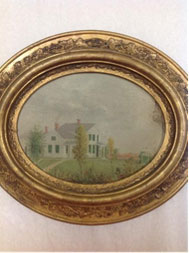
Moses Starr and Jane Lamont Titus Residence, 1868
Residence of Moses Starr and Jane Lamont Titus, 1868. The home was near the Reverend Samuel Pond’s house. This picture is from the Scott County Historical Museum.

Moses and Jane had four children, three sons and a daughter: Seymour Starr Titus (1851), Henry Harlan Titus (1854), Moses Starr Titus (1858), and Jane Marilla Titus (1866). Moses Starr and Jane Lamont Titus were involved in the founding of the Presbyterian Church, and they took an active role. Jane was remembered as a woman of kindness and mercy. As a wife and mother, she was true and tender, and as a mother she exerted all a mother’s love and watchful care.

Moses Starr Titus died on September 22, 1878.

(Some information from Grand Forks Herald, Friday, April 6, 1923; “Who Was Jane Lamont?” Anglo-Dakota Daughters in Early Minnesota by Jane Lamm Carroll, Minnesota History, p. 184-195, Spring 2005; Historic Southwest Citizens: Cloud Man—How Cloud Man, a Dakota leader, led his people to farm on the banks of Lake Calhoun in the early 19th century by Alison Nowak, Southwest Minneapolis Patch, September 7, 2011; Dacotah Children Her Playmates, January 16, 1904 and in Pond Notebook, Scott County Historical Museum; Obituary)

Samuel W. Pond, Jr. and Cordelia Eggleston Pond and Family (1847)

By David Schleper

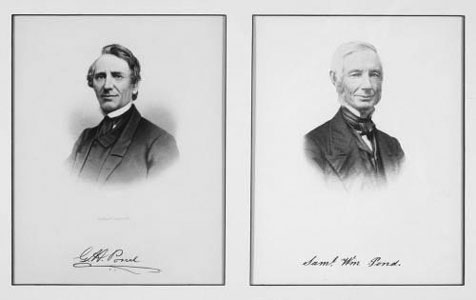
Samuel Pond (1808-1891) and Gideon Pond (1810-1878) were born into a mostly rural United States comprised of 17 states with a population of slightly over 7 million. Young Gideon worked as a carpenter and a farmer, and Samuel as a clothier and teacher. During the “Great Awakening,” one of the 19th century spiritual revivals in America, the brothers heard the call to give their lives to God’s service. Their journey led them to Minnesota in 1834, where they served as missionaries, language translators, agricultural instructors, carpenters, farmers, and ongoing advocates for fair treatment of American Indians.

Gideon and Samuel Pond

Gideon and Samuel traveled to Fort Snelling by steamboat. They began teaching Euro-American farming to Dakota people near Lake Calhoun in present-day Minneapolis.

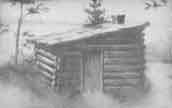
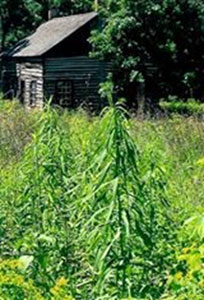
Pond cabin near Lake Calhoun
The cabin built by Gideon and Samuel Pond near Lake Calhoun

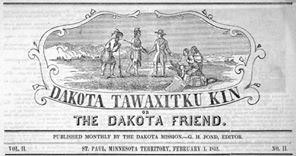
They also created the “Pond-Dakota” alphabet, which is still used today.

Pond-Dakota Alphabet

Cordelia Eggleston was born November 22, 1815, in the small community of Stafford, just outside of Batavia, New York. Her father, Esquire Ebenezer Eggleston, had died eight weeks earlier, leaving Cordelia’s mother, Anna Kingsley Eggleston, a widow with eight children. The oldest, Harvey, was fourteen and the youngest, Jane, was three years old. Baby Cordelia arrived two months later.

Cordelia left home in 1837. At age 22, she joined the Lake Harriet Mission in the capacity of teacher for the mixed blood Dakota daughters of many of the area’s white government officials and traders. After a brief engagement, Cordelia wed Samuel W. Pond on November 22, 1838.

At the invitation of Chief Sakpe II, Samuel and Cordelia moved ten miles up the Minnesota River to Tiŋta-otoŋwe, where they began a mission and school, the Prairieville Mission, from 1847-1853.

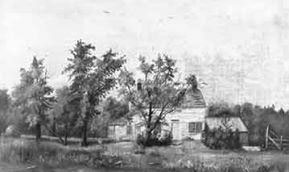
Pond Mission House, 1847
Samuel and Cordelia Pond Mission House in Prairieville, 1847

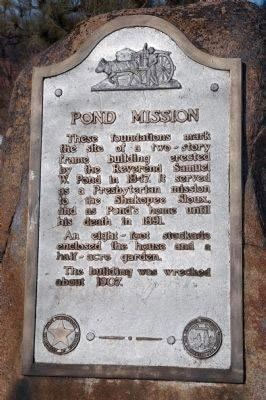
The Pond Mission House was built in 1847. It was a small palisaded mission of stone within one hundred rods of the village. The mission home stood just east of the Faribault Trading Post. It was a two-story frame building within an eight-foot stockade enclosing the house and half-acre garden.

Pond House, 1880
The Pond house in Shakopee, 1880

Troubles and difficulty plagued Samuel over the course of the next several months as he found himself responsible for ordering the delivery of building materials in the form of heavy timbers which he had to haul on the ice to the new site. The lumber of the house was purchased at Point Douglas and brought by oxen to Fort Snelling. A mishap near Grey Cloud Island on the Mississippi nearly cost Samuel his life as the oxen hauling the wood slipped on the ice, fell into the water and nearly drowned, not to mention losing the provisions that they were hauling.

The lumber was brought to Fort Snelling, where the millwork and framing were prepared, and then transported by barge up the Minnesota River to its location in Tiŋta-otoŋwe. By the fall of 1847, Samuel and Cordelia moved into their new mission house at what is today Shakopee, Minnesota. They were 14 miles from Gideon and Sarah Pond at Oak Grove and 50 miles from their nearest non-Dakota neighbors.

The site was described by Samuel: “The mission house at Shakopee was pleasantly located on gently rising ground, about half a mile south of the Minnesota River. At a distance of twenty rods or so to the west was the house of Oliver Faribault. Between these two dwellings was a ravine through which ran a never failing spring of clear cold water…The village was south of the mission house and near by, and was called by the Dakota’s ‘Tintonwan,’ signifying ‘the village on the prairie.’” Mr. Pond named the place Prairieville, by which name it was known until the arrival of white settlers, five years later…

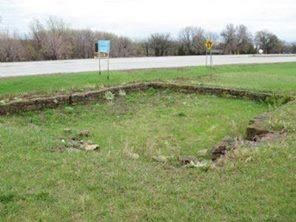
Pond Mission Footprint
The Pond Mission, which is just across the highway from Memorial Park in Shakopee. This picture is from several years ago, so you can see where the house was built.

“Between the mission house and the Minnesota River lay a beautiful and fertile tract of ‘bottom land’…On one side of the tract ran a clear sparkling stream of water…on the other side by the Minnesota, sweeping in a beautiful curve around its border. This piece of land was cultivated by the Indians and when not covered by water, tadpoles, and fishes, in the months of June and July, was rich with waving corn.”

It was in November that Cordelia and the children moved into their new home at the mission. Jeanette was five years old; Rebecca was three and baby Elnathan was scarcely a month old. The house is described as follows:

“…sufficiently commodious, carefully and comfortably built, although inexpensive in all its appointments. The walls were carefully filled with moistened clay, making them probably bullet-proof and rendering the house very warm.”

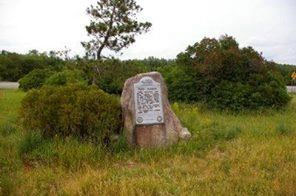
Below is the information on the house, which is still there today.

Pond Mission Marker

Pond Mission Marker

Approximately 600 Dakota lived in Sakpé’s village in the 1840s. Samuel Pond, Sr. described it as a very busy place and felt the need to surround the mission house and front garden with a fence of tall stakes to prevent the Indians from claiming a portion of the crops for themselves.

In the fall of 1851, Samuel obtained from the Board a year’s leave of absence, and prepared to visit New England. The journey was a fatiguing one, as much of it was by stage. Cordelia and the family were visiting relatives in Connecticut when Cordelia passed away at the age of 36 years. She is buried there. Samuel remarried an old school friend, Rebecca Susan Smith, in Connecticut about two months after Cordelia’s death. Samuel and Susan did not have any children. They returned to the mission at Shakopee.

Samuel and his brother Gideon both resigned from the Dakota Mission after the Treaties of 1851 removed all of the Dakota people to the Upper and Lower Sioux Agency reservations in western Minnesota.

Samuel became the founding pastor of the First Presbyterian Church in the rapidly growing city of Shakopee, Minnesota. He served as pastor for 13 years. Susan, Samuel’s second wife, died on July 9, 1891 and Samuel joined her in death on December 12, 1891, at the age of 83.

Rebecca Pond Dean
Cordelia’s second child, Rebecca, was the only one of the siblings to have her own children. She married William Dean and raised a son and daughter in Minneapolis.

As for Cordelia and Samuel’s children, Jennette never married and died at the young age of 25 years on April 4, 1867. Rebecca married William Johnston Dean on Christmas Eve, 1867. They had a daughter, Jennette Cordelia Dean, born in 1868 and a son, Arthur Judson Dean, born in 1871. Rebecca, the little girl who was not expected to survive childhood, was 68 years old when she died in Minneapolis. Elnathan married Minnie Markus and died at Shakopee in 1943 at the age of 96. Samuel Pond, Jr. married a widow, Irene Boyden, and was 66 years old when he died in 1916.

Samuel W. Pond

By the time of Samuel’s death in 1891, the United States had matured into a nation of 44 states with a population of 63 million and was an emerging global power. Minnesota, which was organized as a Territory in 1849 and became a state in 1858, grew from a population of approximately 7,000 in 1854 to 1,300,000 in 1890.

(Some information from Two Volunteer Missionaries Among the Dakotas by S.W. Pond, Jr., 1893; Dakota Soul Sisters: Stories of the Women of the Dakota Mission by Lois A. Glewwe; Dakota Life in the Upper Midwest by Samuel W. Pond, 1908.)

Related Articles

Joseph Godfrey (1844) and Wives Takanheca, Icazontewin/Emma, and Jennie Goodteacher

Compiled and Written by David R. Schleper

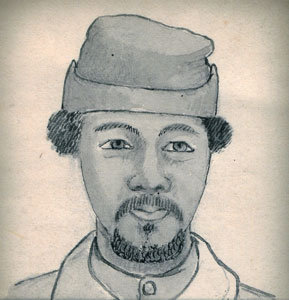
Joseph Godfrey

Joseph Godfrey was living in the Oliver Faribault home in Shakopee, Minnesota. In fact, he was one of the people who actually built the tamarack home in 1844. He was there when the trading post was open for business for the Dakota in Ŝakpe’s village of Tiŋta-otoŋwe.

Joseph Godfrey was African American. And he was a slave.

Joseph Godfrey was born in 1830 in Mendota. In 1830, Mendota was a collection of log huts scattered along the southern bank of St. Peter’s (Minnesota) River. Voyageurs, Indian traders, and tradesmen lived there near the confluence of the Mississippi and Minnesota River. Leading fur traders, including Alexis Bailly and his father-in-law Jean Baptiste Faribault, dealt with the beaver, muskrat, otter, and bear pelts as the trappers stopped there on the way to Prairie du Chien in Wisconsin.

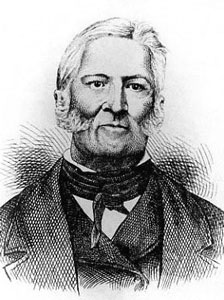
Below is a picture of Jean Baptiste Faribault:

Jean Baptiste Faribault

Below is a picture of Alexis Bailly:

Alexis Bailly

The Mendota community was not a white community, as most of the inhabitants, including all of the Baillys and all of the Faribaults except Jean Baptiste, were Métis, a mixed of white and Indian heritage. Jean Baptiste Faribault had married Pelagie Ainse, a mixed-blood Dakota woman. Alexis Bailly, like most Canadian-born fur traders, had Indian blood. He was ¼ Ottawa. Alexis Bailly had a slave, Courtney. Jean Baptiste Faribault also had a slave, possibly the same Courtney. So it is clear that both the Bailly and Faribault family had slaves.

Mendota also had a few black residents, both free and slaves. Courtney, the slave of Bailly, had a relationship with Joseph Godfrey, Sr., who was a Canadian Frenchman who worked as a trader with Bailly. When Courtney had a child by Godfrey Sr., the child, Joseph Godfrey, was also a slave. And this Joseph Godfrey was the slave who ended up in Shakopee.

In 1836, when Godfrey was just five years old, his master decided to keep him in bondage but to sell Courtney in St. Louis, the closest slave market. Remarkably, Courtney then made her way to one of the Missouri lawyers who later represented Dred Scott. She managed to procure her freedom via the courts of a slave state…even as her son remained in slavery for another decade in supposedly “free” Minnesota.

And so Joseph Godfrey was a slave, born and raised in Minnesota in bondage.

What was Joseph’s life as a young slave? One example found in research was when Philander Prescott and his wife, Nahanamenah (Spirit of the Moon), who was also called Mary, was asked to have their child live in the Bailly house. Lucy, the child, was just six years old in 1833-1834, but Lucy Faribault Bailly wanted to have her help take care of her very young children.

Below is a picture of Lucy Faribault Bailly:

Lucy Faribault Bailly

Below is a picture of Philander Prescott:

Philander Prescott

Lucy Prescott lived with Bailly for a short time, but was removed after her parents noticed that Lucy Faribault Bailly whipped their children.

According to Philander Prescott, Lucy Faribault Bailly’s mistreatment of his daughter was not an isolated occurrence. In fact, she was quite fond of whipping other children. “And whilst I am speaking about the whipping business—Mrs. Bailly had a little black child raised in the family and a young Sioux girl. Those two children, I actually believe, would get from 25 to 50 lashes a day and sometimes more, every day almost. I frequently would leave the house to get away from the miserable crying of those children when she was cowhiding them,” according to research by Walt Bachman in the book Northern Slave, Black Dakota: The Life and Times of Joseph Godfrey. Both the black boy (Joseph) and the “Sioux girl” (Angelique Skaya) were between three or four years old when they got whipped.

In the 1840s, Joseph Godfrey left the Alexis Bailly household and was kept as a slave of Oliver Faribault. Oliver was the brother-in-law of Alexis. It was clear that there was a close family, business, and slave-trading ties between the Baillys and the Faribaults.

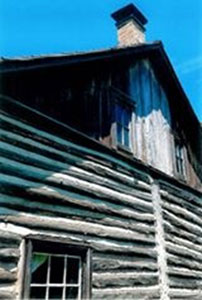
Below is the Faribault Trading Post, now in The Landing in Shakopee:

Faribault Trading Post

Oliver and Wakanyankewin (also known as Henriette Menegre) established the trading post on the St. Peter’s River at Ŝakpe’s village of Tiŋta-otoŋwe, the current site of Shakopee, in 1844. The tamarack-log cabin and an adjacent warehouse were built, probably with the help of Joseph Godfrey, for Oliver and Henriette Faribault to trade with the large Dakota band that lived there. Joseph was Oliver and Henriette’s slave.

Suffering ill treatment from his owner, Joseph ran away and took refuge among the Dakota as a fugitive slave around 1847. He walked about 40 miles southwest along the Minnesota River to Traverse des Sioux. There, he met with Alexander Huggins, a militant abolitionist Presbyterian missionary who had met Joseph when visiting the Pond and Faribault families. Shortly after, Joseph joined the Indian bands led by Chief Wabasha.

Joseph married Takanheca who died in 1873. Takanheca was the daughter of Wahpaduta, or Red Leaf.

Below is a picture of Wahpaduta:

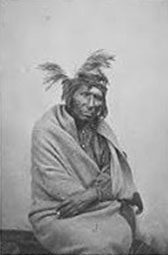
Wahpaduta

In August 1862, while helping local Dakota load hay onto a wagon, Godfrey was approached by a Dakota man who announced that all the white people had been killed at the agency. On the spot, Godfrey was asked what side he would take. Afraid for his life and family, Godfrey felt compelled to join the war.

Later that fall, Godfrey was accused by Sibley of joining the Dakota between August 18 and September 26, 1862, and actively participating in attacks. Dakota warriors awarded him the name “Atokte,” meaning “slayer of many” in Dakota. Godfrey denied he had killed anyone. However, there were conflicting reports about his role in the conflict and how active he really was.

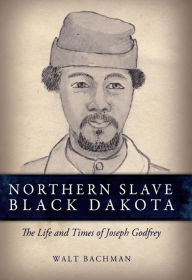
Below is the book about Joseph Godfrey:

Northern Slave, Black Dakota: The Life and Times of Joseph Godfrey Cover

Walt Bachman (one of the Bachmans of the florist company in Minnesota) researched and wrote the book, which is very interesting, and worth reading. (I wish they had students here in Shakopee read it, it is very worthwhile!)

Godfrey’s second wife was Icazontewin, also known as Emma. They married in 1866. She died in 1895. The third wife was Jennie Goodteacher. They got married in 1898.

Joseph spent the rest of his life on the Santee Reservation, where he passed away of natural causes in July 1909. Godfrey’s body was buried at the Episcopalian Cemetery on the reservation.

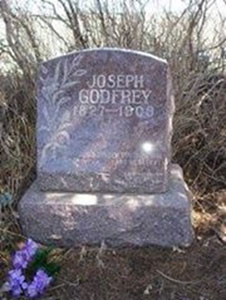
Below is the tombstone of Joseph Godfrey:

Joseph Godfrey's Tombstone

According to Walt Bachman, “In Minnesota, there were never large gangs of farm workers, or auction blocks. There weren’t those trappings of the worst forms of slavery,” he said. “But there is ample evidence of brutality towards slaves in Minnesota, including a slave who was whipped to death by her Army officer master. Slavery, wherever it was practiced, was a pernicious institution, and Minnesota was no exception.” And some of it happened in Shakopee, Minnesota!

And so now you know a little bit about the first black man in Shakopee, in 1844, at the Faribault Trading Post (which he probably helped build), in Shakopee, MN.

Faribault Trading Post

(Information from Walt Bachman, Northern Slave, Black Dakota: The Life and Times of Joseph Godfrey © 2013, Bloomington, Minnesota: Pond Dakota Press.)

Related Articles

Mr. Griffin (1854)

By David Schleper

Mr. Griffin

In the May 9, 1854 diary of Daniel M. Storer, a pioneer builder and merchant in Shakopee, Minnesota, made the following note:

“A black man by the name of Griffin commenced working for me on the 9th.”

Mr. Griffin worked with Daniel Storer in Shakopee as a carpenter, and built some of the buildings in the town of Shakopee.

Daniel Milton Storer was born on July 11, 1828 in Carthage, Maine, and lived in a backwoods hamlet with his siblings until, at age 19, he moved west. He was in Illinois for two years, and in 1849 he moved to Minnesota, locating first at Stillwater, and then in the spring of 1853 Daniel came to Shakopee. The town of Shakopee was in its infancy (though the Dakota were there for years before this). Daniel found an ample field for his trade, that of a carpenter, and over the next ten years he assisted in building many structures, a few still standing, monuments to the good old days of hardwood timbers and careful construction. A year after Daniel started building houses, he met and hired Mr. Griffin to work with him starting on May 9, 1854.

So, who was this African American man in Shakopee in 1854? Was he a slave, hired out by a master from St. Paul or the Minnesota Valley? Or was he a free man? Or was Mr. Griffin a runaway, heading to Canada and freedom?

When you think of slavery, you probably think of a feature of the South part of the United States. But there were many slaves in the north. Slaves were auctioned openly in the Market House of Philadelphia; in the shadow of Congregational churches in Rhode Island; in Boston taverns and warehouses; and weekly, sometimes daily, in Merchant’s Coffee House of New York. Such Northern heroes of the American Revolution as John Hancock and Benjamin Franklin bought, sold, and owned black people.

Practices such as the breeding of slaves like animals for market, or the crime of slave mothers killing their infants, testify that slavery’s brutalizing force was at work in the north. Philadelphia brick maker John Coats was just one of the Northern masters who kept his slave workers in iron collars with shackles. Newspaper advertisements in the North offer abundant evidence of slave families broken up by sales or inheritance. One Boston ad of 1732, for example, lists a 19-year-old woman and her 6-month-old infant, to be sold either “together or apart.”

The Northwest Ordinance of 1787, in theory, outlawed slavery in the Northwest Territory, including the Minnesota area. Though slavery was outlawed, it still happened, especially in the Fort Snelling area.

By the time Fort Snelling was built in the 1820s, slavery was a reality in the Northwest Territory. Fur traders often utilized slave labor and some officers at the post, including Colonel Josiah Snelling, owned slaves. Major Lawrence Taliaferro had many slaves, and he often rented slaves.

Historians estimate that throughout the 1820s and 1830s anywhere from 15 to 30 enslaved African Americans lived and worked at Fort Snelling at any one time. These people likely cooked, cleaned and did laundry and other household chores for their owners.

In the book A Peculiar Imbalance: The Fall and Rise of Racial Equality in Early Minnesota, William D. Green looked at the decades leading up to the Civil War, when some black people lived in freedom on the frontier of Minnesota, working in the fur trades and mingling with Native Americans, French traders and immigrants drawn to the area.

Meanwhile, slave hunters roamed the streets of St. Paul, and military life at Fort Snelling included numerous slaves serving the military in residence as well as visiting officers. “Even though slavery was very present and tolerated in Minnesota at Fort Snelling, the concept was an abstraction. Minnesota was still the frontier at this point, and the issue of slavery was a low priority, even with people who felt they were friends of black people,” said Green.

Green says slavery came to Minnesota in part to discourage race mixing with another group of people, the Native Americans, who still made up a large part of the population. “Virtually every French trader had a Native American wife and children, and a large number of the troops at Fort Snelling were involved with Native American women as well. This didn’t sit well with (John Caldwell) Calhoun, so he initiated a policy that encouraged wives to live at the fort to civilize the corps, and to purchase slaves in order to release wives from the drudgery of housekeeping in frontier conditions.”

Calhoun is best remembered for his strong defense of slavery. He was a patriarch of slavery and succession in the South and he also engineered to bring slavery to the north. Fredrika Bremer, a Scandinavian writer and reformer, quoted Elijah Green, one of the slaves who dug Calhoun’s grave in 1850, stating, “I never did like Calhoun ’cause he hated the Negro; no man was ever hated as much as him by a group of people.”

Besides Fort Snelling, slaves were allowed in other towns, including St. Cloud. Wealthy slave owners from the deep south or neighboring territories like Missouri would vacation in St. Cloud, and often these vacationers brought along their slaves. Slaves were documented in St. Cloud as early as 1854, the same year that Mr. Griffin was in Shakopee.

In the 1850s, free blacks and escaped slaves arrived, following the Mississippi River north, and made Minnesota their home. Records from 1850 show 39 free blacks out of a population of 6,077 citizens (not including Native Americans).

African Americans traveling on the western waters were quite common. Some free black people, as well as slaves, worked on the steamboats, many as firemen, stewards, and chambermaids. African American travelers occupied a different status from that of the white people on board. Sometimes slaves traveled with their masters and mistresses, sleeping on trundles in their owner’s private cabins, and where they could take care of errands. Free black people were not allowed in the private cabins, but had to travel on the lower deck.

According to Lea VanderVelde, “Some of the black boatmen were free, while others were slaves, hired out by their masters to work steamboats. The captains obligated themselves to return as slaves. Some owners bought insurance in case their slaves attempted to escape while on the river. Black cooks, stewards, chambermaids, and barbers attended to travelers’ comforts. Stevedores, deckhands, and engine stokers performed the heaviest tasks of actually moving the cargo and firing the lumbering boats up the great rivers.”

Traveling by steamboat carried considerable risk. They could fall overboard since the decks had no guide rails and few people knew how to swim. Steamboats hit snags, ran aground on sandbars, and the engine boilers, which were on the lower deck close to the African American workers and passengers, exploded regularity. The explosions occurred on the upstream voyage, with the captains pushing their boilers to dangerous levels going against the river’s current.

Was Mr. Griffin a worker on the river, and then stopped and stayed and worked as a carpenter in Shakopee for a short time?

One of the most famous of the early African Americans in the Minnesota territory was George Bonga. He was born in Minnesota in 1802, his father Pierre Bonga the son of a freed slave and his mother a member of the Ojibwe tribe. Bonga was schooled in Montreal and eventually became a fur trader in the Northwest territories. He went on to serve as an interpreter in negotiations with the Ojibwe, particularly as a representative of Michigan Governor Lewis Cass. His brother Stephen served as the Ojibwe interpreter at Fort Snelling for the 1837 treaty.

In A Peculiar Imbalance: The Fall and Rise of Racial Equality in Early Minnesota, William D. Green writes about a meal served at Fort Snelling where Stephan Bonga, who was black, translated information to the Ojibwe, and was served alongside important white political and military leaders, and by a slave named Dred Scott. What must it have felt like for a slave to serve an important, free black man, and what must Bonga have felt to see a person who looked like himself living life as the property of another person? To make it even more interesting, Jim Thompson, who was brought to the area as a slave of a military officer, purchased and freed in 1837 saw Dred Scott, his wife Harriet Robertson Scott, and their first child, who was just born, in 1838. In Mrs. Dred Scott: A Life on Slavery’s Frontier, author Lea VanderVelde remembers that in 1838, Jim Thompson met a steamboat at the dock. He was sent by Agent Lawrence Taliaferro during Reverend Brunson’s absence. Jim was probably the first person Dred, Harriet, and their little baby Eliza saw as they walked down the gangplank. Jim’s Dakota wife, Marpiyawecasta, had just recently had a child. The blessed meeting on the dockside between the freed man, with the new parents carrying their baby Eliza must have been nice, especially onto the snow-blanketed, solid ground of their new home in free territory. It was the village of Shakopee, in the territory of Minnesota, that Jim and Marpiyawecasta and their two children lived starting in 1853!

In the 1850s, Fort Snelling played a key role in the infamous Dred Scott court case. Slaves Dred Scott and his wife, Harriet Robinson Scott were taken to the fort by their master, John Emerson. They lived at the fort and elsewhere in territories where slavery was prohibited. After Emerson’s death, the Scotts argued that since they had lived in free territory, they were no longer slaves. Ultimately in 1857 the U.S. Supreme Court sided against the Scotts. This decision caused rancor over slavery, and eventually the American Civil War.

For Mr. Griffin, if he was not a free man or openly a free man, he might be escaping to Canada. Abolitionists in Minnesota still assisted slaves in running away to Canada. Some free people of color also settled in nearby Canada.

Race is written between the lines in early Shakopee history. Rather than spoken directly, it is only found through diaries, memoirs, letters, government documents. As William D. Green noted, “When you are looking at slavery, you see instead the word ‘servant’ — a nicety that actually means slave. And when you understand that, it changes things. It’s like going into a room and finding a door to another room you’ve never looked into before.”

So who was Mr. Griffin? Was he a slave, working for a master in the Minnesota River area, or St. Paul? Was he a free person of color, living in Shakopee for a year or two, before moving on? Or was he a runaway, stopping to work for a short time before escaping to Canada?

At this time, we do not know. But because of Daniel Storer’s diary, at least we know that an African American lived in Shakopee in 1854.

(Some information from The Diary of Daniel M. Storer from 1849 to 1905: A Pioneer Builder and Merchant, His Personal History of Shakopee, Minnesota from August 1853 to January 1905 by Shakopee Heritage Society, 2003; Mrs. Dred Scott: A Life on Slavery’s Frontier by Lea VanderVelde, Oxford University Press, 2009; Northern Slave Black Dakota: The Life and Times of Joseph Godfrey by Walt Bachman, 2013, Pond Dakota Press; A Peculiar Imbalance: The Fall and Rise of Racial Equality in Early Minnesota by William D. Green, Minnesota Historical Society Press, 2007; Degrees of Freedom: The Origins of Civil Rights in Minnesota, 1865–1912 by William D. Green, University of Minnesota Press, 2015.)


William Louis “Bill” Quinn (November 4, 1828-March 5, 1906)

By David Schleper

William Louis "Bill" Quinn

William Louis “Bill” Quinn was born near Coldwater Springs near Fort Snelling, Minnesota on November 4, 1828. His father was Peter Quinn, who was an Irish immigrant who married Ineyahwin, also known as Mary Louisa Finley, who was a mixed-blood Christeneauz (Cree) Indian. Therefore, William was half Cree by blood.

When Bill was 20 years old, he married a half-blood Dakota woman, Angelique Jeffries, of the Mdewakanton band in 1848. By 1856, the couple had three children, all of which were one-quarter Dakota. Bill was fluent in Chippewa, Dakota, English, and perhaps other languages. At various times he was a clerk, a scout for the army, and an interpreter. Bill was employed as a clerk in the Indian trade for many years.

In the spring of 1851, Thomas A. Holmes employed Bill as a guide. They packed for one week, and Bill had already decided on two possible places for a town. They ascended the Minnesota River and cooked a meal in a hollow near the old Dakota Indian village of Tiŋta-otoŋwe. Thomas and Bill looked the place over, and climbed the bluffs north of the settlement, and Thomas was even more impressed. They decided to continue up the river to Le Sueur. But soon Thomas and Bill returned to the first landing, and deemed it the more favorite place to locate. And so Thomas Holmes picked the area near Tiŋta-otoŋwe, and called the area Holmes Landing. It was here that Thomas built a trading post for the Dakota Indians in Tiŋta-otoŋwe (which was close by where today is Sommerville Street, and continued until beyond Memorial Park.)

One interesting story about William Louis Quinn happened a few years later.

In 1862, Bill and his family were at the Yellow Medicine Agency, where he worked in William Forbes’ store. In 1862-1865 he was a scout, guide, and messenger. Bill was chief of scouts at Fort Wadsworth from 1867-1870. For 30 years, starting in 1870, Bill was immersed in learning, documenting, and providing testimony about the genealogy of Dakota mixed-bloods. In an article written in 1901, Knute Steenerson discussed his experience of being a pioneer. He had a saloon in the village of Lac que Parle. “I sold whiskey by the drink, pint, quart, and gallon. Along in the winter came a half-breed from St. Paul. He had driven up by team—there was no railroad at that time—and he was going to Big Stone Lake, he said, to buy scrip from the Indians.” Scrip allowed the holder to appropriate about 480 acres of land not already occupied for people who were half-Dakota.

“His name was Bill Quinn. He had seventeen hundred dollars in cash in his pocket book. He came into my saloon often and treated the crowd, no matter how many there were or how few. He would throw a five-dollar bill on the counter and did not want any change. When I gave him change back, he would throw it on the dirty floor and tramp on it. So I learned after a while to please him and never gave him change, but slipped the bill into the money drawer and set up the drinks. This pleased him entirely.”

“So he proceeded on to Big Stone Lake and in about a week or ten days he was back again. He brought his son and his son’s sweetheart with him. They were pretty good-looking half-breed Indians. He said he had caught them wild on an island in Big Stone Lake and wanted to ‘buckle them up’ and marry them. So he bought ten gallons of whiskey and ten gallons of cherry brandy. I was invited to the wedding, which was held at the house of a French squaw man, who lived down the river a few miles. The next thing was to send for a justice of the peace to ‘buckle them up,’ as he said.” Knute continued, “A New England Yankee was sent for. His name was Mr. Stowell, and he performed the ceremony. But Mr. Quinn was in such a hurry that he sang out between drinks, ‘buckle them up, buckle them up,’ and then again he would jig and laugh. Well, after it was done Quinn said he was so glad that they were ‘buckled up.’”

“We had a good time at the wedding. Some were drinking, some dancing, and others talking. It was a sort of cosmopolitan gathering. There were Dakota Indians talking with the lady of the house around the cook stove. There were the squaw man and old Bushma taking French. There were Fritz and Rosenbaum talking German. There were Ole Olson and John Johnson talking Norwegian. They were all enjoying a trot sling and conversation between themselves, while Bill Quinn was dancing with a glass in his hand, to the music of the violin played by the half-breed, Joe Laframboise. A more pleasant and jolly time I have never enjoyed.”

(From Knute Steenerson’s Recollections The Story of a Pioneer, Minnesota History Magazine, Vol. 4, Issue 3-4, 1921, pg. 130-151.)

Timothy Canty and Margaret O’Keefe (1851)

By David Schleper

Timothy Canty came to Shakopee as an employee of Thomas A. Holmes. Some said that Timothy came on the flat boat Wild Paddy in the fall of 1851, though others think he arrived a short time later. He came to file on a tract of 80 acres granted him by the government because of his involvement in the Mexican-American War, also known as the Invasion of Mexico.

The Mexican-American War (1846-1848) marked the first U.S. armed conflict chiefly fought on foreign soil. It pitted a politically divided and militarily unprepared Mexico against the expansionist-minded administration of U.S. President James K. Polk. Polk believed the United States had a manifest destiny to spread across the continent to the Pacific Ocean. A border skirmish along the Rio Grande started off the fighting. It was followed by a series of U.S. victories. When the dust cleared, Mexico had lost about one-third of its territory, including nearly all of present-day California, Utah, Nevada, Arizona and New Mexico.

Timothy was born in Lower Canada, and came to the eastern part of the United States at an early age. He was in the Mexican-American War, and was in many of the battles, including Cerro Gordo, Buena Vista, and Vera Cruz. After working with Thomas A. Holmes in Shakopee, he worked on the steamboats, including Greek Slave and Pocahontas.

Tim married Margaret O’Keefe in St. Paul in 1851. When the Civil War arrived, he wanted to go, but Tim couldn’t leave his wife. His wife lost her sight, and was blind at that time, so Tim stayed to be near his wife.

Timothy was dressed in keeping with his manner of living, and his ways and his philosophy was simple, direct, unassuming, and not given to boasting. He did reminisce occasionally about his experience in the Mexican American War, and when General William Tecumseh Sherman became prominent in the Civil War, Canty recalled that he had served under Sherman when Sherman was in the American forces in Mexico.

Tim, as he was called, even went so far one day as to assert that he knew Sherman well. “He’s a fine officer and a real man,” he observed to a group of settlers in Guyermann’s store in downtown Shakopee. Tim had been there to purchase his weekly supply of groceries. Many of the settlers felt that Timothy was exaggerated a bit, and that he didn’t know the great Sherman as well as he claimed. They often asked again and again, but Tim made little comment.

One day the news brought up the Minnesota River from St. Paul said that Sherman was making a tour of the west, and would pass through Shakopee. It happened in the late 1860s. When the news of the impending visit was announced, there was great excitement.

“Where’s Canty?” some of the settlers asked. “He ought to be here, since he claims Sherman knows him so well.” When Timothy was told, he didn’t say much. A few of the townspeople hinted that Tim couldn’t make good with his claim.

Finally, the day of the general’s visit arrived. Homesteaders and city residents formed quite a sizable crowd. Along noon a cloud of dust was seen down the trail. “Here they come!” someone shouted.

Presently the stage came into view, drawn by four large horses. The driver swung around the corner at Strunk’s Drug Store and stopped with a flourish. A cheer arose and General William Tecumseh Sherman put his head out of a window to acknowledge the greeting. His eyes roved over the crowd as he spoke. Suddenly, he stopped and the watchers saw his attention was riveted on a man in the rear of the crowd. Timothy Canty was there, having come to Shakopee to get his scythe sharpened. He was still carrying the scythe.

“Hello Tim!” Sherman called. “Don’t you remember me?” Tim came forward and shook hands. For some time their hands were clasped and the embarrassed settlers who had doubted Tim’s claim saw tears welling in the eyes of the two veterans – the general of all the armies and the humble homesteader.

“I want to congratulate you on your success in the later war, General,” Tim faltered.

“Thank you, Tim,” said Sherman. “Say, do you remember that big black horse I had in Mexico? Wasn’t he a dandy?” Then the general grew serious. “How is the world treating you, Tim, my boy?”

“Fine, General, fine,” said Timothy. “I have a good maple homestead and a wife and boy out here a ways.”

“That’s good. Take care of yourself,” Sherman called as he resumed his seat to continue the journey. After short remarks to the crowd, General Sherman’s coach was again on its way.

The crowd melted slowly and silently, and several went to find Tim, who had disappeared. But when Tim arrived back to Shakopee later, the reception was wholly different. The settlers were inclined to look with awe on the man who had been so intimate with Sherman. It was reported that this feeling never did wear off entirely, and persisted even until Timothy’s death in 1885.

(Some information from Timothy Canty Typical Pioneer: Father of Local Man was Personally Acquainted with General Sherman. Shakopee Tribune, 1925. In Recollections of Early Pioneers 1925 compiled by Betty A. Dols, 2000, Shakopee Heritage Society.)

Witch-e-ain: The Second Wife of Thomas A. Holmes

By David Schleper

Witch-e-ain

Witch-e-ain was around 15 years old in early 1840s. Witch-e-ain’s father was another chief named Mock-ah-pe-ah-ket-ah-pah. (Although some people said that Witch-e-ain’s father was Wah-pa-sha).

The name of Witch-e-ain is closest to the Dakota word wićíte, “the human face,” although like some of LaFayette Houghton Bunnell’s other names, it is highly corrupted. The name “Face” could allude to her beauty and seductiveness. The name may also be a corrupted front formation from Wićítokapa, “the eldest born,” although this posits such a degree of corruption as to defy probability.

In the early 1840s, a special celebration was happening in Wah-pa-sha’s band. They assembled, and after elaborate preparation and sanctification of the ground by invocations and incense, the chief speaker came forward, and in a sonorous address lauded the virtues of chastity and warned against the sin of bearing false witness.

Wah-kon-de-o-tah, the great war-chief of the band, addressed his warriors in a quiet and affectionate manner, and told his braves to maintain the truth as sacred, and not offend the spirits of their ancestors. Wah-pa-sha then called for the virgins and matrons to come forth, and for some time there was the silence of expectation.

Again the call was made for any virgin to come forward and receive her reward. Two maidens came partly forward, but, upon reaching the line of denunciation, faltered and turned back, probably from modesty. We-no-nah, the wife of the speaker, and eldest sister (or cousin) of Wah-pa-sha, motioned to her youngest daughter, Witch-e-ain to come forward.

After repeated calls by the crier of the assembly, Witch-e-ain came modestly forward and was crowned goddess of the feast that immediately followed. Her head was encircled with braids of rich garniture and scented grass, and presents of colored cloths, calicoes, yarns, beads and ribbons were lavished upon her as the tribe’s representative of purity.

Wah-pa-sha said that Witch-e-ain could pick either LaFayette Houghton Bunnell or Thomas A. Holmes, as both allowed royal alliance for the family. Witch-e-aim said she did not like the trader, and preferred LaFayette. When Bunnell declined her offer, Witch-e-ain’s withering, silent contempt was clear.

During the feast, Thomas was so enchanted that he decided at once to make Witch-e-ain his wife.

Witch-e-ain was allowed to marry European American traders, like Thomas A. Holmes, in the fashion of the country. This means that these marriages were not recognized by law or religion. The French speaking traders of Canada term for this is “a la faḉon du pays.” Some people would call them “country wives.” While many marriages brought loving couples together for the rest of their lives, other marriages were very short-lived or violent. Many traders married native women, but also had other wives back home. Sometimes when the men retired from the fur trade, they returned to their legitimate, or legally married wives.

These marriages came with the expectation that trade between the woman’s relations and the trader would be secured, and that aid would be mutually provided in times of need. It was also the hope of the woman’s family that the trader’s generosity would increase after the marriage took place. The marriages between these two groups would lead to the creation of the Métis people, who would be considered the offspring of the fur trade.

So Thomas gave Wah-pa-sha an offer that he accepted. Based on this, Witch-e-ain then picked Thomas A. Holmes. This was in the early 1840s.

Thomas then married Witch-e-ain a la faḉon du pays. They were married in the fashion of the country, and lived together. But Witch-e-ain did not like living with Thomas. Like a caged bird, she soon pined for her Dakota prairie home. By the spring, while flowers bloomed, Witch-e-ain died of consumption.

(Some information from Lafayette Houghton Bunnell, Winona (We-No-Nah) and Its Environs on Mississippi in Ancient and Modern Days, Winona, MN: Jones & Kroeger, 1897; History of Wabasha County: Together with Biographical Matter, Statistics, Etc. Gathered from Matter Furnished by Interviews with Old Settlers, County, Township and Other Records, and Extracts from Files of Papers, Pamphlets, and Such Other Sources as Have Been Available. Also a History of Winona County, H.H. Hill & Company, 1884.)