Compiled and written by David R. Schleper, 2025.
On September 1, 1925, newspaper headlines in Minnesota included “Veteran Found Slain, Officials Hold Wife;” “Veteran Stabbed to Death After Party;” and “Man Stabbed to Death; Wife Held — Stocking in Childless Home in Clue.”
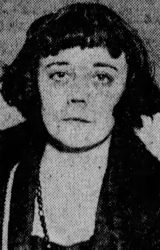
According to an article, “Was It Murder, Suicide, or an Accident?” by Lindsay Marshall, Evelyn Maloney Geschwind, born in 1894, was held in the death of her husband, Frank Frederick Geschwind.
Frank was born December 20, 1892 in Sleepy Eye to Peter Wilhelm Geschwind (1852-1938) and Amelia Margaret Piehl Geschwind (1859-1901). Frank’s father was a retail grocer, real estate agent, postmaster, and a farmer.
Peter and Amelia had ten children, with Frank being the eighth child, a twin with his brother, Peter. According to Marshall’s article, Frank was living in Detroit, Michigan working as a metal polisher at Federal Brass. “His military training was with the 247th Aero Squadron.” After a year in England, he flew with the 41st Squadron the remainder of his service before he returned to the Midwest, and in 1922 he joined his brother, Peter, Jr., in Minneapolis.
On January 1, 1924, Frank married Evelyn Maloney in Minneapolis. Frank worked for a short time in Ironwood, Michigan before returning to Minnesota.
“The night prior, Frank and Evelyn Geschwind were drinking with a few friends at their apartment located a few blocks from where the U.S. Bank Stadium sits today. Newspapers reported a few variations on who contacted the police. Some stated that several neighbors heard a fight happening (loud voices, cursing, articles being thrown and finishing with a loud thud). Others stated that a specific neighbor, Mrs. Kenneth Lee, answered the door in the middle of the night to find Mrs. Geschwind on the other side. Either way, police arrived at the Geschwind apartment to find a blood-strained breadknife on the windowsill and Frank lying dead in the kitchen” said the article by Marshall.
Evelyn was charged worth murder in the first degree and taken in by police.
Evelyn was allowed to attend Frank’s funeral service accompanied by detectives. On September 4, 1925, the Minneapolis Star reported, “Enroute she was asked by an officer the nature of her husband’s religion. ‘He didn’t believe in anything,’ she said. ‘That is why I hated him. He didn’t believe in God or anything.’ But after a few moments she came to his defense. ‘But he was good to me, he never beat me. He never abused me. He was always kind. It was moonshine—moonshine. That was the trouble.’”
According to Marshall, “During the trial, other pieces of her past were exposed, including that prior to her marriage with Frank, Evelyn had a baby whom she deserted. William Geschwind, Frank’s brother, testified that the couple lived at William’s Niagara, Wisconsin home the previous year, in 1924. He saw Evelyn attempt to strike Frank with an axe during a quarrel. This story was corroborated by a neighbor, Mrs. Canavara. William brought said axe to the courtroom that day. He also saw Evelyn strike Frank with metal handle of a mop while he was working under his automobile.”
Dr. Folson of the University of Minnesota, who performed the postmortem examination, took the stand next. The physician testified that the knife entered Frank’s heart in an upward movement.
When asked by the prosecutor, “It would take a strong plunge to make a knife cut through the heart and into a rib, would it not?” Dr. Folson responded, “Yes.” When asked, “When anyone plunges a knife into one that knife usually takes a downward turn, doesn’t it?” Dr. Folson, again, responded, “Yes.”
“Frank’s twin, Peter, testified that on the night of Frank’s death, he had driven him home and had just returned to his own home when he received the phone call notifying him that Frank had been stabbed.”
The jury consisted of an even number of men and women. They were Caucasian (as they were the only allowed in the jury pool). They had just allowed women to serve in the jury three years earlier.
Evelyn believed that with the female jury members, sympathy for the woman would help her case.
According to Marshall, “Judge Baldwin explained to the jury their duties as jurors as well as the difference between first-, second-, and third-degree murder, shall they decide that Evelyn was guilty. He noted that manslaughter did not figure into this case.”
Evelyn’s Sentencing and Life Afterwards
Evelyn was sentenced to a term of no less than seven and no more than thirty years at the Shakopee Women’s Reformatory. During the reading of her sentence, Evelyn reportedly showed little emotion. Judge Baldwin noted, “Any other person who did not have that background would probably have been acquitted in the fact of the evidence” (Duluth News).
It took three-hours and 25 minutes for the jury to reach a verdict of murder in the third degree.
According to Marshall, “each quarter, the state board heard pleas and pardons from previously tried cases.” The Star reported on July 8, 1928 that Evelyn Geschwind’s plea was among the 78 heard that quarter. She stated that she did kill her husband, but claimed it was in self-defense. According to the 1930 census, taken April 26, Evelyn was still housed at the reformatory. Her “occupation” on the census showed she was a seamstress. By 1940, Evelyn was no longer at the reformatory.
Bibliography
Duluth News, 5 Nov. 1925. p. 8.
Marshall, Lindsey. Scott County Historical Society Gazette, Vol. 4, No. 5, May 2025.
Minneapolis Star, 4 Sept. 1925.
Minneapolis Star, 8 July 1928.