Compiled and written by David R. Schleper, 2020
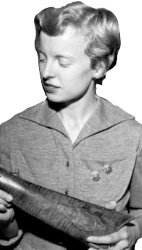
Marie D. Schneck was born in Menomonie, Wisconsin on April 13, 1909, daughter of Gustav Adolf Schneck and Marie Friendrike Hedwig Engel.
Marie moved to Minnesota and married Osbone “Ozzie” Wesley Klavestad, who was born August 28, 1903, in Norway, son of Klaus Svensen Klavestad and Hilda Mathilde Roed.
Marie and Ozzie had one child, Marjorie Marie Klavestad Rines, in 1928.
In 1951, during a thunderstorm, Marie and Ozzie, found the building on the former site of the Gellenbeck Stage Stop (1849-1880). They bought it for a place to display Ozzie’s gun collection. A lifelong collector, Ozzie amazed an assemblage of firearms including engraved rifles belonging to Jesse James, Annie Oakley, and Buffalo Bill Cody on the walls. A four-barrel, percussion plains rifle of Ṡakpedaŋ was also there, though it is now part of Hoċokata Ti at the Mdewakanton Sioux Community.
Marie and Ozzie named it the Stagecoach Museum. Over the years it expanded to include the Stagecoach Restaurant, Stagecoach Opera House, and Sand Burr Gulch.
The restaurant had waitresses dressed as cowgirls, with earrings that were little, tiny six shooters that actually shot. Ozzie often came out looking like Wild Bill Hickok, shooting his pistols into the ceilings. One area had a Silver Dollar Bar, with silver dollars under glass. Heads of dead animals, such as buffalo and elk, were on the walls. A player piano played by itself and an old vending machine, called a mutoscope, had picture shows on it – put in a penny, turn a crank on the side, and watch the pictures flip through to appear like a movie!
Behind the museum was Sand Burr Gulch, a replica of a western town with over twenty buildings containing 75 animated life-size figures synchronized with recordings in appropriate settings. It recreated an Old West street complete with blacksmith, barber shop, saloon, an underground gold mine, and the Palace which had an animated band playing Sousa’s music. On Sundays fast-draw shoot-outs happened in the “Old West” town.
Next to the museum was the Bella Union Opera House, where actors put on “mellerdramas” of yesteryear. The audience could hiss the villains and cheer the heroes as loud as they wanted.
The Stagecoach Players company was founded in 1962 by Wendell Josal (president and managing director) and Robert Moulton (vice-president and artistic director) to perform melodramas with musical olios in the Stagecoach Complex opera house. In 1971, Moulton was succeeded by Lee Adey. The troupe mounted 44 productions in 18 years, playing to over 300,000 people in 1,898 performances, as a commercial company.
For thirty years, Ozzie and Marie ran their enterprise, with help from a few hired hands who helped run the restaurant and the theater and kept the place running.
By 1981, Ozzie and Marie retired and sold the property. Though it was supposed to carry on the tradition, nothing happened, and the Stagecoach Museum began the slow descent of time into rubble, according to “How the West was Lost” by Joseph Hart in the Oct. 9, 1996 issue of City Pages.
In 1996, five fire departments burnt the remnants of the restaurant, bar, Sand Burr Gulch, and Bella Union Opera House. The area is now the Dahlen Sign Company at 901 Stagecoach Road in Shakopee.
Marie Schneck Klavestad died October 14, 1983. Osborne “Ozzie” Wesley Klavestad died in a nursing home on April 6, 1986, the abandoned dream museum already in broken fragments.
Bibliography
Hart, Joseph. “How the West was Lost” City Pages, 9 Oct. 1996.
My brother and I along with our friends in Schroeder’s Acres would find some change from time to time, and then visit the Stagecoach so we could play some of the machines. The boys’ favorite ones were the old fashioned peep shows. Later, the big dinner hall next door became Doc Holliday’s where great bands came to play. Amazing times there back in the day. Golden memories.
Thanks for sharing, Jenny! Love hearing these stories from those who experienced places first-hand. I’m just a little too young to experience the Stagecoach Museum.
In the 60’s a bunch of us from Richfield would walk yes walk to Shady Valley riding stables. We would go riding for 7 hours
We would stop for a break at the Stagecoach for refreshments. Stage coach was north of 13 and 101. Just at the sharp curve
Very cool place
Thanks for sharing, Tom! Cool memory. That is a long way to walk, too!