Before Valleyfair and the Renaissance Festival, there was the Stagecoach Museum. From 1951 to 1981, Ozzie and Marie Klavestad, proprietors, dressed in old western garb and greeted the visitors one by one. The Stagecoach Museum was located on Highway 101 between Savage and Shakopee.
Ozzie and Marie developed the Stagecoach Museum complex to preserve Americana. It was built on the site of the former Gellenbeck Stage Stop (1849-1880). The area is a valley near the Minnesota River, and near the Dakota’s Maka Yusota, or Boiling Springs.
The museum and restaurant displayed a collection of 3,000 guns that Ozzie owned. A lifelong collector, Ozzie amassed an assemblage of firearms including engraved rifles belonging to Jesse James, Annie Oakley, and Buffalo Bill Cody on the walls. A four-barrel, percussion plains rifle of Chief Shakopee was also there.
Stagecoach Museum postcard
The restaurant had waitresses dressed as cowgirls, with earrings that were little tiny six shooters that actually shot. Ozzie often came out looking like Wild Bill Hickok, shooting his pistols into the ceilings. One area had a Silver Dollar Bar, with silver dollars under glass. Heads of dead animals, such as buffalo and elk, were on the walls. A player piano played by itself and an old vending machine, called a mutoscope, had picture shows on it – put in a penny, turn a crank on the side, and watch the pictures flip through to appear like a movie!
Behind the museum was Sand Burr Gulch, which was a replica of a western town with over 20 buildings containing 75 animated life-size figures synchronized with recordings in appropriate settings. It recreated an Old West street complete with blacksmith, barber shop, saloon, an underground gold mine, and the Palace which had an animated band playing Sousa’s music. On Sundays fast-draw shoot-outs happened in the Old West town.
Next to the museum was the Bella Union Opera House, where actors put on “mellerdramas” of yesteryear, where the audience could hiss the villains and cheer the heroes as loud as they wanted.
The Stagecoach Players Company was founded in 1962 by Wendell Josal (president and managing director) and Robert Moulton (vice-president and artistic director) to perform melodramas with musical olios in the opera house of the Stagecoach complex. In 1971, Moulton was succeeded by Lee Adey. The troupe mounted 44 productions in 18 years, playing to over 300,000 people in 1,898 performances as a commercial company.
Stagecoach Museum, circa 1978
Ozzie loved guns. He bought his first cap gun at the age of five and owned over 100 before he turned 18. He also was fascinated with the western frontier. Ozzie loved history. He read all the time: history of the West and Civil War history. The Stagecoach became a public display case for his obsessions.
For 30 years, Ozzie and Marie ran their enterprise, with help from a few hired hands who helped run the restaurant and the theater, and kept the place running. By 1981, Ozzie and Marie Klavestad retired and sold the property. Though it was supposed to carry on the tradition, nothing happened, and the Stagecoach Museum began the slow descent of time into rubble. When Ozzie died in a nursing home in 1986, his abandoned dream museum was already in broken fragments.
In 1996, five fire departments burned the remnants of the restaurant, bar, Sand Burr Gulch, and Bella Union Opera House.
And so, the Stagecoach is just a memory.
(Information from Bea Nordstrom, Scott County History Museum, and “How the West Was Lost” by Joseph Hart, City Pages, Oct. 9, 1996.)
The Gellenbeck Stage Stop, also known as the Four-Mile House, was located near Highway 101, at Stagecoach Road. It was called Four-Mile House because it was four miles from Shakopee.
Stagecoaches came from St. Paul and Fort Snelling via the Indian trails later called Old Shakopee Road. They crossed the Rivière Saint-Pierre (St. Peter’s River), which became the Minnesota River on June 19, 1852. The stagecoaches continued via the Bloomington Ferry. Then the stagecoaches head down to Shakopee. The stages were called “swift wagons” by the Dakota since they kept the speed to 15 miles per hour.
The stagecoach companies used riding coaches to open air wagons to winter sleighs. A wagon would be used instead of a coach over muddy spring roads, or a sleigh would be used in the winter. The stagecoach got its name from the fact that it traveled by stages, usually about ten miles, and then the coach changed horses providing the passengers with as quick a ride as possible. The stagecoaches opened the interior lands that were not accessible by the Minnesota River.
Amherst Willoughby, a former stagecoach driver from Chicago, and his partner Simon Powers, opened the first stagecoach company in Minnesota in the spring of 1849. Another company also started a stagecoach in 1851, but after a few seasons, they agreed to divide the routes, and Willoughby and Powers kept the lines to Shakopee. By 1854, the two dissolved their partnership, with Willoughby gaining control of the livery stables and Powers assuming control of the coaches. Powers continued to run passage lines to Shakopee.
The stagecoaches had to deal with the road’s poor condition. One traveler, Roy Johnson, called it “a succession of swamps, corduroy bridges, holes, and stumps.” Some people also complained about the mosquito problem. According to Manton Marble, “They are larger than the usual size, they are more painful, their attack more bold and determined, and their number like the atoms in the air.”
The stage stops, such as the Gellenbeck Stage Stop, became an important local gathering point. They often had taverns, and it served as a place to hear the latest news, and was often used for public meetings. It was also a place where the stagecoach left mail. In most places, the stage stops also included a family residence. The Gellenbeck Stage Stop was a popular place. Another stage stop was located in downtown Shakopee.
In 1936, at age 90, E. Judson Pond remembered the first time a stagecoach arrived in Shakopee. It arrived on Oct. 6, 1853, with four horses leading the way.
In 1861, Gellenbeck Stage Stop became part of history just north of the stop. In April 1861, Fort Sumter was fired upon, and the Civil War began. President Abraham Lincoln asked for 75,000 volunteers and the famous Minnesota First gathered north of the Gellenbeck Stage Stop. The men marched from this mustering point along the stage route to the vacated Fort Snelling.
Stagecoaches flourished until 1880, when railroads became the mode of travel. And as for the Gellenbeck Stage Stop? It later became the Stagecoach Museum from 1951 until 1981.
(Information from Bea Nordstrom, Scott County History Museum, and “How the West Was Lost” by Joseph Hart, City Pages, Oct. 9, 1996.)
Skat tournament participants outside the opera house, April 24, 1905
George Reis paid $1000 in 1876 for the undeveloped property at the northeast corner of First Avenue and Holmes Street in Shakopee. In January 1883, George Reis built a two-story brick building that was to house a hardware store and another business on the first floor, and a “commodious opera house and dance hall” on the second floor. (The façade misspelled the original owner’s name as Reiss, instead of Reis.)
Two stories in height, it used a channel of contrasting yellow brick and decorative arches to set off its many windows, noted Jack El-Hai. The top of the building had a brick cornice with triangular projections. The first floor provided a home for two retail stores, including Reis’s own hardware shop, and the second floor contained the opera house that could seat an audience of 350. According to the St. Paul Daily Globe, the opera companies “can now make this city one of their list of good towns to go to.”
In the opera house, the interior decoration, all of the scenery, and two stage curtains were artistically painted by local artist John Kodylek.
Ladies standing on a platform at a street fair across from the Reiss Building
Many people may remember John Kodylek. He painted the artwork at Babe’s Place in Shakopee. (Unfortunately, the art work was torn down this last year). Local artist and Bohemian Master John Kodylek painted the murals in the 1880s. Kodylek was born in Austria on June 22, 1845. He entered the Academy of Arts in Prague, Bohemia when he was 14 years old and remained there three years. He immigrated to New York in 1865 and went to St. Joseph, Missouri for two years, where he married Clara Hundt on May 14, 1867. They had two children, Julia and Arnold. Kodylek next moved to Sioux City, Iowa for three years. Later he moved to St. Paul, Minnesota. He moved to Shakopee in 1880 where he opened an art gallery.
Once the opera house was open, a group of local amateurs staged Macbeth as a grand opening.
In 1890, Sheriff Theodore Weiland bought the building from George Reis for $4000. Sheriff Weiland was born in Green Bay, Wisconsin on Jan. 5, 1849. He came to Scott County in 1864. He was the sheriff in 1879, and had a reputation for catching horse thieves. He became mayor of Shakopee for four years, starting in 1891.
North side of First Avenue, between Holmes and Lewis streets, looking west, ca. 1960. The Reiss Building is on the corner.
Around 1900, a two-story addition was built at the rear of the structure. The triangular roof projections were removed. Theodore Weiland renovated the first floor, and laid a new hardwood dance floor on the second floor. This second floor added frescoes and it was tastefully decorated.
Weiland owned the building until about 1913. At that time, it was bought by Louis Elmer Dawson. Dawson owned the building until 1968, when Mr. and Mrs. Hoy bought it.
Though only four people owned the Reiss Block, there were several incarnations of the first floor. While it started as Reis’s hardware store, it also included a hamburger shop, a soda fountain, a theatre, a grocery store, a pool room, and several bakeries. The upstairs was used for plays, basketball games, high school graduations, dances, and other community events. Gordy Gelhaye remembered playing basketball in the upstairs of the Reis building. He remembered paying 25 or 50 cents to use the upstairs for all afternoon. The only problem is that it didn’t have any showers, so when the new gymnasium and showers were built at Central Elementary School, the basketball players were very happy.
Diane Sexton remembered her grandma, who was around during the Prohibition Era. Her grandma remembered “the old wood floor shook with dancing!”
The House of Hoy, a bar, opened in the first floor in 1957. The Hoys rented the building from Louis Elmer Dawson, and then bought it from his estate in 1968. At this time, there were other businesses on the first floor, including an auto supply store and a children’s dress shop. Upstairs was a publishing company. This was the last business upstairs.
Looking west on First Avenue from Fuller Street, 1959. The corner of the Reiss Building can be seen.
The Hoys sold the bar business to James Corniea in 1969. The street level part of the building continued to be used, but the opera house on the second floor sat vacant, in need of maintenance. There were several bars in the downstairs building, including Cactus Jack’s, which shut down in September 1985.
The publishing company upstairs was Suel Publishing which published the Shakopee Valley News. It was owned by Cormac, Brendan, and John Suel, three brothers from Robbinsdale, Minnesota.
The Reiss Building was placed on the National Register of Historical Places in 1979. The city bought it to be used as a free right-turn lane. They demolished the building in 1986.
A book, Lost Minnesota: Stories of Vanished Places by Jack El-Hai compiled and profiled 89 historic buildings, including the Reis Block, which was torn down in 1986. (It also included the Merchants’ Hotel/Conter Hotel/Pelham Hotel, also in Shakopee, which was leveled in 1987.)
(Some information from History of the Minnesota Valley: Including the Explorers and Pioneers of Minnesota by Rev. Edward D. Neill, 1882 by North Star Publishing Company; St. Paul Daily Globe, Jan. 23, 1883; “Wrecking ball writes final chapter of House of Hoy’s 103-year history by Beth Forkner Moe, Shakopee Valley News, Dec. 24, 1986; and Lost Minnesota: Stories of Vanished Places by Jack El-Hai, 2000, University of Minnesota Press.)
One of Shakopee Public Schools’ first schools was the Union School, originally built in 1881. This held all grades in the Shakopee school district. Over the years, the school had many transformations, including additions, fires destroying part of the building, and demolitions of sections. Grade-wise, the school in later years held junior high and elementary students, the district office, and finally served as an early childhood facility, known as Central Family Center.
In August 2023, the building was demolished. The Scott County CDA built Legacy Central, a senior living apartment complex, and relocated its offices here.
If you have any memories you wish to share about attending the first Shakopee Public School, please email us at info@shakopeeheritage.org, or comment below, and we may include them on this page.
The Federal Art Project (FAP; 1935-1943) was a New Deal program to fund the visual arts in the United States. It was created not as a cultural activity but as a relief measure to employ artists and artisans to create murals, easel paintings, sculptures, graphic art, posters, photography, theatre scenic design, and arts and crafts. One of the WPA murals was painted in Shakopee 80 years ago.
The Federal Art Project was the visual arts arm of the Great Depression-era Works Progress Administration. Funded under the Emergency Relief Appropriation Act of 1935, it operated from Aug. 29, 1935 until June 30, 1943. It was created as a relief measure to employ artists and artisans, and 10,000 artist and craft workers sustained them during the Great Depression.
The project created more than 200,000 separate works, some of them remaining among the most significant pieces of public art in the country.
The Federal Art Project’s primary goals were to employ out-of-work artists and to provide art for non-federal municipal buildings and public spaces. Artists were paid $23.60 a week; tax-supported institutions such as schools, hospitals and public buildings paid only for materials. As many as 10,000 artists were commissioned to produce work for the WPA Federal Art Project.
In 1938, John Metcalf, Superintendent of the Shakopee Public School, asked the Federal Art Project of the WPA to do a mural. The mural was to be at the school library, and to show the history of Shakopee from 1842 until 1940. Muralist Harmon Arndt, a graduate of the Minneapolis School of Art, was employed to do the work.
Harmon met with several of the town’s leading citizens, the school board, high school students, and John Metcalf. After many meetings to discuss both the type of art work and the subjects and people to be portrayed in the mural, the work began. Three other artists assisted Arndt, who supervised the work. The classes of 1938, 1939, and 1940 donated funds to pay for the mural project.
The following is a brief description of the mural:
The first panel depicts Reverend Samuel W. Pond teaching a group of Dakota Indians the Christian word for God and the arts of white culture and civilization. He and his brother, Gideon, came to Minnesota as missionaries from Connecticut in 1834, and in the fall of 1847, Samuel, his wife, Cordelia Eggleston Pond, and their first three children came to the village of Tiŋta-otoŋwe, or Prairie Village. Samuel called it Prairieville, which later was called Shakopee. Although not in the picture, the Ponds took care of Jane Lamont Titus, who was half Dakota, and only spoke Dakota when moving in with them at age 13. The Dakota had been living in this area since the 1690s, first on the north side of Watpá Mnísota, which was later called the Rivière Saint-Pierre (St. Peter’s River), and finally the Minnesota River. Around 1839, the Dakota moved to the south side of the river, and the 600 Dakota Indians lived in tipi tanka, or bark lodges, during the summer months.
Also in the first panel, the first steamboat to churn the muddy waters of the Rivière Saint-Pierre (St. Peter’s River) in 1842 bears a party of pleasure-seekers to see the village of Tiŋta-otoŋwe and see Chief Ŝakpe II.
The second panel represents the laying out of the town site (even though a village of 600 Dakota Indians were already there for more than 150 years!) In the background is the tamarack log cabin/trading post of Oliver Faribault, who was ¼ Dakota Indian. One important missing piece is that Oliver’s wife, Wakan Yanke, was also there (though not in the picture). She was Dakota, and was born in the Minnesota Valley among her Dakota relatives, including Ŝakpe II. Another missing person was Joseph Godfrey, who was enslaved. Joseph helped build the cabin, and around 1847 he escaped, walking 40 miles along the St. Peter’s River to freedom.
Two other early settlers are also represented in the panel: Thomas A. Holmes holds a scroll which is a plan of the future town; and David L. Fuller looks through his surveyor’s transit. One person not in the picture was William Louis Bill Quinn, who met with Holmes at Fort Snelling in fall of 1851. Thomas discussed looking for a possible place for town sites. Holmes engaged Quinn as a guide and companion on an investigating tour. Bill, who was part Cree, knew several languages, including Dakota, English, French, and Ojibwe. He also knew places for possible towns along transportation routes provided by the Minnesota River and along with the numerous oxcart trails that crisscrossed the region. After they gathered supplies for one week of travel, Tom and Bill headed up the Minnesota River, and stopped just beyond Tiŋta-otoŋwe, Ŝakpe village. Tiŋta-otoŋwe was located between Sommerville Street to Shenandoah Drive, for about three miles south. Holmes liked the place, and determined that the area was perfect for establishing a trading post. Many Dakota Indians were about. Thomas called the place Holmes’s Landing, and it was here that he built a trading post with help from John MacKenzie and Benjamin Emerson Shumway.
The third panel shows the coming of the pioneers in their covered wagons. In the background are the tipi of the Dakota, the original settlers of this territory (though since it was a summer planting village, they lived in tipi tanka, or bark lodges, though a few tipi were around, also). The Dakota were forced off the land by land spectators and traders who made treaties, in which they often took advantage of the Dakota. The white population in 1852 consisted of about 20 families; the Indians numbered about 600. There were many Métis people here, and people spoke Dakota, French, and English.
The fourth panel pictures the buildings of early Shakopee. The grey building to the left is the Methodist Episcopal Church, erected in 1867. In the background the red building is the City Hall and Fire Department, erected in 1883. The brown building is the Union School located between Holmes and Lewis Streets on the south side of Fifth Avenue, which opened on Jan. 4, 1882. In 1908 the name Union was changed to Independent School District No. 1, and in 1957 District No. 1 was changed to District No. 720 and remains that today. Farther along the panel is a 1908 dock scene of the wharf on the Minnesota River. The boats would dock at the shore or the levee and throw out a gang plank. A swing bridge was built and the bridge swung around on its center pier. The picture shows white people, though there were other races in Shakopee, including Dakota and other Indians, African Americans and, just before the turn of the last century, Asian American also lived and worked here.
The fifth panel shows a Shakopee soldier leaving for the Civil War. Ho-Chunk Indian Charlie Menaige and other Dakota and Métis people also were involved in the Civil War, though they are not included in the mural. This panel also shows the first railroad train puffing into Shakopee on Nov. 11, 1865. Shortly after, a combination engine and passenger car named “The Shakopee” made regular trips between Shakopee and Mendota.
The firemen in this panel are shown fighting Shakopee’s first great fire which occurred in 1872, destroying the frame railroad shops of the St. Paul and Sioux City Railroad along with all the equipment and five locomotives. More than $100,000 of buildings and equipment was destroyed.
H. H. Strunk and Sons Drug Store and John Berens’s Grocery Store are represented in the sixth panel. White-bearded H. H. Strunk is standing at the left of the panel. Also in this same panel, seated in one of the earlier cars of the period, are Dr. and Mrs. H. W. Reiter. Dr. H. O. Smith, standing beside the car, is accepting one of the first telephones from Dr. H. W. Reiter. Dr. H. P. Fischer, wearing a brown tie, is standing on the other side of the car. John Berens is shown in the white apron. His son, Arthur, is carrying groceries. One interesting note is that the majority of German shop owners spoke German, in church and at the stores for almost 85 years, until 1940. Although this mural focuses mostly on men, women also lived and worked in Shakopee, including Dr. Lizette Schmitz Entrup, who delivered more babies than anyone in the area.
The seventh panel represent the 1909 Street Fair at which James J. Hill delivered an address to one of the largest gatherings Shakopee had ever entertained. The personalities in the panel of the Street Fair follow from left to right: Theodore Jaspers (the man with a hand in his pocket, a blacksmith by trade); Mrs. William F. Duffy (woman in the blue dress, active in women’s organizations such as the Book Lovers’ Club and League of Women Voters); Mrs. Leo Siebenaler (woman in brown dress) representing motherhood holds the hand of her daughter, Martha, mother of 16 children; Henry Hinds (man in gold suit, brown tie, with full beard, attorney and former owner of the Argus-Tribune, worked hard to get a school built and realized his dream when the Union School opened in 1882); Horace B. Strait (profile, man with full brown beard and navy blue suit, bank president and mayor at one time); David L. How (man with glasses and white beard, organized the Bank of Shakopee in 1865); Theodore Weiland (man with a full beard and blue suit, former bank president and chairman of the school board); Major McGrade (tall man in blue uniform, father of Mrs. Duffy); H. C. Schroeder (man with mustache and gold suit, former mayor of Shakopee and owner of Schroeder Brick Yard), even though Dakota Indians and Métis people, such as Minnie Josephine Otherday Weldon and Jane Lamont Titus, African Americans, such as servant Alice Briggs and farm worker Dan Eddings, and Asian Americans such as laundry worker Liu Kwong Kee are not included in the mural, even though they also lived in Shakopee at this time; Jacob Ries (man with the newspaper in his hand, founder of Rock Spring Bottling Works); Rev. Mathias Savs (clean-shaven pastor of St. Mark’s Catholic Church); Julius A. Coller II (little boy with ice cream cone, and later a prominent attorney in Shakopee); Julius A. Coller I (clean-shaven man talking to Mr. Hill, a former city attorney and bank president, played an important role in getting the Women’s Reformatory located in Shakopee); Elizabeth Ries (woman in green dress, was mayor and postmistress of Shakopee at one time – daughter of Jacob Ries); Colonel G. L. Nye (white bearded man in gold suit, also worked to get the Women’s Reformatory located in Shakopee and headed the foundry); James J. Hill (standing on the steps, full white beard, railroad builder and financier); H. J. Peck (man in gold suit and white beard, attorney); John P. Ring (sitting on the porch, brown suit, mustache, operated a cafe, was former mayor of Shakopee); and Eli Southworth shaking hands, sitting on the porch (the other man is just a figure), an attorney. In the background is the Davy Building. The mural does not show people with disabilities, though many people, such as Hopstina Makaakaniwankewin Black Flute Lucy Otherday, who was almost blind but used a walking stick to move around town, gathering food from the tinta, or prairie, including watercress at Faribault Springs; Francis Hirscher, who carved in butternut the altars at St. Mark’s Church, or Ida Gjerdrum Buck, who walked downtown with her seeing-eye dog, and who got a reading machine and was involved in the Book Club.
The eighth panel represents “modern” Shakopee in 1938-1939. In the background are the water tower, Rock Spring Bottling Works, St. Mark’s Church, the foundry, and Rahr Malting Plant. The new baseball stadium, Riverside Park, is also shown. The children to the left of the panel are students of the Shakopee Public Schools: Mary Ellen Metcalf wears an orange sweater; Charles Bowdish has red hair and wears a green shirt; Edward Pond wears a blue shirt and is the great-grandson of Gideon Pond; Joan Garvey holds a rose; and Dennis Dahlgren holds a softball. Other people left off of the mural include Samuel Ferdman, his wife, Anna, and their two children, Lucille and Max, probably the first Jewish families in Shakopee in 1933.
Standing by the tree in uniform is Arthur Lemmer, who was killed in World War I. The three men standing by the car are from left to right: Edward J. Sweeney, Superintendent of the Shakopee Public School from 1923-1936; Donald Childs, Scott County engineer and former school board member; and Ed Huber, cashier of the First National Bank and former school board member.
The girls in band uniforms are Dorothy Schroeder, carrying a clarinet and Carol Schumacher. Marion Heinen is the girl in the blue sweater on the bicycle. She is talking to Warren Stemmer, who is wearing a baseball uniform (Stemmer Field is named after him). Behind them is Rev. H. W. Schroeder, Dorothy’s father and pastor of St. John’s Lutheran Church. Standing next to him is John Metcalf, superintendent of schools (father of Mary Ellen), who is carrying a briefcase. The graduates are Ruth Huber, daughter of Ed Huber, and Joseph Schaefer. Behind them is Father McRaith, pastor of St. Mary’s Catholic Church. Joseph Strunk, a druggist, is wearing a brown suit and has his head turned to the side. He is a grandson of H. H. Strunk. Paul Ries is wearing a white suit. He is a grandson of Jacob Ries. John Cavanaugh, mayor of Shakopee at the time, has his back to us. John Kline is taking a picture of the graduates.
Gertrude Siebenaler Roepke whose mother is Mrs. Leo Siebenaler, mother of 16 children, represents motherhood in the 1909 Street Fair mural. Marion Heinen Caron was one of the models.
The eight-panel mural is a great part of Shakopee’s history, and is located at the Central Family Center, in the area that used to be the library, and later was the band room. Although overlooking many women and people of color in the mural, the work was stunning. The building, located at 505 South Holmes Street, was originally the Union School, a kindergarten to high school school, an elementary school, a district office, and now the Central Family Center.
The Shakopee mural project was completed at a time when Americans were dealing with a difficult economy, not unlike today. In the midst of the Great Depression, the U.S. government created the Public Works of Art Project — the first federal government program to support the arts nationally, according to “Let’s Go: Markers in Time” by Richard Crawford at chanvillager.com on June 2, 2012.
“It’s something quite unique and depicts Shakopee at the time, and I think it’s very important,” said Pat Ploumen, a member of the Shakopee Heritage Society. Even though the mural panels are located in a public space, not all residents are aware of it.
Shakopee Heritage Society is a volunteer organization that focuses on promoting the history of Shakopee. For more information, or to join, please contact shakopeeheritage.org. The Shakopee Heritage Society also works with the Scott County Historical Society, which focuses on all of the cities in Scott County, including Shakopee.
“Most people don’t even know about it, I would guess,” Ploumen said. “It wasn’t until I retired and became active in the heritage society that I would learn about it.”
While dozens of WPA art projects were completed at public buildings throughout the state, the Shakopee murals are apparently the only WPA-era art project in Scott County.
Kathleen Klehr, executive director of the Scott County Historical Society, called the murals “a marker in time.”
“Any community would want to preserve something that’s going to tell the history of their community,” Klehr said. “And it’s particularly important to preserve it because it’s so rare.”
(Much of this information is from Gertrude Siebenaler Roepke. Much of the information is from The Shakopee Story by Julius Coller II, with further references from David R. Schleper and the Shakopee Heritage Society at shakopeeheritage.org. An article called “Let’s Go: Markers in Time” by Richard Crawford at chanvillager.com on June 2, 2012 was also used.)
According to the Shakopee Argus-Tribune, on Dec. 5, 1940, the inventor of the movable type had direct descendants living in Shakopee in the 1850s.
The Minneapolis Tribune published an article about the descendants of Johann Gutenberg. In 1439, Johann Gutenberg invented a movable type, which changed history.
Johannes Gensfleisch zur Laden zum Gutenberg (ca. 1400 – Feb. 3, 1468) was a German blacksmith, goldsmith, printer, and publisher who introduced printing to Europe with the printing press. His introduction of mechanical movable type printing to Europe started the Printing Revolution. It spread the learning to the masses.
Johann Gutenberg
Gutenberg in 1439 was the first European to use movable type. Among his many contributions to printing are: the invention of a process for mass-producing movable type; the use of oil-based ink for printing books; adjustable molds; mechanical movable type; and the use of a wooden printing press.
Movable Printing Press
The use of movable type was a marked improvement on the handwritten manuscript, which was the existing method of book production in Europe, and Gutenberg’s printing technology spread rapidly, throughout Europe and then later the whole world.
Gutenberg Bible
The lineage of Johann Gutenberg, who made possible today’s newspapers through his invention of movable type in 1439, extends into Minnesota.
John Gutenberg was born April 7, 1828, in Prussia. On Feb. 20, 1851, John married Dora Vichman. In 1853, the family emigrated to America. They lived in Pittsburgh, Pennsylvania for a short time.
In 1855, John and Dora and their children moved to St. Paul, Minnesota, and in the spring of 1857 they moved to Shakopee. He was a musician.
John Gutenberg, in company with H. Fanakuch, built a hotel. He also did mason work and dealt in livestock. John then worked in the butcher business, and in 1869 he established the City Meat Market on Holmes Street.
Dora Vichman Gutenberg died in Shakopee on Jan. 6, 1875.
The Great Fire of 1879 happened on Thursday, Oct. 2, 1879. According to The Shakopee Story by Julius Coller II, it was a clear, warm, lazy fall day. The trees had lost most of their leaves, and Shakopee people were on downtown streets, busy after lunch. At the Argus building, Editor William Hinds was finishing the paper that was ready to go to press.
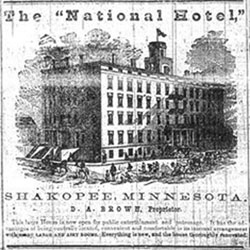
He could smell burning leaves wafting through the open windows. Suddenly, someone below yelled out, “Fire!” When he looked out from the window, Hinds saw the National Hotel on the corner of Holmes and First Street was on fire.
Here is an advertisement from 1866 for the National Hotel.
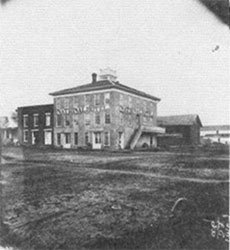
Here is a picture of the National Hotel, taken in 1875.
Please note that the City Meat Market is to the left of the National Hotel. It is the two-story building. The first floor was the City Meat Market, while an apartment was on the second floor. The National Hotel is located at what currently is Valley Sports at 102 1st Ave. West, on the corner of First Avenue and Holmes Street.
Hinds, always a newspaper man, scribbled a few lines on the fire for the paper, and then, after looking out and seeing the black clouds of smoke coming towards his building, hurried outside.
A bucket brigade and willing hands of the citizens of Shakopee helped, but the wind fanned the flames, and it continued to spread. The mayor, recorder, and city attorney rushed to the train depot and telegraphed St. Paul for help. The St. Paul and Sioux City Railroad offered a special train, and St. Paul city responded with a hose and fire company with all equipment. A clear track was allowed to allow the train to hurry to the stricken city.
Meanwhile, the increasing wind continued to blow out of the north. The fire moved beyond the National Hotel to Mrs. Schutz’s residence and storehouse. Next it continued to the two-story frame building of John Gutenberg. Gutenberg’s stock of meat and the contents of the apartment upstairs were in flames. The building, including the City Meat Market, burned to the ground.
Across the street, Kohls’s and Berens’s removed their stock of merchandise in case it blew across the avenue. (Note: The Kohls’s and Berens’s Store was located on the east side of Holmes Street and First Avenue.)
Next it was the Heidenreich’s one-story saloon with the apartment in the rear. The black smoke and embers soon enveloped the bar. It continued to burn southward and leaped across the alley to Peter Mergens’s building, which was also a saloon of John Donnersbach. Up in flames went the saloon, even with the hard work of the bucket brigade. It just wasn’t helping; the wind kept blowing. Next was John Frank’s tailor shop. Frank moved most of the contents across the street to D. L. How’s lawn across the street. (Note: This is David Lennox How and Mary Sherrard How’s house, which later became the first hospital in Shakopee, and later became the American Legion, finally torn down to build the First National Bank, which later became the third city hall before being torn down recently.)
The John Frank’s tailor shop (located probably where Paul’s Bike Shop or Riverside Printing Press are located today) was up in flames.
By 3 p.m., the National Hotel was a smoldering ruin, with the north and east walls collapsed into the fire. One of the dignified citizens of Shakopee, looking at the mess, said to his companion, “Looks like she’s all going up in smoke. Let’s have a drink!” (One of my favorite responses!)
Finally, just before 4 p.m., the strike of the locomotive whistle announced the arrival of aid from St. Paul. The train stopped near Holmes Street, and people started unloading the fire equipment.
At the same time, the saloon of Herman Baumhager fell prey to the crackling flames, and on the corner, the confectionery store of George B. Gardner started bursting into flames. As the firemen from St. Paul had a steam pumper pumping water from the river, people in Shakopee were worried that the flames would leap across to the east side of Holmes Street. The swirling smoke made it hard to see, but some people thought all of Shakopee would be lost.
St. Paul’s Fire Department, 1879
Luckily, the fire was confined to the west side of Holmes Street.
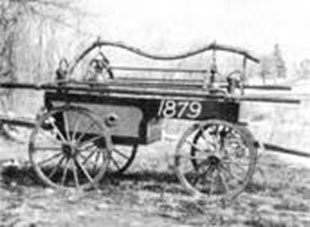
Below is a pumper, similar to one used in Shakopee:
That evening, Shakopee citizens entertained the St. Paul firemen at the United States Hotel. Later that evening, Rev. Alois Plut, pastor of St. Mark’s Catholic Church, had a reception at his residence. By 11 p.m., the special train, filled with the fire engines and many of the firemen, headed back to St. Paul. A few firemen stayed overnight, and waited the next day to head back. They needed the extra day to recover from their exertion and the celebration.
The next morning, Shakopee citizens looked discouraged as they saw the whole block of blackened walls and twisted, smoking wreckage. A day before, it was a block of prosperous business establishments and happy homes. But they took a breath, smiled at each other and knew that they were still alive, and began to build new buildings that rose from the smoke of the fire.
Mayor H. B. Strait requested St. Paul to present its bill for the valuable service rendered to fight the fire. Mayor Dawson of St. Paul replied, “…So far as any remuneration for services rendered is concerned, the opportunity of being able to render assistance to a neighboring city in distress is ample reward.” The railroad also did not charge for the special train that it placed in service on that October day.
John Gutenberg rebuilt the City Meat Market, and carried on a successful trade until his death on June 23, 1880.
After John died, his sons, Henry and John, Jr., conducted the business. The family consisted of these two young men and their sisters, Lizzie and Christina.
In the Nov. 17, 1892 Scott County Argus, a note mentioned that John Gutenberg, Jr. was in St. Paul on Monday, and brought home with him some choice venison for his meat market.
John Gutenberg, Jr. died in 1910. His wife then moved to Seattle.
According to the Minneapolis Tribune, in 1940, the widow of John Gutenberg, Jr., born in Shakopee, walked into a display of printing craftsmanship at Seattle, where she had lived for some years, and disclosed her relationship to the man whose memory was being honored.
The Minneapolis Tribune added that “One of her cousins, A. C. Austin, 91, a resident of the Odd Fellows home at Northfield, Minn., added the details about the former Gutenberg residence at Shakopee.”
And so now you know about the City Meat Market, and the famous Gutenbergs, who spread the news via the printing press, and were involved, through their store, in the famous Great Fire of 1879.
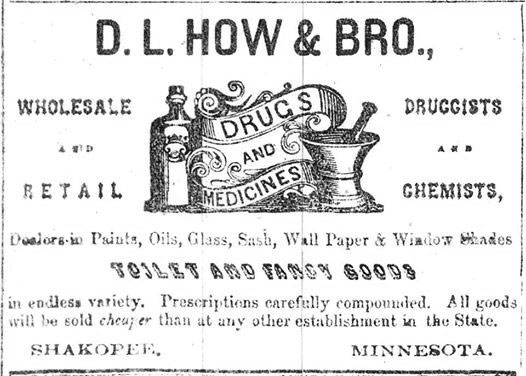
On May 28, 1857, David Lennox How arrived in Shakopee by riverboat from Alden, Michigan via Chicago, and opened the Old Drug Store. It was a three-story building on the north side of First Avenue, between Lewis and Holmes streets. The first owners were David Lennox How and D.W. C. Wisner.
David continued in the business until 1870, when he sold out to Edward G. Halle and Charles H. Lord. D.W.C. Wisner retired in 1858 and sold his part of the enterprise to Dr. J.S. Weiser, who held it until he was killed in action in the Civil War in 1861.
(Below is D. L. How)
The Old Drug Store operated in the frontier community in which Dakota Indians performed dances on the main street and frequently peeked into the windows of the white settlers’ homes. Bears, deer, and other wild animals were plentiful and roamed within a short distance of the city limits in the 1850s and 1860s.
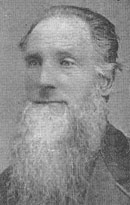
The Strunks operated the store since 1874. Herman H. Strunk came to Shakopee in 1854 from St. Louis, Missouri, where he was working as a drayman since coming to Germany in 1838. He married Mary Ann Dinklage in St. Louis, and on September 1, 1852 Charles Joseph Strunk, known as Joseph, was born.
(Below is Herman H. Strunk):
Joseph got into the drug store business on a hot July day in 1866. Herman and Joseph were returning from a fishing trip when they stopped to weigh their catch. They met Arnold Grafenstad, a Shakopee cabinet maker. “I can get your boy a job in the drug store in town if he wants it,” Grafenstad told the elder Strunk.
The 15-year-old Joe Strunk was happy to get away from the family farm, and to earn some money, so soon he was performing small tasks and errands for E.G. Halle, who had purchased David Lennox How’s drug store. Joe, or C.J. Strunk, went on to practice the art of pharmacy for 66 years, until, at his time of death in February 1930, he was the oldest pharmacist in Minnesota. His wife was Mary Gellenbach Strunk.
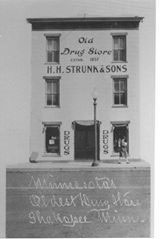
(Below is the Old Drug Store in the 1920s):
Herman also followed his son into the drug store business when he bought the City Drug Store on Lewis Street with G.W. Gellenbeck in 1871. Strunk purchased the Old Drug Store in 1874, and moved his stock from the Lewis Street location to main street in Shakopee. The store had been operated continuously by the Strunk family except for a brief time in 1953-1955 until it was closed for good in June of 1977.
An ad in the Argus in the 1870s listed drugs, medicine, white leads, glass, dry and mixed paints, lard, linseed, turpentine, artist materials and many more items. Pills, tinctures, and ointments were made by hand. A large cast iron mortar with heavy cast iron pestles was used.
When C.J. Strunk died in 1930, A.M. Strunk continued the operation until his death in 1938. Then Joe B. and George H. Strunk continued the store. At that time, the third floor was removed and the store remodeled. Strunk Pharmacy remained in this building until 1972, when it moved to a building on Lewis Street between Second and Third avenues. (This is now Pablo’s restaurant.)
In 1957, the Old Drug Store celebrated its 100-year birthday celebration. In the basement they found many interesting files and old records. One was the first recorded prescription, which was issued to F.H. Themes on November 10, 1863, for silver nitrate solution, a prescription for tonsillitis.
A journal of Shakopee’s first doctor, Dr. J.S. Weiser, who was later killed while serving with the Union army, was in the basement. Some of the records included Comfort Barnes, who got box pills for Andrew for 25 cents. John Hinds visited and got advice for his wife for $1.00. Henry Pauly paid $5.00 to have his wife deliver a baby. Comfort Barnes extracted a tooth for Johnny at 50 cents. And George Keyser received medicine and attendance at night for $10.00.
Other finds in the Old Drug Store were part of history, according to the Shakopee Valley News, including:
An old map of 1855, showing Minnesota with only 18 counties (it currently has 87).
An old, badly damaged still, which was used in compounding drugs years ago, and which was very suspicious of the revenooers in the prohibition era.
Two tickets to the 1893 World’s Fair and Columbian Exposition in Chicago, Illinois.
An ingenious device known as a pill machine, used in the days when the pharmacist had to full their own pills!
In 1879 it was one of only four places in Shakopee that had a telephone.
The Old Drug Store did not have many of the items which a modern drug store had; it did offer a wide variety of goods and services to the customers. A soda fountain was installed in 1870. Prayer books, text books for school, and other items, including paint, were offered.
The Strunk Pharmacy at the Old Drug Store closed after 120 years of service in June of 1977.
(Some information from Shakopee Scrapbook by Michael, Patricia, and Joseph Huber; Strunk Pharmacy to Note 100th Birthday During Year by Argus Tribune, March 7, 1959; Local Pharmacy Oldest in State; Has Been in Business 100 Years by Shakopee Valley News, March 7, 1957; Strunk Pharmacy Ends 120 Years of Service, Shakopee Valley News, June 14, 1977.)
The first hotel built in Shakopee was the Wasson House, named after its owner and proprietor, Frank Wasson. It was built in 1853 by Barney Young. The hotel was built in the days when steamboats and stagecoaches furnished all transportation to its hospitable portals, and whose solid timbers were brought to Shakopee by steamers plying up and down the Minnesota River between the village of St. Paul and Shakopee.
The Wasson House was a favorite stopping place for traders and travelers, and was headquarters for the boatmen when their boats were tied up at the levee below, waiting to unload freight and take aboard fresh cargo of the spoils of the pioneers. The Wasson House was built when the country was a wilderness and the Dakota were neighbors.
The big frame building was a prominent stage house and hostelry in the pioneer days. By 1854, the Wasson House was a fixture, one of only six buildings in Shakopee (other than the tipi tanka of the Dakota). During the next few years the boom changed things so rapidly that there was quite a town in Shakopee, but back in 1853, when the Wasson House was erected, there was naught but wilderness, a stage road, and the river steamboats being the only connection links with white civilization.
A year or so later, William Sherrerd purchased the hotel and conducted the hotel under that name of the American Hotel, which it is best known. It became the social center for the settlement, with many a hospitable gathering and social revel for the sturdy pioneers.
As the years passed the hotel changed hands a number of times, finally falling into disuse as a public house, and eventually half of it was removed, reducing it to the proportions of a dwelling house for which it had been used for many years.
Gertrude Berens had lived there for many years before Fred Gollmeier bought it in 1911. He lived there with his family, as well as William Wandschneider and his family.
On Sunday night, March 15, 1912, at 7 p.m., the once famous Wasson House, which had crowned the river bank above the steamboat landing for 59 years, caught fire from a defected flue, and in a couple of hours the north half was razed and the left side was standing, a charred and blackened skeleton.
Neighbors saw the blaze and gave the alarm, and the fire bell and the fire whistle brought out half the town to witness the spectacular fire. The fire department had a line of hoses running from the hydrant to the corner of Lewis and First Street in short order, but there was no water. So people thought that the hydrant was frozen, while others say it was not properly opened. It took more than half an hour after the fire started before a line of hose was run to the power house and the pump called upon to take the place of the standpipe. By that time, the fire had consumed the roof and upper floors, and the deluge of water simply held the flames from preventing other property to be up in flames.
During the long wait for water, the firemen and bystanders managed to save much of the furniture downstairs. They even carried out two Coral ranges. Both families suffered the loss of practically all of their clothing and a number of pieces of furniture which could not be removed from the sleeping rooms upstairs.
The Wasson House/American Hotel has found shelter and refreshment from statesmen, lawyers, and governors, as well as regular people of Minnesota. The old landmark is no more.
(Some information from “Old Landmark Prey to Flames,” The Shakopee Tribune, March 22, 1912.)
The first Shakopee City Hall was built at the northeast corner of Lewis and Second streets, across from what is now known as Bill’s Toggery. The plan was drawn by Charles Bornarth (who ended up using the same plan for the Jordan City Hall). It was built in 1883, and Frank Buch was the contractor for the new two-story building.
The city hall was used until September 1957. The City decided to abandon and raze the old city hall, which was a termite terminal, in September 1957. (That area became a parking lot, and is now being renovated for a new downtown parking lot across from Bill’s Toggery.)
Meanwhile, the city hall was moved to the north side of First Avenue. The First National Bank was here for many years, and was the location of a bank robbery that happened in 1929. The City of Shakopee decided to buy the building for $20,000, and the city offices were moved to the first floor on June 15, 1958. This was the second location of the city hall. The City of Shakopee was in this location for 32 years.
In 1968, the original fire bell, which was in the tower of the first city hall, on the northeast corner of Second and Lewis, was decoratively placed for posterity at the front of the city office at the second city hall. The bell, cast in bronze, was sandblasted at Rahr Malting to get a revived look. The bell bared the names of officials of earlier times, cast in relief on the side of the bell: George E. Strait, mayor; David L. How, president of the council; Julius Coller, city recorder, and Jacob S. Kunsman, chief of the fire department. (The bell is now located at Fire House #2 in Shakopee.)
Meanwhile, the First National Bank moved to Holmes Street, on the northeast corner of Holmes Street and Second Avenue. Before this, this location was the location of the first brick house, which was built in 1853 by Mr. Coulton. The location became the house of the Sherrard family, and when David Lennox How married Mary M. Sherrard in 1862, they moved into this house.
Dr. H. P. Fischer remodeled it to become the first hospital in Shakopee, the Shakopee Hospital. From a hospital, it became an apartment, and then the American Legion Club. It was finally razed in 1955 to build the First National Bank building, which opened on Feb. 10, 1958. (This was the fifth place for the bank, which started at the old National Hotel in 1865.)
The First National Bank became Marquette Bank. The building is on 129 Holmes St. S., and became the third city hall. On Feb. 11, 1993, the city hall was occupied. The third city hall was about one block from the second city hall, which was about one block from the first city hall.
And finally, this year, 2017, a new city hall, Shakopee’s fourth city hall, was built on the east side of downtown Shakopee, near the police station. The location is 485 Gorman St. If you need to contact people at City Hall, please call 952-233-9300. The website is http://www.shakopeemn.gov/.
City hall at northeast corner of Second Avenue and Lewis StreetCity hall at 129 First Ave. E.City hall at 129 Holmes St. S.City hall at 485 Gorman St.
Peter Geyermann was born in Germany on Dec. 13, 1825, son of Henry and Christina Nell Geyermann. He came to America on July 7, 1851, and was located at Milwaukee, Wisconsin, where he worked on a farm for a few weeks. For a short time he worked on the Michigan Central railroad in Indiana, before he began chopping wood in northern Illinois for two years. Peter then purchased a tract of timber land in Illinois along the Chicago & Aurora Railroad. In 1853, he was in the mercantile business in Aurora for two years.
In 1855, Peter moved to Minnesota Territory and took a preemption claim in Carver County. Two years later he sold out and moved to Shakopee, where he was involved in the merchandise business.
In a letter to his brother and sister-in-law, Peter described his life in Shakopee. This letter was translated from German to English in January 1991 by Ernst Wirt, Mitchell, S.D:
Shakopee, Nov 30, 1855
Dear Brother and Sister-in Law,
I wrote to you on August 30, a letter but I never got an answer which surprised me very much.
In our family we have lots of news to report. Our sister Anna Maria got married on the 23rd of July with the blacksmith. He comes from Saxony. His name is Johann Heinz. He is a very ambitious and hard working man. And on the 20th of August, it pains me very much to write that our dear and only brother, Joseph, died. He was such a strong and young brother (just like Michel and Joseph were). Our Joseph was about 10 days sick. He had something called the red Ruhr. He was very happy here in America because he didn’t have to take care of anybody, only himself, and he remembered where his home was. He never had it so good in his whole life. He could eat and drink anything he wanted. It didn’t cost him a penny. I never saw him so happy as in the time I saw him here.
Our sister Anna Marie was not too happy when our other sister, Magdalene left here because her new husband died on the 10th of September of the same sickness like Joseph. On the same day died also Simon Derbach. They all lived with me. You can’t imagine the hardship. It was not only that all those people died, but everybody also sick in the house. I was very depressed and always was thinking that I was the next to go. I wanted to move from here and look for a different place.
So I did. I moved to Shakopee, Minnesota Territory, and I live outside in the country. I bought a claim there. The land belonged to the government and was not yet sold. The law says whoever comes first and homesteads it has a claim to it, but you have to be over 21 years of age. I had to take 160 acres of land and you were supposed to build a house on this land, and supposed to take care of the land. And whoever is doing this first has the first right and claim. For this I paid $300.00 but if I ever wanted to sell it, then I would have to pay $1.25 per acre and I have to announce this 3 months in advance. If I don’t pay it in time then I can sell it to someone else, but I must leave the homestead. This can take the time of 1 or 2 years. The house that exists is in very poor condition in the country and we are in the process of building a new one. Last Wednesday we started.
You are probably surprised to hear that people build houses here in the winter, but here in the country people take tree stems and they make very nice houses (log houses). So if you plan to build a house you have to see that you get all the logs nearby, bring it to the place, and cut them into the measurements as big as the house is supposed to be. Then you go and call on 8 to 10 neighbors and then everything will be put together in one day but the roof. The rest a person has to do himself and that goes better than anybody can imagine. Once you are between 3 and 4 years in America, you become a pretty good builder, and you acquire all the tools that craftsmen need to make a building.
Our land is ½ mile long and ½ mile wide. That is called 160 ruten (rods?) and the house is as wide as 1 rod is. (ed. note: 5.5 yards) Now you can imagine how big the house is. I have approximately 40 acres of wood on my land, approximately 6 acres of meadow and the rest are hedges. But we don’t do it here the same way we did it in (Lehnheck?). Here we take 2 or 3 young oxen and put them into a yoke, and then the land will be worked. One yoke of oxen I own and that cost me $150. Animals are very expensive here. I must say that animals are much more expensive now than when I came to America, because when I came to America, a yoke of oxen I could buy in those days for $60. Here the animals are not quite so expensive as in the old states like in Illinois where I came from.
I am now about 600 miles away NW from Arora (Aurora, Illinois) and it is much colder than there. We had already for 14 days, snow, but this week is exceptionally nice weather and the snow was almost melting away. I hope there is not new snow coming, but we will take it. It would be alright if we got snow so tomorrow morning and Sunday we want to go hunting for deer, while we are waiting to finish the house, because when the house is ready, we won’t have much time. That’s why we want to go and hunt now. And when the Indians don’t come back and take the animals away, there is plenty of deer over here.
What I’m talking about are the natives or the wild people and they don’t do anything else but hunting, but they do not hurt the white people. If it would ever happen, they have to deliver the murderer, or they receive very harsh treatment, and get blamed for that by their own people. The wild man don’t want to work at all. They think work takes something away from their honor. They do not do anything else but hunting and be a warrior, and that is the main reason that America is not so populated as Europe. These wild people have friction among themselves. There are lots of different tribes, and if anybody enters their territory, then they have a war.
We and our sister Magdalena live here on my land. She will get married. Her husband’s name is Hilliarius Schumacher. He comes from a town called Metternich, near Cologne. She is married on the 23rd of October.
Our Margaret is a servant in Shakopee. She gets $2 a week. Our Marie is a servant still in Arora (Aurora). She got the best conditions. She is in good health, and receives good money. Wherever she works, the people don’t let her go. They like her. She’s a very ambitious girl and she is the biggest and heaviest of us all. She could have got married many times before if she liked to. I think she wants to remain there until next spring, and then she will come here with our Anna Marie who still lives in the same house where I live. She would have been gone before but I was expecting some money, and I couldn’t get the money until next spring.
The letter gives a good explanation of Shakopee in 1855.
Peter married Emelia Berreau in Shakopee. They had six children.
Peter and Emelia operated Geyermann’s General Store between First and Second avenues and Lewis Street in downtown Shakopee, which included groceries, dry goods, boots and shoes, hats and caps, dress goods, clothing, and crockery. The store opened in 1857.
A Board of Trade was organized in March 1878, with Peter as president. The editorial of the Shakopee Argus noted that:
“Shakopee is now a metropolitan city. It has twelve street lamps, each with the illuminating power of ten lightning bugs. On a dark night the flickering rays of light are cast fully twenty feet around and on a clear night with a full moon, the city is brilliantly lighted up.”
Peter also became mayor of Shakopee. He was mayor from 1873-1876, and again in 1878. While he was mayor in 1878, Peter was involved in controversy. The town needed a bridge over the Minnesota River. After lots of discussion over several years, the legislature voted in favor of building a bridge in Shakopee. The bridge was to be built on Fuller St.
The mayor owned a store on Lewis St., so he vetoed the resolution for building the bridge on Fuller St. He wanted it on Lewis Street, so that people arriving over the bridge would go directly to his store. Another resolution, putting the bridge on Holmes Street, was also vetoed by the mayor. They tried other sites, including one near Murphy’s Landing, and later the Shakopee Argus editor looked out from the third floor of his building, and saw a huge cottonwood tree across the river. He suggested that they could lasso the tree, and build the river across at that part. Obviously, that did not win, either.
After many more meetings, the mayor won out, and the bridge was built on Lewis St. in 1880.
Many people were upset, though, and the mayor’s store was boycotted by many residents, especially the people in the First Ward, who wanted the Fuller St. site. So effective was the action that Peter and Emelia were forced out of business, and after 24 years in the business, they left the town of Shakopee.
Peter and Emelia moved to the little town of Hersey (now called Brewster) where they started a new general merchandise store. After several years, the family established stores in Pipestone, Worthington, and Storm Lake, Iowa. In the 1920s, Peter and Emelia’s sons opened stores in Huron, Mitchell, Madison, and Brookings, South Dakota. In the 1940s they added stores in Sioux Falls and Rapid City, as well as Beatrice and Hastings, Nebraska. Record books of the old Brewster, Minnesota store noted that a man’s suit cost $9.50, a boy’s boots cost $2.13, eight yards of printed goods cost 66 cents, a gallon of oil was 25 cents, butter was just 20 cents a pound, and Rock and Rye was $1.00 a bottle.
Emelia Berreau Geyermann died in 1907, and Peter Geyermann died in 1911.
Meanwhile, the Lewis Street Swing Bridge in Shakopee was opened for river boat traffic heading further west in 1880.
On July 15, 1896, the boat the Daisy was heading up the Minnesota River when it hit the bridge, knocking over its smoke stacks. It seems that the boat didn’t wait until the Lewis Street Swing Bridge was open before it crashed!
When the Holmes Street Bridge was built in 1927, the Lewis Street Swing Bridge was open for foot traffic. In 1942, with the war effort, the scrap metal was requisitioned by the government, and the Lewis Street Swing Bridge supplied the metal. It was estimated that it contained 100 tons of needed metal for bombs, jeeps, and ships.
And so that is what happened with the Swing Bridge on Lewis St. in downtown Shakopee.
(Some information from The Shakopee Story by Julius A. Coller, II, pages 118-120; Shakopee Scrapbook by Michael C. Huber, Patricia A. Huber, and Joseph C. Huber; Taped Interview of Jack Coller on KSMM Radio, July 1982; and information from Rick Geyermann via email to David R. Schleper.)